
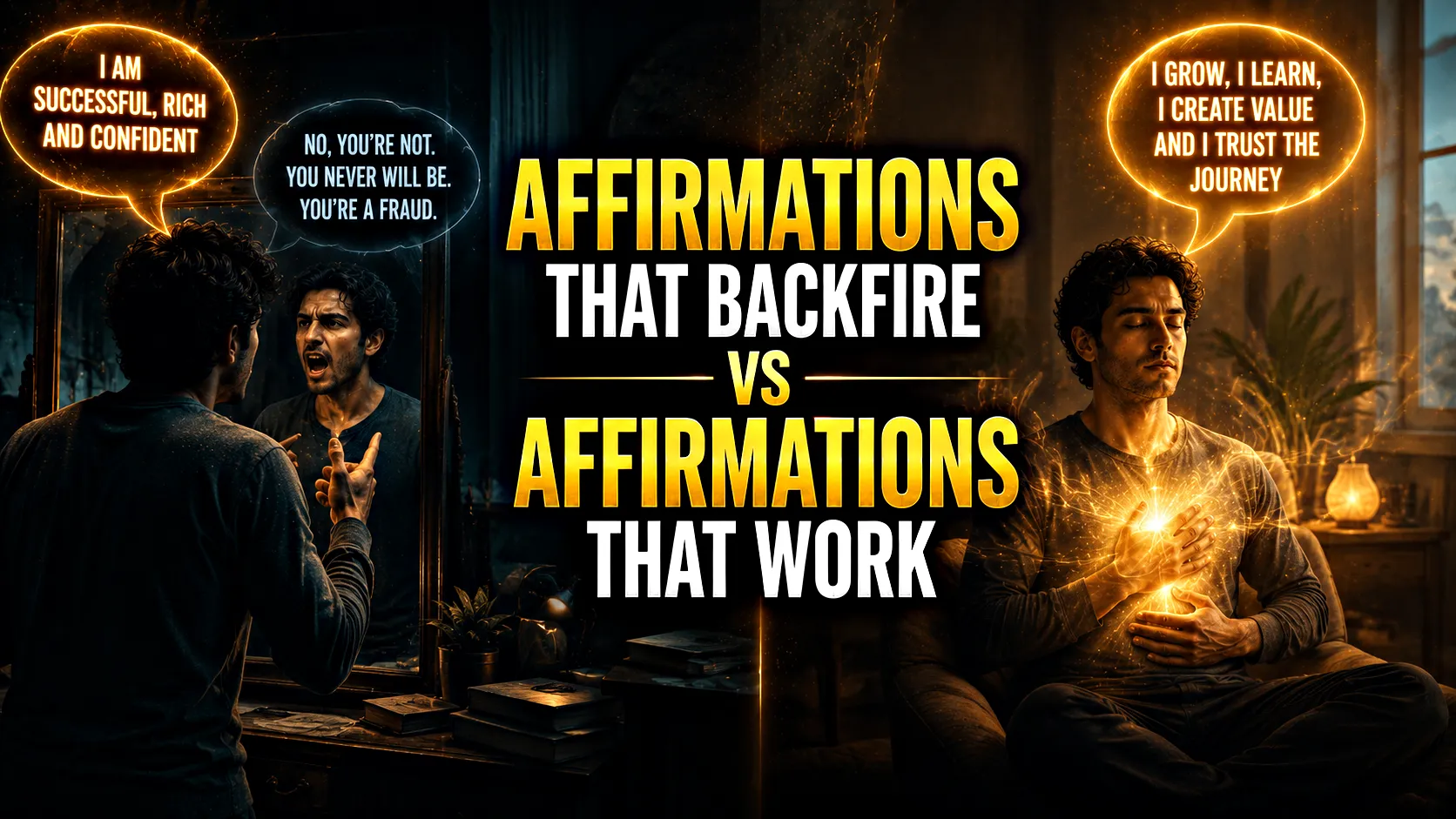
Affirmations are the most widely practiced and most poorly understood tool in the personal development and manifestation toolkit. The instruction sounds simple enough: choose a positive statement about yourself or your desired reality, repeat it daily with conviction, and watch the belief gradually take root in your subconscious. Millions of people follow this instruction faithfully. A significant number of them feel worse after doing it, not better, and they have no framework for understanding why.
The rest either experience modest benefits that plateau quickly or produce no measurable change at all. And almost none of them receive an honest explanation of what the research shows about when affirmations genuinely work, when they actively backfire, and what the structural differences between effective and harmful approaches actually are.
I teach affirmation practice to Reiki students as one component of a complete subconscious reprogramming system. What I tell them at the outset is different from what most affirmation guides say, because the research is more nuanced than the popular narrative, and the practical difference between an affirmation that heals and one that harms is specific enough to be taught clearly. This article gives you the full picture: the documented research on when affirmations backfire, the precise mechanism that causes the backfire, the structural differences between harmful and effective approaches, and how Reiki energy healing addresses the energetic dimension that all purely cognitive affirmation approaches miss.
Contents of Affirmations That Backfire
The Research That Most Affirmation Guides Do Not Tell You About
In 2009, psychologist Joanne V. Wood and her colleagues W.Q. Elaine Perunovic and John W. Lee at the University of Waterloo and the University of New Brunswick published a study in Psychological Science that produced findings the self-help industry has largely ignored in the seventeen years since.
The study asked participants with both high and low self-esteem to repeat the positive self-statement “I am a lovable person.” Researchers then measured participants’ mood and feelings about themselves after the affirmation exercise. The results were divided and revealing. Participants with high self-esteem showed modest improvement in mood and self-regard after repeating the statement. Participants with low self-esteem, the people most likely to be using affirmations in the first place, showed the opposite effect. Their mood scores dropped. Their self-regard decreased. They felt measurably worse after repeating the affirmation than they had felt before.
Wood and her colleagues concluded: “repeating positive self-statements may benefit certain people, such as individuals with high self-esteem, but backfire for the very people who need them the most.”
This is the finding that most affirmation content either ignores or treats as an anomaly. It is not an anomaly. It is a precise description of a documented psychological mechanism, and understanding that mechanism is the prerequisite for using affirmations effectively rather than harmfully.
The Replication Question: Is the Wood Finding Reliable?
It is worth addressing an important caveat honestly. A 2020 study published in ScienceDirect specifically attempted to replicate Wood, Perunovic, and Lee’s 2009 findings and found that the differential effect based on self-esteem level did not replicate in their sample. The researchers noted that further studies are needed to clarify the conditions under which the backfire effect occurs.
This does not mean the 2009 finding was wrong. It means the effect may be more context-dependent than the original study suggested, occurring reliably under specific conditions that were not fully controlled for across replications. What remains consistent across the research landscape is the underlying mechanism: cognitive dissonance between a stated affirmation and a deeply held contradicting belief generates resistance rather than acceptance, and this resistance can increase negative feeling about the gap the affirmation has just highlighted.
Whether this effect is reliably tied to measured self-esteem levels or to other variables including the specific belief being affirmed, the degree of contradiction, or the emotional state during practice remains an active research question. The practical implication is clear enough regardless: affirmations that contradict current felt reality without sufficient internal support for the new belief can produce counterproductive effects in some people under some conditions.
The Mechanism: Why Some Affirmations Backfire
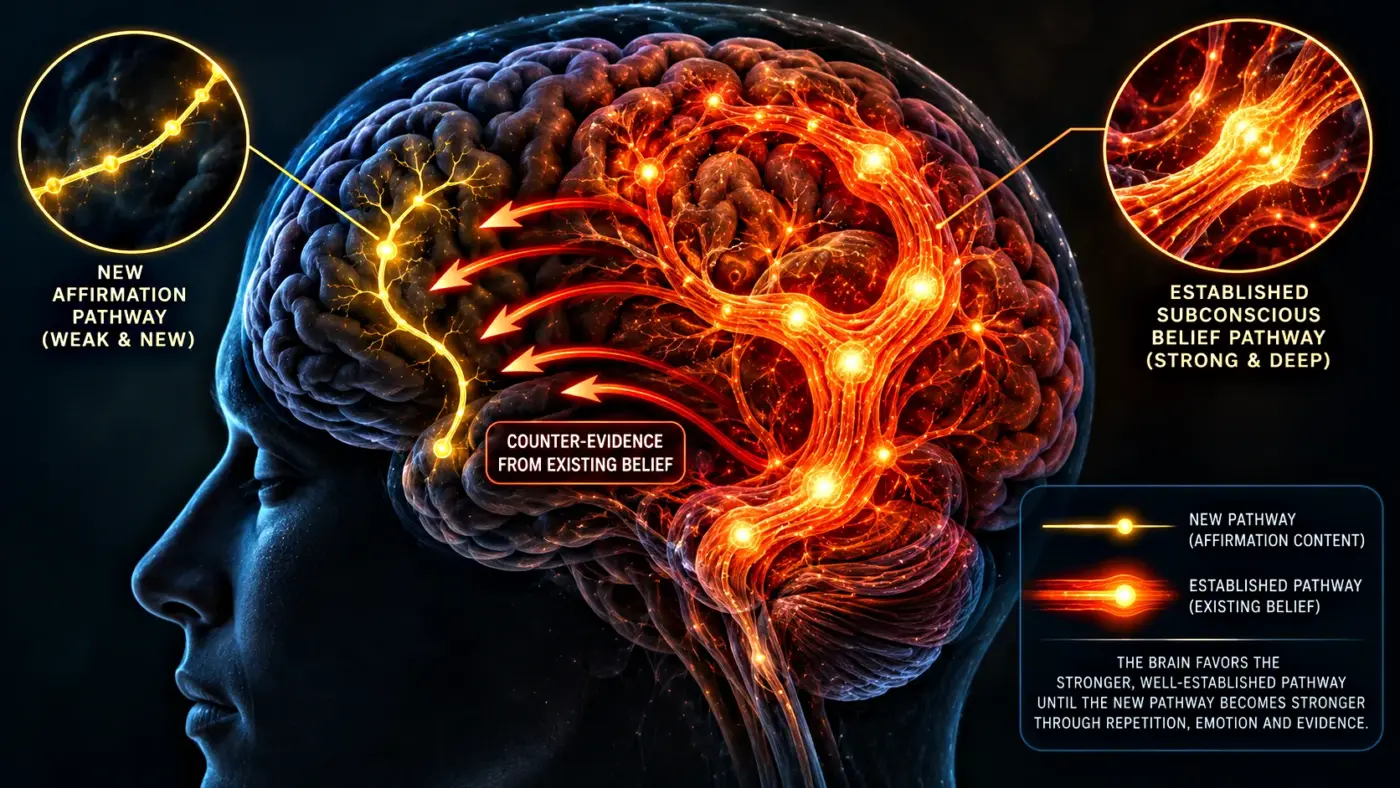
The precise mechanism behind affirmation backfire is cognitive dissonance, the psychological discomfort that arises when two contradictory beliefs or experiences are held simultaneously. Leon Festinger, who formally described cognitive dissonance in 1957, established that the brain resolves this discomfort not by updating toward the newer, weaker belief but by reinforcing the older, more established one to restore internal consistency.
When you state “I am financially abundant” while your nervous system is actively registering financial stress, your brain does not process the affirmation as new information to integrate. It processes it as a claim that contradicts an established reality. The prefrontal cortex, running its habitual pattern-comparison function, generates counter-evidence: every unpaid bill, every past financial failure, every piece of evidence that the statement is not currently true. That counter-evidence is more available, more emotionally charged, and more consistent with the established subconscious program than the affirmation itself. The dissonance resolves in favor of the established belief, and the affirmation has not installed a new pattern. It has highlighted the gap between the desired state and the current felt reality, which often produces a brief but genuine worsening of mood.
The research on belief maintenance in psychology confirms this mechanism. Once a belief is established in the subconscious, the cognitive system actively seeks evidence consistent with it and discounts or filters out evidence against it. An affirmation that contradicts the established belief is not simply competing on equal terms with it. It is competing against a system that has been actively selecting evidence in the established belief’s favor for years or decades. The affirmation loses that competition almost every time it is conducted from ordinary waking beta consciousness without the energetic and neurological support that would allow it to genuinely reach the subconscious.
What Happens in the Body During a Backfiring Affirmation
The backfire is not only psychological. It is physiological. When cognitive dissonance is activated, the body’s stress-response system engages. The amygdala flags the contradictory information as a form of internal threat, activating a mild cortisol release and the physiological markers of discomfort. This means that an affirmation practice conducted from a state of significant mismatch between the stated content and the felt reality is not simply neutral. It is generating a low-level stress response in the very system the person is trying to heal and reprogram. Over time and daily repetition, a mildly dysregulating affirmation practice can entrench the stress response associated with the topic of the affirmation, which is precisely the opposite of the intended effect.
Claude Steele’s Self-Affirmation Theory: What Actually Works and Why
While Joanne Wood’s research documented when affirmations backfire, a different body of research conducted by Claude Steele, social psychologist at Stanford University, offers the clearest available framework for when and why affirmations genuinely work. Steele developed self-affirmation theory in the late 1980s, establishing a framework that has generated substantial supportive research across four decades.
Steele’s core finding was specific and important: affirmations work most reliably when they affirm the person’s core values rather than contradicting their current self-concept. The distinction is critical. A value-based affirmation, “I am someone who cares deeply about kindness and connection,” does not claim a specific external reality the person may not currently be experiencing. It affirms something the person genuinely believes about their own character or values, which produces no cognitive dissonance because it is not contradicting an established belief. It is reinforcing one. The resulting psychological effect is a strengthened sense of self-integrity from which the person is more open to new information, more capable of growth, and less defensive when encountering challenges to their self-concept.
Research by J. David Creswell at Carnegie Mellon University, building on Steele’s framework, documented that value-based self-affirmation improves problem-solving under stress, reduces health-threatening stress responses, and boosts academic performance in underperforming students. The key across all of these applications is the same: the affirmation engages something already genuinely true and valued, not something aspired to from a position of felt lack.
The Three Types of Affirmation and Which One to Use When

Understanding the research makes it possible to classify affirmations by their likely effect based on where a person currently is relative to the belief being affirmed. This is the framework I teach to Reiki students, and it produces far more consistent results than generic affirmation advice.
Type 1: State Affirmations (When They Work and When They Backfire)
State affirmations are the most familiar form: “I am abundant,” “I am confident,” “I am healthy.” They claim a specific present reality in declarative terms. The research is clear on when these work and when they backfire. They work when the stated reality is genuinely congruent with the person’s current felt experience and subconscious belief, or close enough to it that no significant cognitive dissonance is generated. They backfire when the gap between the stated reality and the felt reality is large enough to activate the counter-evidence generation mechanism documented in the Wood research.
The test is simple and subjective but reliable: when you state the affirmation, does it feel true? Not intellectually true, not aspirationally true, but genuinely felt as real in the body? If yes, the affirmation is likely to work. If repeating it produces an immediate internal voice of contradiction, a tightening of discomfort, or a flood of counter-evidence, the affirmation is working against a belief gap that is too large for the affirmation to bridge from this position.
Type 2: Bridge Affirmations (The Most Widely Useful Form)
Bridge affirmations, sometimes called process statements or transition affirmations, are the most reliably effective form for most people working with established limiting beliefs. Instead of claiming a final state that contradicts current felt reality, they affirm a believable transitional truth that acknowledges both where the person is and where they are going. Examples include: “I am becoming more financially confident every day,” “I am learning to trust myself and my decisions,” “I am in the process of building genuine self-worth,” “Every day I am releasing old patterns that no longer serve me.”
Bridge affirmations work for two reasons. First, they are true. A person genuinely doing inner work is becoming more confident, is in the process of change, is releasing old patterns. Affirming this generates no cognitive dissonance because it is not contradicting an established belief. It is accurately describing a current reality. Second, the direction of the affirmation is toward the desired state, which means the RAS receives a goal-direction signal even without the full state claim that would generate resistance.
In my Reiki teaching practice, I guide students to use bridge affirmations during the early stages of working with a specific limiting belief, before the Reiki healing and subconscious reprogramming work has cleared enough of the energetic and neural ground for state affirmations to land without resistance. As the inner work progresses and the gap between felt reality and desired state narrows, the bridge affirmation can gradually shift toward a state affirmation that now lands with genuine felt resonance.
Type 3: Value Affirmations (Claude Steele’s Framework)
Value affirmations affirm what the person genuinely believes about their own character, values, and identity rather than claiming a specific external state. “I am someone who shows up with care for the people in my life,” “I am a person who values growth and learning,” “I act with integrity in my work.” These affirmations produce the self-integrity reinforcement that Steele’s research documented as the source of genuine affirmation benefit: they strengthen the person’s overall sense of self-coherence without requiring them to claim a specific external reality they do not yet experience.
Value affirmations are particularly powerful for people who are currently in difficult circumstances that make state affirmations difficult to sustain. A person in financial hardship who genuinely values generosity, creativity, or resilience can authentically affirm those values without cognitive dissonance, even while working through the deeper subconscious reprogramming that addresses the financial pattern directly.
The Delivery Conditions That Determine Whether Any Affirmation Works
The type of affirmation matters. The delivery conditions matter equally, and most affirmation practice gets the delivery conditions wrong in ways that guarantee reduced effectiveness regardless of the affirmation’s content.
Emotional Presence Is Not Optional
A dryly repeated affirmation, stated mechanically while the mind is elsewhere, produces negligible neuroplastic change. The brain encodes experience based on its emotional intensity, which is why traumatic and deeply joyful experiences leave the most durable imprints. An affirmation stated without genuine felt engagement is providing minimal signal to the neural systems that produce lasting change. The emotional presence during the affirmation is not a helpful addition. It is the primary mechanism of effect.
The practical implication is that three affirmations stated with genuine felt conviction, pausing to actually feel the truth of each one before moving to the next, will produce more neuroplastic change than twenty affirmations stated rapidly while making coffee. Quantity without presence is not practice. It is ritual without function.
State of Nervous System During Practice
As established in the research on survival mode and manifestation discussed elsewhere on this site, the prefrontal cortex’s critical filtering function is suppressed during sympathetic nervous system activation. This means that the quality of affirmation practice is significantly influenced by the state of the nervous system during the practice. An affirmation stated from a calm, parasympathetically activated state reaches the subconscious with less resistance than the same affirmation stated from a state of anxiety or stress.
This is one of the primary reasons I teach Reiki self-healing as the preparation for affirmation practice, not as a separate activity. The Reiki session brings the nervous system into the calmer state in which affirmations produce their strongest effect, and in some cases into the alpha-theta border state in which the prefrontal cortex’s filtering is genuinely quieted and new content can reach the subconscious more directly.
Timing: The Theta-Adjacent Windows
The two daily windows in which affirmations produce the strongest subconscious effect are the hypnagogic window before sleep and the hypnopompic window upon waking, as detailed in the sleep-based reprogramming article on this site. During both windows, the brain is in theta-adjacent frequency states in which the prefrontal cortex’s critical evaluation function is reduced and new content reaches the subconscious with significantly less resistance than during ordinary waking beta consciousness. An affirmation practiced once with genuine emotional engagement in the hypnagogic window will typically produce more subconscious effect than the same affirmation repeated twenty times during fully alert waking consciousness.
The Reiki Energy Dimension: Why Affirmations Alone Often Fall Short

The most important limitation of affirmation practice that purely cognitive approaches to subconscious change cannot address is the energetic dimension of the limiting belief being overwritten. Every subconscious program has an energetic imprint in the body’s chakra system, not only a neural pattern in the brain’s implicit memory. Affirmations work at the neural and cognitive layer. They do not address the energetic layer that maintains the program in the energy body.
This is why students who practice affirmations consistently, in the right theta-state windows, with genuine emotional engagement, and with properly structured bridge statements, sometimes still find that specific limiting beliefs remain unusually resistant. The cognitive approach is working. The energetic dimension of the belief has not yet been addressed, and it continues to generate the emotional frequency that contradicts the affirmation’s content at a level below the cognitive work’s reach.
In my practice, I address this by combining affirmation practice with targeted Reiki self-healing on the specific chakra center that holds the energetic imprint of the belief being worked with. The Solar Plexus Chakra for beliefs about personal power, worthiness, and self-confidence. The Root Chakra for beliefs about safety, survival, and foundational deserving. The Heart Chakra for beliefs about love, belonging, and connection. The Sacral Chakra for beliefs about creativity, pleasure, and relational safety. The Throat Chakra for beliefs about authentic self-expression and the right to be heard.
The Reiki self-healing session first clears the energetic charge that maintains the limiting belief in the energy body. The affirmation practice that follows then has a qualitatively different landing ground: the energetic field is clearer, the contradicting charge is reduced, and the new content meets less resistance at both the energetic and cognitive levels simultaneously. The combination consistently produces deeper, faster, and more stable results than either practice produces alone.
Disclaimer: The information in this article is intended for educational purposes only and does not constitute medical advice. Reiki and energy healing are complementary practices and are not a substitute for professional medical treatment. Always consult a qualified healthcare professional for medical concerns.
Building an Affirmation Practice That Works: The Honest Framework
Step 1: Assess the gap honestly. Before choosing an affirmation, assess the current gap between where you are and what the affirmation claims. Can you state the intended affirmation and feel a genuine sense of its truth in the body, even partially? If yes, it is likely a state affirmation you can work with. If the immediate response is an internal flood of counter-evidence and a tightening of resistance, choose a bridge affirmation instead. The most effective starting point is always the most believable honest statement that moves in the desired direction, not the most aspirational statement that the subconscious immediately rejects.
Step 2: Reiki self-healing before practice. Before your affirmation session, spend ten to fifteen minutes in Reiki self-healing focused on the chakra center corresponding to the belief you are working with. The self-healing reduces the energetic charge of the limiting belief and prepares the ground for the affirmation to land with less resistance. This step is not optional for beliefs that have proven resistant to standard affirmation practice. It is what makes the difference.
Step 3: Practice in the theta windows. Conduct your primary affirmation practice in the hypnagogic window before sleep and the hypnopompic window upon waking. State each affirmation three to five times with a genuine pause between repetitions to actually feel what is being stated. Three genuinely felt repetitions outperform twenty mechanical ones in every meaningful measure.
Step 4: Progress from bridge to state as the inner work deepens. As your Reiki self-healing and subconscious work progresses, periodically retest the state affirmation you initially found too distant from current felt reality. As the energetic and neural ground clears, you will find that statements which previously produced immediate resistance begin to land with a degree of genuine felt resonance. This progression from bridge affirmation to state affirmation is not a sign of arrival at the end of the work. It is a reliable marker of genuine subconscious change in progress.
FAQs
Why do affirmations sometimes make people feel worse?
Affirmations make people feel worse when they create cognitive dissonance between the stated content and the person’s deeply held subconscious belief. Research by Joanne Wood and colleagues at the University of Waterloo published in Psychological Science in 2009 found that participants with low self-esteem felt measurably worse after repeating the positive affirmation “I am a lovable person” compared to a control condition. The mechanism is cognitive dissonance: when the affirmation contradicts the established subconscious belief significantly, the brain generates counter-evidence to resolve the contradiction, reinforcing the original belief rather than updating toward the affirmation. The affirmation highlights the gap between the desired state and the felt reality, which produces a temporary worsening of mood rather than improvement.
What are bridge affirmations and why do they work better?
Bridge affirmations, also called process or transition statements, affirm a believable transitional truth rather than a final desired state that currently contradicts felt reality. Instead of “I am financially abundant,” a bridge affirmation might be “I am consistently taking steps toward greater financial stability” or “I am becoming more confident in my relationship with money.” Bridge affirmations work better for two reasons: they are true, which means they generate no cognitive dissonance because they accurately describe a genuine current reality of growth and change, and they provide the RAS with a direction signal toward the desired state without triggering the resistance that a large gap between stated claim and felt reality produces.
What is Claude Steele’s self-affirmation theory and how does it differ from standard affirmations?
Claude Steele, social psychologist at Stanford University, developed self-affirmation theory in the late 1980s to describe how affirming core personal values, rather than claiming specific external states, produces genuine psychological benefits. Value-based affirmations work because they affirm something the person genuinely believes about their own character or values, which produces no cognitive dissonance. The resulting sense of self-integrity makes the person less defensive and more open to growth. Research by J. David Creswell at Carnegie Mellon University confirmed that value-based self-affirmation improves problem-solving under stress and reduces health-threatening stress responses. This contrasts with standard state affirmations that claim external realities not yet experienced, which can generate cognitive dissonance when the gap between stated and felt reality is large.
How does Reiki healing make affirmations more effective?
Reiki healing makes affirmations more effective by addressing the energetic dimension of limiting beliefs that purely cognitive affirmation practice cannot reach. Every subconscious program carries both a neural pattern in the brain’s memory systems and an energetic imprint in the body’s chakra system. Affirmations work at the neural and cognitive layer. Reiki self-healing on the specific chakra center holding the belief’s energetic imprint clears the energetic charge that maintains the limiting belief and generates the contradicting emotional frequency that causes affirmation resistance. When Reiki self-healing precedes affirmation practice, the affirmation meets a cleared energetic field with significantly less internal resistance, and the resulting subconscious imprinting is deeper and more stable than affirmation practice alone typically produces.
Related Guides
- What Is the Subconscious Mind and How Does It Shape You
- How to Reprogram Your Subconscious Mind While You Sleep Tonight
- The 95 Percent Subconscious Rule That Controls Your Life
- Theta Brainwaves and the Subconscious Mind: The Complete Science
Discover more from Isrg Healing
Subscribe to get the latest posts sent to your email.