

Failure feels terrible for a specific neurological reason, and that same reason is why it teaches your subconscious more efficiently than success ever does. The brain is not designed to notice when things go as planned. It is designed to notice when they do not. When a prediction fails, a specific chain of events fires in the brain that success simply does not trigger, and that chain is the biological mechanism behind every genuine behavioral change, skill improvement, and subconscious belief update you have ever made. The problem is that most people either avoid failure entirely or experience it in ways that prevent the learning signal from reaching the subconscious. Understanding how the mechanism actually works changes what you do with setbacks completely.
This article covers the neuroscience of how the subconscious learns from failure, why the brain’s response to negative prediction error is its most powerful learning signal, what conditions make failure genuinely instructive versus traumatizing, and how to deliberately structure your relationship to setbacks so the subconscious extracts maximum learning from each one.
Disclaimer: This article is for educational and informational purposes only. It does not constitute psychological or medical advice. If you are experiencing significant distress related to failure or setbacks, please consult a qualified mental health professional. Read our full Disclaimer Page here.
Table of Contents
How the Subconscious Mind Learns From Failure: The Prediction Error Signal

The neuroscience behind why failure teaches comes from one of the most important discoveries in modern neuroscience. Wolfram Schultz, Professor of Neuroscience at the University of Cambridge and winner of the Brain Prize in 2017, spent decades studying what dopamine neurons actually do in the brain. What he found upended the popular understanding of dopamine entirely.
Most people understand dopamine as a reward chemical. Something good happens, dopamine fires, you feel good. Schultz’s research, published in landmark papers in Science in 1997 alongside Peter Dayan and P. Read Montague, showed something far more specific. Dopamine neurons do not fire when a reward arrives. They fire when a reward arrives that was not fully predicted. When an expected reward fails to arrive, dopamine dips below its baseline. When something worse than expected happens, dopamine drops sharply. These drops below baseline are called negative prediction errors, and they are the most powerful learning signals the subconscious has.
The discovery was initially made monitoring dopamine neurons in macaque monkeys. When a monkey received a reward it was not expecting, dopamine spiked. When it received exactly what it expected, dopamine barely moved. When it expected a reward and did not get one, dopamine dipped distinctly below baseline. Dopamine neuron responses reflected the changes in reward prediction during individual learning episodes; dopamine neurons were activated by unexpected rewards, and depressed when expected rewards were omitted.
This is the biological reason failure teaches more than success. Success, when expected, produces minimal dopamine signal. Failure, as an unexpected negative outcome, produces a sharp prediction error signal that the subconscious is designed to act on immediately. The brain says: update the model. Something was wrong with the prediction. Fix it before it happens again.
Why the Brain Is Wired to Learn More From Failure Than From Success
This seems counterintuitive until you understand what learning actually is at the neurological level. Learning is the process of updating predictions. The subconscious is running a continuous predictive model of the world: what actions lead to what outcomes, what situations signal what risks, what behaviors produce what results. When that model is correct, there is no need to update it. When it is wrong, the update is urgent.
Andrew Huberman, neuroscientist at Stanford University School of Medicine, described this directly in his neuroplasticity research: errors during learning are neurologically valuable because they increase activation of neural circuits that increase alertness. When we make errors, the subjective experience is stressful. Neurologically, that stress is simply increased attention, which puts the brain in a significantly better state to learn on the next attempt than it was before the error occurred. If you perform something correctly, the brain has no reason to update its prediction. When you fail, the brain has every reason to.
This is not motivational framing. It is how synaptic plasticity, the brain’s mechanism for forming new connections and strengthening existing ones, actually operates. New neural connections form most readily when prediction errors signal that the current neural architecture has produced a wrong output. The error is the signal that change is needed. The sharper the prediction error, the stronger the plasticity signal, and the more durable the resulting learning.
The Implicit Growth Mindset Finding
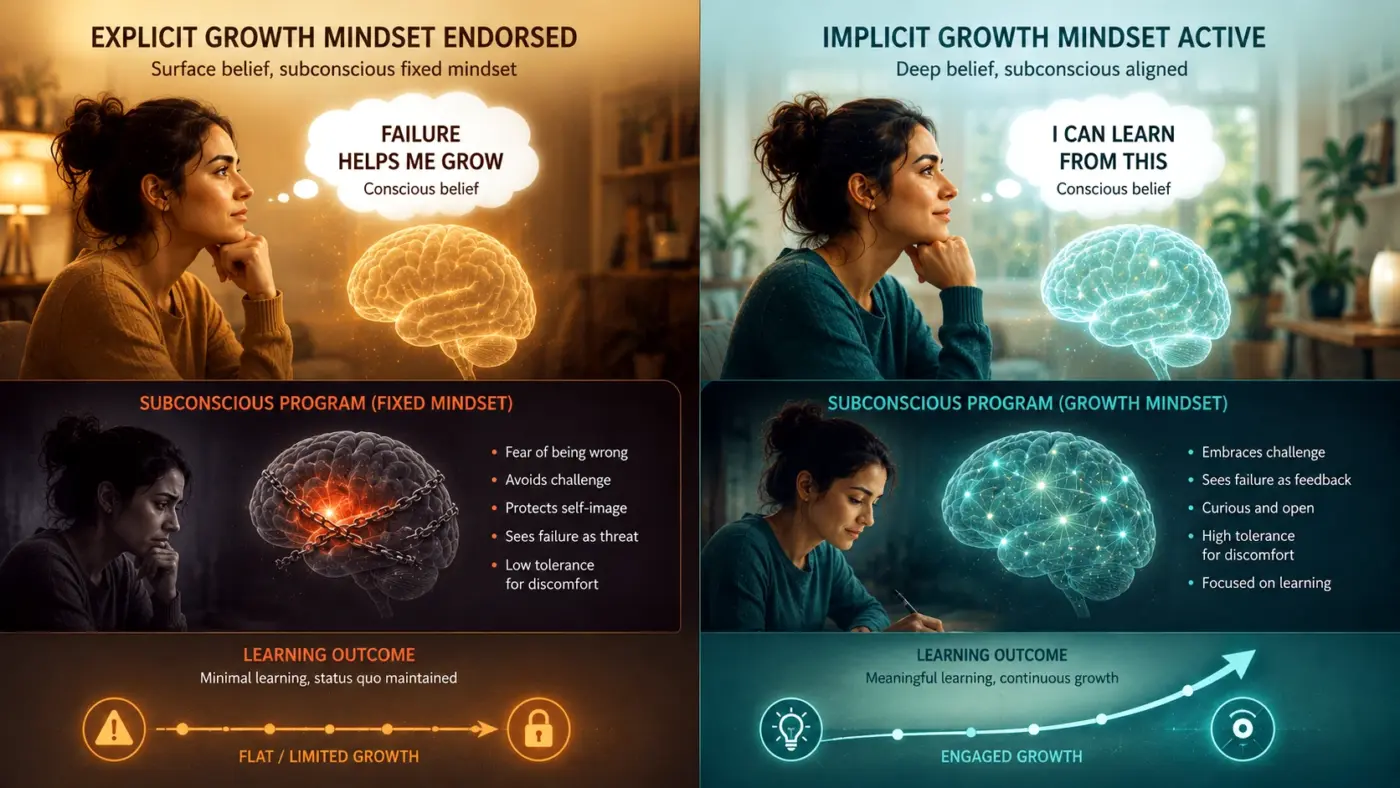
A 2024 study published in Scientific Reports by Sik, Cummins, and Job from the Universities of Vienna, Ghent, and Bern added an important nuance to what determines whether failure produces learning. Using a mouse-tracking propositional evaluation paradigm to measure implicit rather than self-reported mindsets, they found that implicitly held growth mindsets, the spontaneous subconscious belief that ability can be improved, predicted post-failure learning engagement above and beyond explicitly stated growth mindsets. In other words, consciously saying “I have a growth mindset” did not predict learning after failure. Actually having one at the subconscious level did.
This is the piece most growth mindset interventions miss. You can consciously endorse the idea that failure is instructive while your subconscious is running a fixed mindset program installed in childhood: “failure means I am not capable,” “mistakes reveal who I really am,” “getting it wrong confirms I am not good enough.” When those programs are running, the prediction error signal from failure does not update the prediction. It confirms the threat. The learning signal becomes a shame signal. And the subconscious responds not by updating the model of how to do better, but by strengthening the avoidance response that keeps the person away from situations where failure might occur again.
When Failure Traumatizes Instead of Teaching
The prediction error signal that makes failure a powerful learning tool is the same signal that, under specific conditions, makes failure traumatizing rather than instructive. Understanding the conditions that determine which outcome occurs is practically essential.
Failure produces learning when the nervous system is regulated enough to process the prediction error as information rather than as threat. When the brain is in a calm, safe physiological state, a negative prediction error is processed as: this approach did not work, what might work better? This activates the prefrontal cortex’s problem-solving and strategic updating functions. The subconscious updates the model and the person is genuinely better prepared for the next attempt.
Failure produces something closer to trauma when the nervous system is already in a state of threat activation, when the failure carries significant personal meaning tied to self-worth, or when the failure occurs without any felt sense of control or agency over the outcome. In these conditions, the amygdala dominates the processing. The prediction error is tagged as a threat to survival of the self rather than as information about a specific approach. The subconscious updates the model, but what it updates is not “this technique failed, try a different one.” It updates “this type of situation is dangerous to my sense of self, avoid it.” The avoidance response strengthens. The learning about how to improve does not occur.
This is why the same failure experience can produce growth in one person and lasting avoidance in another. The determining factor is not the failure itself. It is the physiological and psychological state the person is in when the failure occurs and how the self-worth dimension of the failure is framed at the subconscious level.
The Three Conditions That Make Failure Instructive
Based on the prediction error research and the implicit mindset findings, three specific conditions determine whether a failure experience produces subconscious learning or subconscious avoidance.
Condition 1: The Failure Must Be Followed by Reflection, Not Rumination
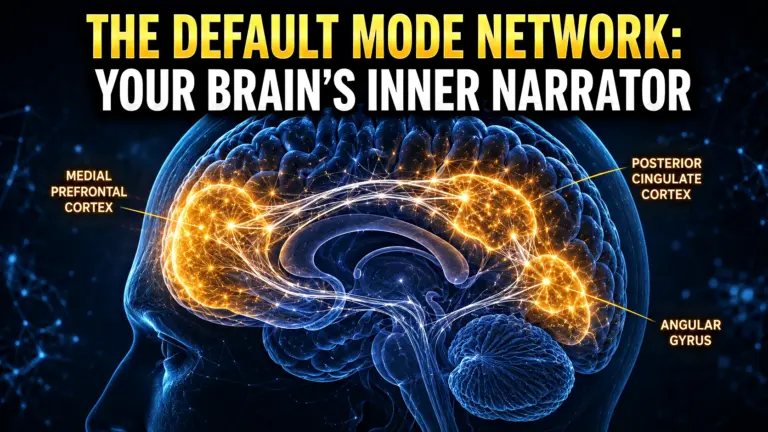
There is a specific and important difference between reflection and rumination that the research consistently identifies. Reflection is asking “what happened and what can I adjust?” Rumination is replaying the failure experience repeatedly while attached to its emotional charge, particularly the self-worth implications. Reflection activates the prefrontal cortex and produces the model update that the prediction error signal was designed to prompt. Rumination activates the Default Mode Network in its most self-critical mode and produces the shame response that converts the learning signal into an avoidance signal.
The practical implication is that what you do in the first 20 to 30 minutes after a significant failure determines much of what the subconscious extracts from it. Moving too quickly past the failure prevents the reflection. Getting caught in emotional replay prevents the analytical update. The window of useful reflection is specific, and it requires enough physiological regulation to allow the prefrontal cortex to engage.
Condition 2: The Failure Must Be Separated From Identity
The 2024 Scientific Reports study found that implicit fixed-mindset beliefs, the subconscious conviction that failure reveals fixed ability rather than adjustable approach, consistently converted the prediction error learning signal into a self-worth threat signal. When failure means “I failed at this task,” the subconscious updates the task prediction. When failure means “I am a failure,” the subconscious activates the threat response and learns primarily to avoid exposure.
Carol Dweck’s decades of research at Stanford on mindset and failure established this separation as the central variable in whether failure produces learning. But Dweck’s research primarily measured explicit, consciously reported mindset. The 2024 implicit mindset study revealed that what matters is the subconscious belief, not the consciously endorsed one. A person can genuinely believe in growth intellectually while their subconscious runs a fixed-mindset program that converts every failure into a self-concept threat. The subconscious program, not the conscious belief, determines the biological response.
Condition 3: The Nervous System Must Be Regulated Enough to Process Information
A prediction error cannot be processed as learning information if the nervous system is in a state of acute threat activation. When the amygdala is dominant, the prefrontal cortex is suppressed, and the model update that constitutes genuine learning cannot happen fully. The failure is recorded as a threat rather than as data. The subconscious learns: avoid situations like this one. That is a genuine subconscious update, but it is the opposite of the learning that would improve performance.
This is why how you feel about yourself when you fail is not a secondary consideration. It is the neurological prerequisite for extracting genuine learning from the experience. Regulated enough to reflect means: not flooded by shame, not in acute threat response, not dissociated from the experience entirely. The window of useful processing is in the middle ground between those extremes, and reaching it requires either natural regulation or deliberate physiological regulation through practices like breathing, Reiki self-healing, or movement.
How to Deliberately Structure Your Relationship to Failure
Taking the prediction error research seriously produces a specific approach to failure that is quite different from either the “failure is good, embrace it” positivity or the avoidance that most people default to.
Immediately after a significant failure, regulate first. Before any reflection, before any analysis, before any conversation about what went wrong, regulate the nervous system. Ten minutes of slow breathing, a brief Reiki self-healing session, a short walk, any practice that shifts physiological state from threat activation toward parasympathetic calm. The learning cannot happen until the prefrontal cortex is sufficiently online. Rushing to analysis before regulating first means analyzing from a threat state, which produces the rumination and self-worth damage rather than the model update.
Ask the prediction error question specifically. The question that activates the subconscious learning mechanism is: “What did my approach assume that turned out not to be true?” Not “what did I do wrong” (identity-adjacent) and not “why did this happen” (often unanswerable and prone to rumination). The specific question is about the prediction that failed. What did you expect to happen that did not? That question targets the exact information the dopamine prediction error signal was trying to convey. Answer it, write it down, and it becomes an explicit subconscious update rather than just an emotional experience the subconscious tags as a threat.
Update the approach rather than the self-assessment. The subconscious update the brain is designed to make after a prediction error is about the approach, not about the self. “This approach did not work in this context” is the neurologically appropriate update. “I am not capable of this” is the self-threat version that activates avoidance. Deliberately directing the update toward approach rather than identity is not denial of the failure. It is using the prediction error signal correctly rather than misdirecting it into self-concept damage.
Build a track record of survived failures. One of the most consistent findings in research on resilience and post-failure recovery is that people who have a history of surviving and learning from previous failures are significantly more resilient in subsequent ones. Each survived failure updates the subconscious prediction about what failure means. If your subconscious track record shows that failure has been followed by adjustment, learning, and continued engagement, the prediction error from a new failure is processed against that context. The amygdala’s threat activation is modulated by the accumulated evidence that failure is survivable and instructive.
How Reiki Healing Supports Post-Failure Subconscious Learning

Reiki self-healing is practically relevant to failure-based subconscious learning through the same physiological mechanism it serves in any inner work context. The nervous system regulation that Reiki produces through parasympathetic activation is precisely the physiological prerequisite that determines whether a failure experience produces learning or avoidance.
A Reiki self-healing session in the period following a significant failure does two specific things. First, it brings the nervous system out of the sympathetic threat state that prevents useful reflection. When the hands are placed on the Solar Plexus Chakra, which holds the subconscious patterns around self-worth and personal power that failure most often activates, the Reiki healing energy addresses the energetic charge of the self-worth dimension of the failure. This is what distinguishes a Reiki-supported failure processing session from simply “calming down.” The energetic charge around the self-worth threat is addressed directly, not just soothed over.
Second, Reiki self-healing before sleep in the days following a significant failure supports the overnight memory consolidation process that determines how the subconscious encodes the experience. As covered in the sleep reprogramming article on this site, what is most emotionally salient at sleep onset is what the subconscious prioritizes for overnight processing. A Reiki session that reduces the emotional charge of the failure and introduces a reframed understanding of the experience before sleep means the subconscious processes a less charged, more informative version of the event during the night. The encoding that results is more likely to be “this approach did not work, here is what to adjust” than “this situation is a self-worth threat, avoid it.”
Frequently Asked Questions
Why does the subconscious mind learn more from failure than from success?
The subconscious learns more from failure because of how the brain’s prediction error system works. Wolfram Schultz’s landmark research published in Science in 1997 established that dopamine neurons fire most strongly on unexpected outcomes, not expected ones. When an expected reward fails to arrive, dopamine dips sharply below baseline, producing a negative prediction error signal that the brain is designed to act on immediately by updating its predictive model. Success, when expected, produces minimal dopamine signal because no update is needed. Failure produces the prediction error that signals: this approach produced a wrong output, adjust the model. Andrew Huberman’s neuroplasticity research confirmed that errors increase activation of neural circuits for alertness, putting the brain in a significantly better learning state than correct performance does.
Why does failure sometimes traumatize instead of teach?
Failure becomes traumatizing rather than instructive when the nervous system is in threat activation during the failure, when the failure is linked to self-worth rather than to a specific approach, or when no sense of agency or control over the outcome is felt. In these conditions, the amygdala dominates processing and the prediction error signal is tagged as a threat to the self rather than as information about an approach. The subconscious update that follows is not “this technique failed, try differently.” It is “this type of situation is dangerous to my sense of self, avoid it.” The 2024 Scientific Reports study found that implicit fixed-mindset beliefs at the subconscious level consistently converted prediction error learning signals into self-worth threat signals, producing avoidance rather than engagement after failure.
What is the prediction error signal and how does it relate to learning from failure?
The prediction error signal is the dopamine system’s response to the gap between what was predicted and what actually happened. When an outcome is worse than predicted, dopamine dips below baseline, producing a negative prediction error that signals the brain’s learning system to update its predictive model. This update is synaptic plasticity in action: new neural connections form or existing ones strengthen to encode the new information about how the world works differently from the previous prediction. The prediction error is the biological trigger for all genuine learning and behavioral change. Failure produces the largest prediction error signals, which is why the neurological learning potential of failure is greater than the learning potential of expected success. The key is ensuring the prediction error is processed as information rather than as self-concept threat.
How does having an implicit growth mindset affect how the subconscious processes failure?
A 2024 study in Scientific Reports by researchers from the Universities of Vienna, Ghent, and Bern found that implicitly measured growth mindsets, the spontaneous subconscious belief that ability is improvable, predicted post-failure learning engagement above and beyond explicitly stated growth mindsets. Consciously believing in growth did not predict whether someone actually engaged in learning after failure. The subconscious belief did. When the subconscious holds a fixed mindset program, often installed in childhood, the prediction error from failure is processed as a self-worth threat rather than as approach information. The avoidance response strengthens. When the subconscious holds a genuine growth orientation at the implicit level, the same prediction error is processed as useful information about what to adjust. Changing the subconscious mindset requires working at the subconscious level through Reiki healing, theta-state practice, and genuine belief updating, not just consciously endorsing growth mindset ideas.
What is the most effective thing to do immediately after a significant failure?
The most effective immediate response to significant failure is nervous system regulation before any analysis or reflection. The prefrontal cortex, which is needed for the model update that constitutes genuine learning, is suppressed under threat activation. Attempting to analyze a failure while in threat activation produces rumination and self-worth processing rather than useful prediction updating. Slow breathing, Reiki self-healing, or brief physical movement can shift the nervous system toward parasympathetic calm within 10 to 15 minutes. From that regulated state, the specific reflection question that activates the learning mechanism is: what did my approach assume that turned out not to be true? This targets the prediction that failed rather than the self that failed, directing the update toward approach rather than identity and using the prediction error signal the way it was neurologically designed to be used.
Related Guides
- What Is the Subconscious Mind and How Does It Shape You
- The 95 Percent Subconscious Rule That Controls Your Life
- How to Reprogram Your Subconscious Mind While You Sleep Tonight
- What Your Subconscious Mind Does During Dreams: The Neuroscience
- Subconscious Mind and Intuition: When to Trust Your Gut Feeling
Discover more from Isrg Healing
Subscribe to get the latest posts sent to your email.