
Mikao Usui considered Gassho important enough to engrave it on his gravestone. He opened every class, every workshop, and every meeting with it. He instructed his students to practice it for 20 to 30 minutes each morning and evening without exception. And yet most Western Reiki practitioners today have either never heard of Gassho meditation or know it only as a polite bowing gesture the two-handed prayer position used to open and close a session. That description is technically accurate and deeply insufficient. Reiki Gassho meditation is not a ritual courtesy. It is the first of the three pillars on which Usui built his entire healing system, and understanding what it actually does, why it works, and how to practice it correctly is one of the most practically significant things a Reiki practitioner at any level can do to deepen their practice.
Table of Contents
What Is Reiki Gassho Meditation and Why the Japanese Meaning Matters

The word Gassho (合掌) is composed of two Japanese characters. Ga (合) means to come together, to unite, or to join. Sho (掌) means the palm of the hand. Together, Gassho translates precisely as two palms coming together. This is not merely descriptive of the physical gesture. It contains the practice’s essential principle: the joining of two palms brings together two channels, the right representing the sun, active, giving, and the left representing the moon, receptive, receiving, into a single unified circuit of energy at the heart centre.
In Buddhism, from which Usui drew significant influence in developing his system, Gassho is not only a gesture but a mudra a sacred hand seal that embodies a specific quality of consciousness. The Buddhist Gassho mudra represents the union of self and other, the dissolution of separation, and the arising of compassionate awareness. When Usui incorporated Gassho into the foundation of Reiki practice, he carried this meaning with him. The practitioner who places their palms together is not merely adopting a posture. They are enacting a principle: the recognition that healing moves through the dissolution of separation between healer and healed, between self and source.
The Three Pillars of Usui’s System: Where Gassho Actually Sits
Western Reiki teaching typically presents the practice as consisting of the Gokai (the Five Principles), the hand positions, and the attunement process. This is accurate but incomplete. Usui organised his teaching around three foundational pillars that preceded all of these elements. They are documented in the Original Reiki Handbook attributed to Mikao Usui and preserved across multiple Japanese Reiki lineages.
The first pillar is Gassho the meditative foundation from which all practice begins. The second pillar is Reiji-ho the technique of inviting Reiki to guide the practitioner’s hands to where healing is needed, rather than relying solely on fixed hand positions or Byosen scanning. The third pillar is Chiryo the actual treatment, whether self-treatment or treatment of others.
This sequence is significant. Usui placed meditation before guidance, and guidance before treatment. The implication is clear: a practitioner who moves directly to treatment without first establishing the meditative state of Gassho is working from the second or third pillar without the foundation of the first. The hands may deliver Reiki effectively, but the quality of presence from which those hands work is qualitatively different when it emerges from Gassho than when it emerges from ordinary daily consciousness.
Bronwyn Ayla, a licensed acupuncturist and Reiki Master Teacher who has documented the Hatsurei-ho sequence in detail, notes that most Western Reiki students learn hand positions and symbols but are never taught this foundational sequence a pattern that has persisted across most Western lineages since Takata adapted the system for a Western audience in the 1930s.
The Pericardium 9 Connection: What Acupuncture Reveals About Gassho
This is the aspect of Gassho that almost no Western Reiki article covers, and it is one of the most practically clarifying pieces of information a practitioner can have.
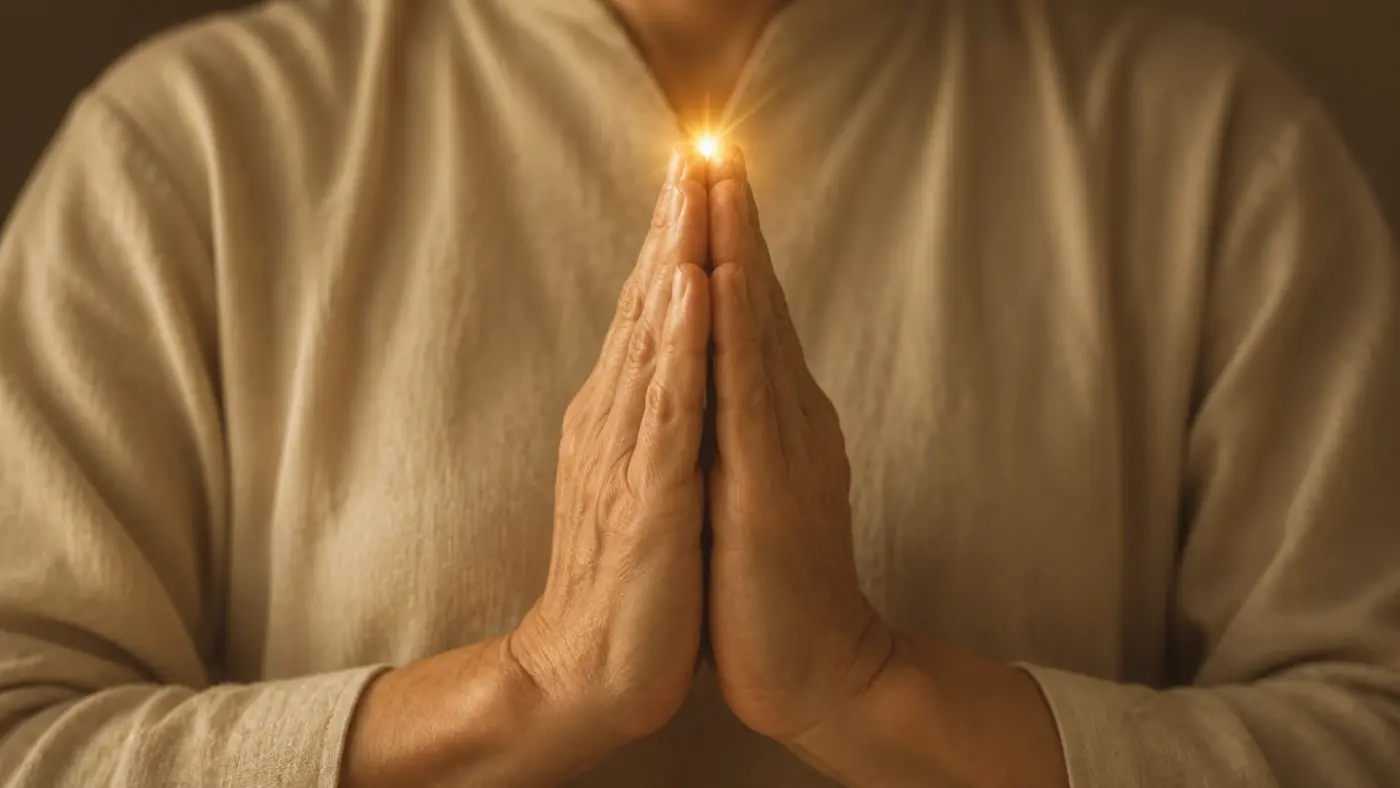
In Gassho, the specific instruction from Usui’s teaching is to bring all of one’s awareness to the point where the tips of the middle fingers meet. Not the entire palm, not the joined hands generally, but specifically the tip of the middle finger of each hand, held in contact at that point.
In Chinese and Japanese acupuncture, the acupuncture point at the very centre of the tip of the middle finger is called Pericardium 9, abbreviated P9 or PC9. It is the final point on the Pericardium meridian the energy channel associated with the heart’s protective function, with the quality of shen (spirit or consciousness) as it moves through the body-mind, and with the practitioner’s capacity to remain energetically boundaried while working in close energetic contact with others.
P9 is specifically the point in Chinese medicine that spreads the influence of shen throughout the entire body-mind system. When the tips of the middle fingers are brought together in Gassho and held in sustained, focused contact, the practitioner is effectively activating P9 bilaterally stimulating the Pericardium meridian on both sides simultaneously, opening the hand chakras, and drawing the quality of consciousness governed by the Pericardium channel into the present moment of the practice. The result is the focused, heart-centred, energetically boundaried awareness that makes Reiki practice both effective and sustainable.
This is also why Gassho was Usui’s recommended preparation before giving Reiki to others. The Pericardium meridian’s protective function is precisely what allows a practitioner to work in deep energetic contact with a recipient without absorbing the energetic residue of that session. A practitioner who enters healing work without this quality of Pericardium activation is working without their primary energetic protection.
What Gassho Was Engraved On: The Gravestone Evidence
One of the most direct pieces of historical evidence for Gassho’s centrality to the Usui system comes from Usui’s own memorial stone, erected by his students in 1927 in the Saihoji Temple cemetery in Tokyo, the year after his death. The inscription on the stone, translated from Japanese, includes the five Reiki principles in a form that has been documented and cross-referenced by multiple Reiki historians. The opening of the inscription reads, in various translations: for the improvement of body and soul, the secret method to invite happiness, the spiritual medicine for all diseases of body and mind.
According to documentation preserved in the Jikiden Reiki lineage and corroborated by researcher Bronwyn Ayla’s published work on the Hatsurei-ho sequence, Gassho was so important to Usui that it is referenced in his gravestone inscription. The physical posture and the daily practice it represents are not peripheral to his system. They are inscribed into the historical record of what he taught and what he considered essential.
How to Practice Gassho Meditation: The Complete Instruction
The instructions below follow the traditional teaching as preserved across Japanese Reiki lineages. The practice is simple in form and deep in effect.
Posture
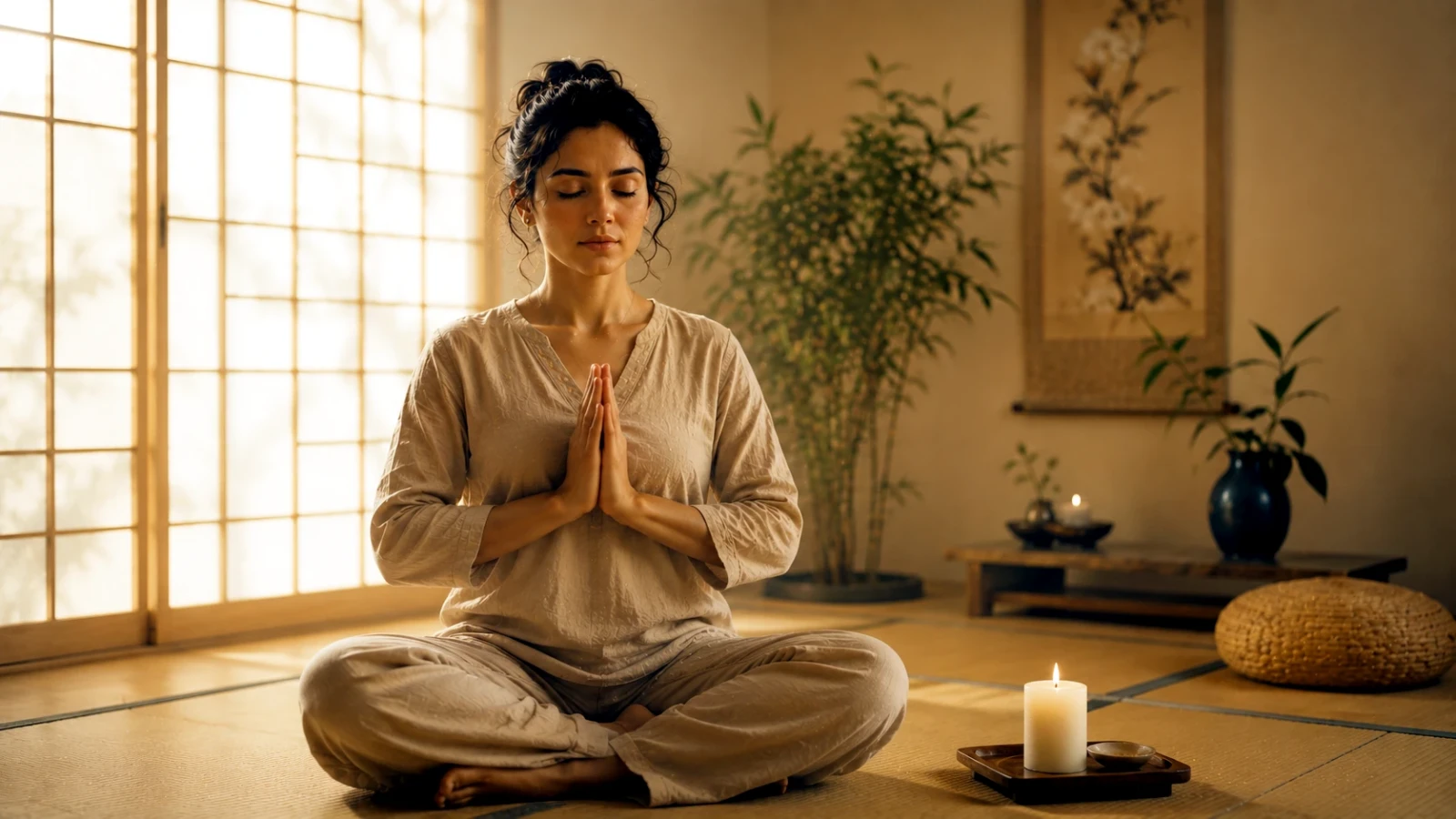
Sit with the spine upright but not rigid. The head is in a neutral, balanced position neither dropped toward the chest nor tilted back. The shoulders are relaxed and dropped away from the ears. You may sit on a chair with feet flat on the floor, in a cross-legged position on a cushion, or in any seated position that allows the spine to remain naturally erect without muscular strain. The posture should be stable enough to maintain for 20 minutes without the body demanding attention.
The Hand Position
Bring both palms together at the centre of the chest, at the level of the heart. The fingers point upward. The thumbs rest lightly against the sternum or float slightly away from the chest. The pressure between the palms is light enough to maintain contact, not enough to create tension. The hands are not squeezing together. They are resting together.
Now bring all of your attention to the specific point where the tips of the middle fingers meet. Not the whole hand, not the general sensation of palms together the precise point of contact between the tip of the left middle finger and the tip of the right middle finger. This is where Pericardium 9 activates bilaterally. This is where the practice concentrates.
The Attention
With eyes gently closed, maintain your entire attention at the point where the middle fingertips meet. Notice what you feel there. Initially, most practitioners notice only the physical sensation of skin against skin. With sustained practice over days and weeks, the sensation typically evolves: warmth builds, tingling or pulsing develops, a sense of energetic flow between the two fingers may emerge. These are signs that the hand chakras are activating and the Pericardium meridian is engaged.
When the mind wanders and it will the traditional instruction from Usui’s teaching is simple: gently press the middle fingertips together slightly more firmly for a moment, then release the extra pressure and return attention to that point. The slight pressure serves as a physical anchor that brings the attention back without requiring the mind to fight itself. This technique, deceptively simple, is one of the most effective single-pointed concentration tools in any meditative tradition.
Duration and Timing
Usui’s instruction was 20 to 30 minutes each morning and evening. For practitioners new to the practice, beginning with 10 minutes once daily and building gradually toward the traditional duration is a more sustainable approach than attempting the full duration from the first day. The practice deepens with repetition. Even 10 minutes of genuine single-pointed Gassho produces a qualitatively different effect than 30 minutes of restless partial attention.
The most productive times are immediately upon waking, before engaging with the day’s activity, and in the evening before sleep. These are the natural windows of relative stillness in the daily cycle, and the nervous system is most receptive to meditative practice at these boundaries between activity and rest. For practitioners who use Gassho before giving Reiki sessions, even three to five minutes of Gassho immediately before beginning a session shifts the quality of the work in ways that are consistently perceptible to both practitioner and recipient.
Gassho in Group Practice: What Changes When Two or More Practice Together
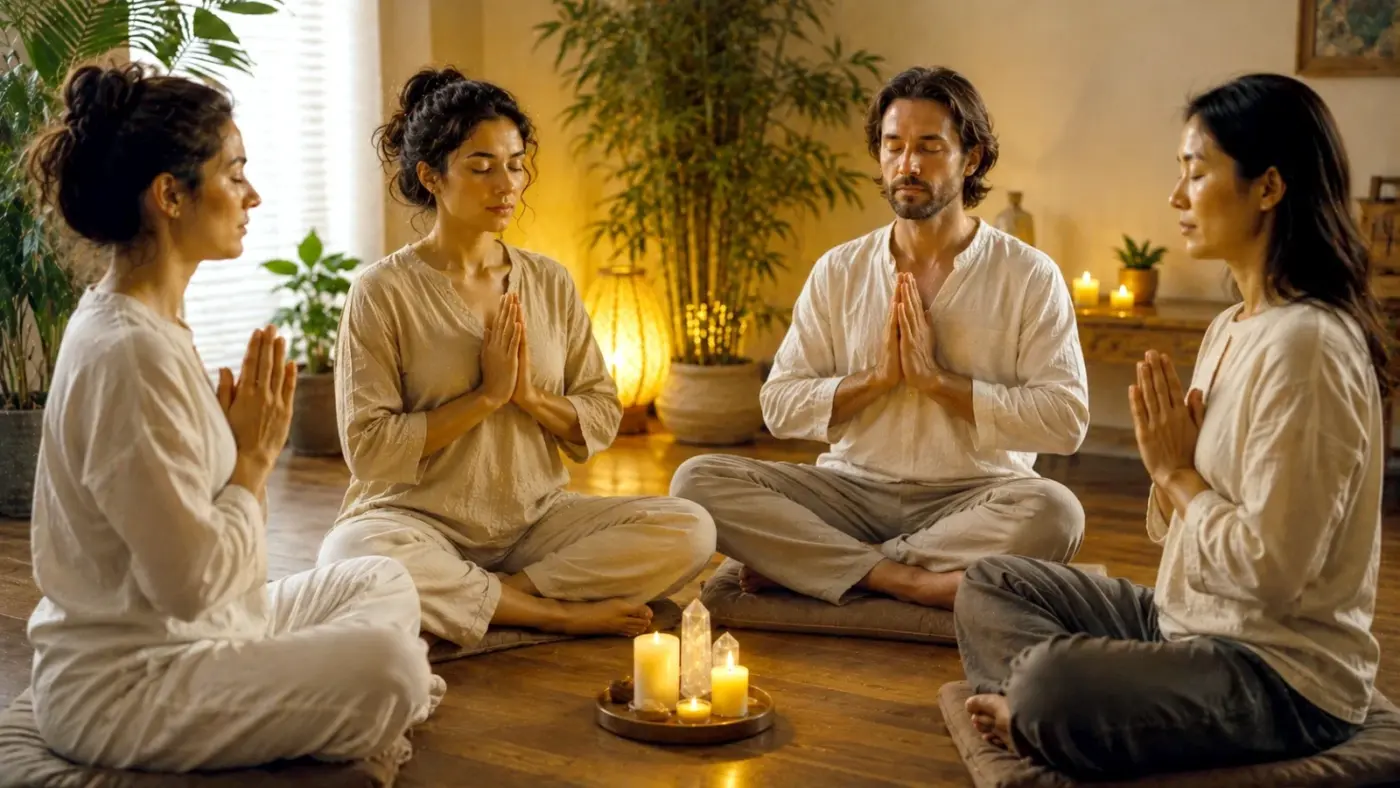
Usui practiced Gassho both individually and in group settings, and he specifically noted that group Gassho produces an energy that exceeds the sum of individual practices. This is consistent with what HeartMath Institute research has documented regarding the coherence of collective heart electromagnetic fields: when multiple individuals achieve internal coherence simultaneously, the combined field is substantially more ordered and powerful than individual fields simply added together.
Reiki circles and group practice sessions that open with five to ten minutes of shared Gassho consistently produce a noticeably different energetic quality in the subsequent healing work than sessions that begin without this shared foundation. The energy in the room becomes more still, more unified, and more receptive. Practitioners who have experienced group Gassho regularly describe the shift as tangible rather than conceptual.
What Gassho Produces Over Time: The Cumulative Effect of Daily Practice
The effects of Gassho are not primarily experienced in any single session. They accumulate over weeks and months of consistent daily practice in ways that change the practitioner’s relationship to Reiki at a fundamental level.
Within the first two to three weeks, practitioners typically notice an improvement in the clarity and consistency of their energy perception during healing sessions. The hands become more reliable in their sensitivity. The capacity to maintain focused presence during a session without the mind drifting to appointments, conversations, and the ordinary concerns of daily life increases measurably. This improved focus is not a side effect of Gassho. It is precisely what the practice is designed to produce.
Over months of consistent practice, what typically emerges is a shift in what might be called the practitioner’s baseline. The quality of presence that Gassho produces in dedicated practice sessions begins to become available in ordinary daily life. The Pericardium 9 activation that requires 20 minutes of focused meditation at the beginning of practice becomes accessible more quickly. The heart-centred awareness that initially required deliberate cultivation begins to arise naturally. This is the gradual development of what the Japanese Reiki tradition calls the practitioner’s Ki their personal life force quality and Gassho is specifically the practice Usui designed for its cultivation.
Disclaimer: The information in this article is for educational purposes only and does not constitute medical advice. Reiki and meditation are complementary practices and are not substitutes for professional medical treatment. Always consult a qualified healthcare professional for medical concerns. Read our full Disclaimer Page here.
Frequently Asked Questions About Reiki Gassho Meditation
Do I need a Reiki attunement to practice Gassho meditation?
No. Gassho meditation as a mindfulness and centering practice is accessible to anyone regardless of whether they have received a Reiki attunement. However, practitioners who have been attuned typically experience stronger energetic sensations at the Pericardium 9 point because their hand chakras have been opened to the Reiki flow. The practice deepens noticeably after attunement.
How long does it take before I feel something during Gassho?
Most practitioners begin to notice warmth or tingling at the middle fingertip contact point within the first three to seven days of consistent daily practice. The Original Reiki Handbook notes that after three days of practice, you will know on the basis of your feelings whether the practice is working for you. For some, the sensation is immediate. For others, it develops gradually over the first week or two. Consistency matters more than session length in the early stages.
Can I practice Gassho for less than 20 minutes and still benefit?
Yes. Usui’s traditional guidance was 20 to 30 minutes, but even five to ten minutes of focused Gassho practice produces measurable shifts in the practitioner’s energetic state and the quality of subsequent healing work. Shorter, consistent daily practice is more valuable than occasional longer sessions. Beginning with what you can sustain and building gradually toward the traditional duration is the approach most likely to produce lasting results.
What is the difference between Gassho and Hatsurei-ho?
Gassho is the first and foundational element of the broader Hatsurei-ho practice. Hatsurei-ho is the complete daily Reiki cultivation sequence that Usui prescribed to his students, consisting of Gassho (the meditative opening), Reiji-ho (the invitation for guidance), and Chiryo (the treatment). Gassho can be practiced on its own as a standalone meditation. Hatsurei-ho is the full sequence of which Gassho is the beginning.
Should I recite the Gokai during Gassho meditation?
Many practitioners and teachers, including those in the Jikiden lineage, incorporate the Gokai recitation either before or after the silent Gassho meditation as part of their morning and evening practice. The two practices are complementary: Gassho prepares the state of presence from which the Gokai can be received not just as words but as lived intention. Whether you combine them or practice them separately is a matter of personal practice rather than strict protocol.
Related Guides
- How to Build a Daily Self Reiki Practice You Will Actually Keep
- Cho Ku Rei The Reiki Power Symbol Most Practitioners Use Incorrectly
- What Is Reiki and How Does It Actually Work Complete Guide in 2026
- Reiki Level 1 2 and 3 What No One Tells You About Each Attunement
Discover more from Isrg Healing
Subscribe to get the latest posts sent to your email.