

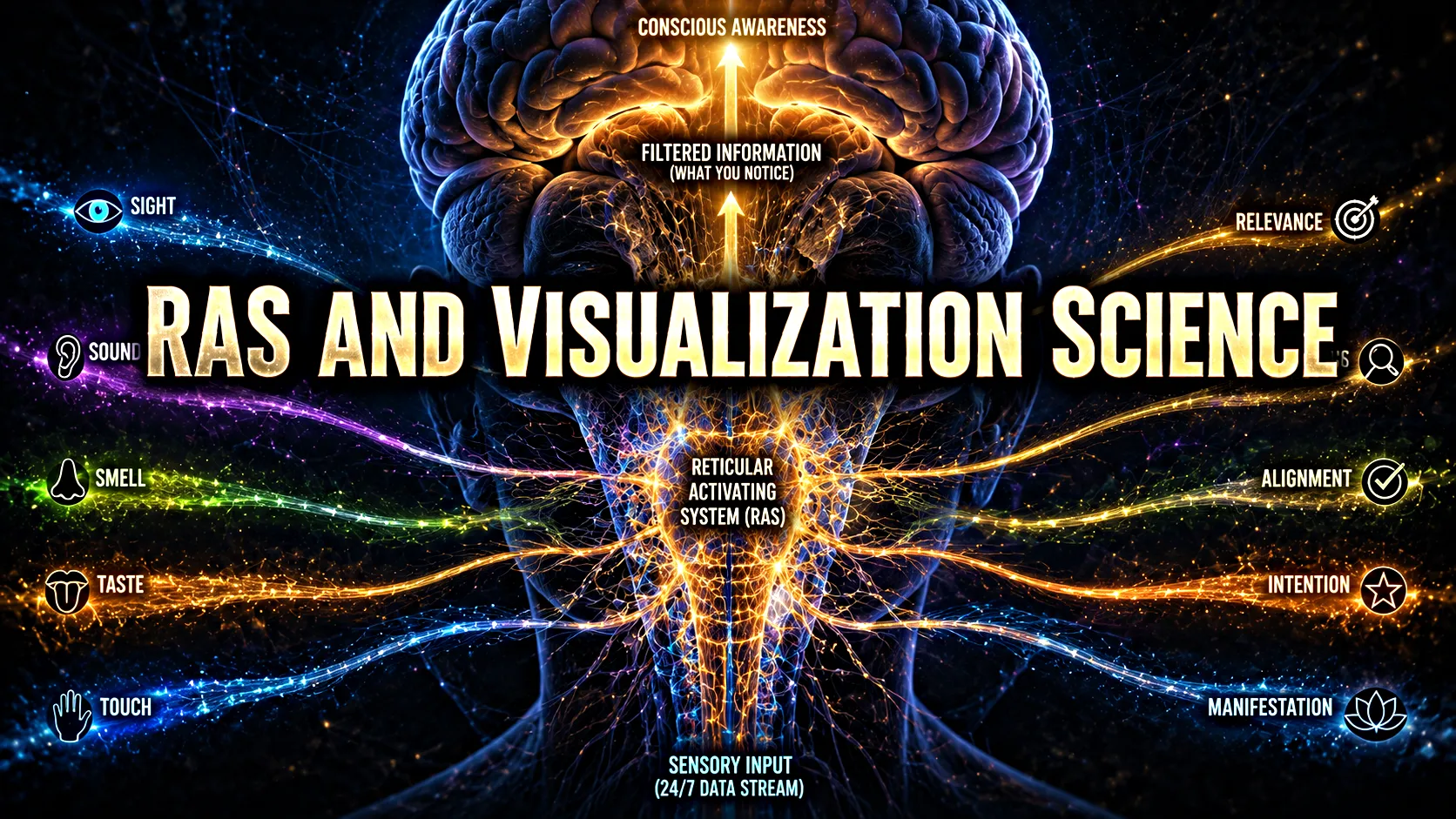
Every time you have ever bought a new car and then suddenly noticed that same model everywhere on the road, your brain revealed something about itself that most people never fully investigate. Those cars were always there. The roads did not change. What changed was a filter deep in your brainstem, a cluster of neurons called the Reticular Activating System, and it started doing something it had not been doing before: it started tagging that car as relevant and surfacing it into your conscious awareness.
That same filter, running continuously and silently beneath every waking moment, is the neurological mechanism that determines what you notice, what you miss, and ultimately what becomes possible for you. And it is the mechanism that explains, in precise biological terms, why visualization actually works.
Most people who practice visualization do so because someone told them it helped. Few understand what is physically happening in the brain during a visualization session, which is exactly why most people practice it incorrectly and then conclude it does not work. In my years of teaching Reiki and energy healing, I have found that students who understand the neuroscience behind visualization practice it with an entirely different quality of attention. That quality of attention changes the results completely. This article is the complete picture: what the RAS is, how visualization trains it, what the research actually confirms, and why combining visualization with Reiki healing produces results that neither practice produces alone.
Table of Contents
What the Reticular Activating System Actually Is
The Reticular Activating System is a network of neurons located in the brainstem, specifically in the reticular formation, a region that runs through the core of the brainstem from the medulla oblongata up through the midbrain. It is not a single structure with a clean boundary. It is a diffuse network of interconnected neurons whose collective function is to regulate wakefulness, arousal, and most critically, the selective filtering of incoming sensory information.
At any given moment, your sensory systems are delivering an estimated 11 million bits of information per second to your brain. Your eyes alone contribute approximately 10 million of those bits. Your conscious awareness can process somewhere between 40 and 50 bits per second. The RAS is the system that decides, moment by moment, which 40 to 50 bits make it through. Everything else is filtered out before reaching conscious awareness, not because it does not exist, but because the RAS has determined it is not currently relevant.
The RAS does not make these filtering decisions randomly. It operates on learned criteria derived from your goals, your established beliefs, your repeated patterns of attention, and critically, your emotional priorities. The things you have emotionally invested in, the things that feel important to your survival or your deepest desires, receive the highest filtering priority. The RAS surfaces them into awareness. Everything else remains in the background.
How the RAS Connects to the Prefrontal Cortex
The RAS does not operate in isolation. Research published in the Annual Review of Neuroscience in 2001 by Miller and Cohen established that the prefrontal cortex, the brain region responsible for goal-setting, planning, and higher-order decision-making, sends direct descending signals to the RAS that modulate its filtering parameters. When you consciously set a specific goal or deliberately direct your attention toward a desired outcome, the prefrontal cortex communicates that priority downward to the RAS, which then recalibrates its filter accordingly.
This is the neuroscience behind what happens when you write down a goal and begin noticing relevant opportunities almost immediately afterward. The prefrontal cortex has registered the goal and signaled the RAS to begin surfacing related information. Those opportunities were present before. The RAS was simply not flagging them as relevant. The goal-setting changed the filter. The changed filter changed what you could see.
The RAS and Emotional Priority
Research by Joseph LeDoux at New York University, documented in his 1996 work The Emotional Brain, established that the RAS maintains close functional connections to the limbic system, the brain’s emotional processing network. This connection means that emotionally significant stimuli receive priority filtering, surfacing into awareness faster and more reliably than emotionally neutral information.
This has a direct and important implication for visualization practice. The RAS does not respond with equal strength to all goal-directed thinking. It responds most powerfully to goals that carry genuine emotional weight. A goal that is intellectually stated but emotionally inert produces a weaker RAS response than a goal that is felt deeply, that connects to values, desires, and meaning that the person genuinely cares about. The emotional charge is not decorative. It is the signal strength that determines how aggressively the RAS filters for related information.
The Science of Visualization: What the Brain Does During Mental Imagery
Visualization is not imagination for its own sake. It is a specific neurological process that, when conducted correctly, activates many of the same neural pathways as the actual physical experience being imagined. This is the finding that changed how the scientific and sports communities understood mental rehearsal, and it is the finding that makes visualization relevant to far more than athletic performance.
The Richardson Experiment: Where the Modern Understanding Began

In 1967, Australian psychologist Alan Richardson conducted what became one of the most cited studies in the science of mental rehearsal. He divided a group of basketball players into three groups. The first group practiced free throws physically for 20 minutes every day for 30 days. The second group spent 20 minutes per day visualizing themselves making perfect free throws, without touching a basketball. The third group did neither.
After 30 days, the physical practice group improved their free throw accuracy by 24 percent. The group that did nothing showed no improvement. The visualization-only group improved by 23 percent. One percent less than the group that practiced every single day, physically, for an entire month.
The question Richardson’s study raised was obvious: how? The players in the visualization group had not moved. Their muscles had not practiced. Their hands had not touched a ball. What had improved? The answer lay in the neural pathways. Vivid mental rehearsal of a skilled movement activates many of the same motor circuits in the brain that physical execution activates. The neural blueprint for the movement was being strengthened during visualization, almost as effectively as it was being strengthened through physical practice.
The NASA Visual Motor Rehearsal Program
NASA developed its own structured visualization application, which became known as Visual Motor Rehearsal, initially through the Apollo program in the 1960s. Sports psychologist Dr. Denis Waitley, who later adapted this program for the United States Olympic team during the 1980s and 1990s, described what the Olympic testing revealed: when athletes were connected to biofeedback equipment and asked to run their event only in their mind, the same muscles fired in the same sequence as when they physically ran the event. The brain’s motor system could not distinguish between vivid mental rehearsal and physical performance.
This finding, described by Waitley as “when you visualize then you materialize,” has since been replicated and validated across numerous studies and elite performance contexts. Olympic programs, military training units, and professional sports organizations now incorporate structured visualization as a standard component of performance preparation, not as a motivational tool but as genuine neural training.
John Decety’s Research: The Same Brain Regions Activate
Neuroscientist John Decety published research in 1996 establishing through brain imaging that imagining a motor activity and actually performing that motor activity activate the same brain regions, specifically the prefrontal cortex and its connections with the basal ganglia. This neural overlap between imagined and real experience is what makes visualization a genuine training tool rather than a merely psychological one.
Further support came from researchers Roger Shephard and Steve Kosslyn, whose experiments demonstrated that the time required to complete an imagined motor task scales linearly with the complexity of the task, exactly as it does in the real world. The brain is not producing a shortcut during visualization. It is producing a genuine simulation of the experience, using the same processing infrastructure.
A 2024 Surgical Study: Mental Rehearsal Changes Brain Activation
A 2024 study published in the National Center for Biotechnology Information by researchers examining mental rehearsal in surgical training used functional near-infrared spectroscopy to measure brain activation changes in surgical residents after mental rehearsal compared to a control group that read textbooks. The mental rehearsal group showed reduced activation in the bilateral prefrontal cortex, indicating greater neural efficiency, alongside increased activation in the motor cortex regions associated with the rehearsed task.
Surgical performance measures, including objective performance scores and leak volume in the rehearsed procedure, improved significantly in the mental rehearsal group but not in the control group. The researchers concluded that mental rehearsal enhances skill acquisition by improving neural efficiency in motor areas. This is not sports psychology research. This is clinical neuroscience confirming that mental rehearsal produces measurable, specific neurological changes in skilled performance domains.
How Visualization Trains the RAS: The Exact Mechanism
Understanding how visualization and the RAS work together requires connecting these two systems, which most articles treat separately. The connection is the key to understanding why visualization sometimes works powerfully and sometimes seems to produce no result at all.
When you visualize a specific desired outcome with genuine emotional engagement, two things happen simultaneously. First, the neural pathways associated with the imagined experience are activated and strengthened, the mental rehearsal effect documented in Richardson’s research and Decety’s brain imaging studies. Second, the emotional charge attached to the visualization signals the RAS that this outcome is a high-priority item, prompting the RAS to begin recalibrating its filter to surface related information into conscious awareness.
The result is that consistent, emotionally engaged visualization begins to change what you notice in your daily environment. Opportunities that were always present begin to surface into awareness because the RAS is now flagging them as relevant. Connections that were always possible begin to feel more visible. Information that was previously filtered out starts reaching conscious attention because it matches the pattern the RAS has been programmed to prioritize.
This is the precise mechanism through which visualization supports manifestation. It is not that the universe rearranges itself in response to mental images. It is that your brain’s filtering system rearranges its priorities in response to consistent, emotionally present visualization, changing what you perceive, what you notice, and what you are motivated to act on. The action that follows the changed perception is what produces the external results.
Why Most Visualization Fails: The Frequency Mismatch Problem
Here is what most guides on visualization do not address, and it is the explanation for why so many people practice visualization diligently and still see no results. The RAS filters for emotional frequency, not for content alone. If the visualization session contains the imagery of the desired outcome but the underlying emotional state during the session is one of lack, doubt, or longing, the RAS receives conflicting signals. The imagery says “abundance” but the emotional frequency says “I don’t have this yet.” The RAS responds to the emotional frequency because that is the more fundamental signal.
This is why the distinction between visualizing from the wanting state and visualizing from the having state is not a minor technical point. It is the central variable that determines whether visualization trains the RAS effectively or not. A visualization session conducted from a place of genuine felt presence in the imagined outcome, what Neville Goddard called “living in the end,” programs the RAS with a clear and unambiguous signal. A session conducted from a place of wishing and longing programs the RAS with the signal of lack, which the RAS then filters for in the daily environment, surfacing evidence of the very lack the person is trying to move away from.
In my Reiki teaching practice, I guide students to prepare their energy state before any visualization session. A brief Reiki self-healing session calms the nervous system, clears the emotional field of the surface layer of stress and doubt, and brings the practitioner into a more coherent internal state from which genuine felt visualization becomes accessible. The quality of the RAS programming that results from a visualization session conducted from this cleared, coherent state is categorically different from one conducted while the nervous system is still running in its habitual patterns.
Why Reiki Healing Amplifies Visualization and RAS Training
The connection between Reiki healing and RAS-based visualization is not a spiritual claim layered on top of science. It is a functional description of what happens at the neurological and energetic levels when both practices are combined. Let me explain this precisely.
Nervous System Coherence as the Foundation
The RAS’s filtering criteria are shaped in part by the current state of the nervous system. A nervous system running in chronic sympathetic activation, the fight-or-flight stress response, programs the RAS to filter primarily for threat-relevant information. This is an evolutionary design feature: when you are in danger, the brain redirects its attention resources toward survival-relevant inputs. The RAS becomes a threat detector rather than an opportunity detector.
Reiki healing, through its documented effect on parasympathetic nervous system activation, shifts the body out of this threat-detection state and into the calmer, more receptive physiological condition in which the prefrontal cortex can engage fully with goal-directed thinking. Research on relaxation response states, including work building on Herbert Benson’s foundational research at Harvard Medical School in the 1970s, established that the shift from sympathetic to parasympathetic dominance produces measurable changes in attention, creativity, and receptivity to new information. This is the physiological state in which RAS reprogramming through visualization is most effective.
The Throat and Third Eye Chakra Connection

From the energy healing perspective, two chakra centers are directly relevant to the visualization and RAS training process. The Third Eye Chakra, located at the center of the forehead and corresponding to the region above and between the eyes, governs the capacity for clear mental imagery, intuition, and inner vision. When this chakra carries energetic blocks, the ability to generate vivid, emotionally present mental imagery is compromised. Visualization feels effortful, flat, and unconvincing to the person practicing it.
The Throat Chakra governs clear intentional direction, the capacity to state and hold a specific intention with conviction. When the Throat Chakra is balanced, intention-setting feels natural and purposeful. When it is blocked, intentions feel vague or are stated without the underlying conviction that gives them power.
In my practice, students who struggle with visualization despite genuine effort often show energetic congestion in the Third Eye Chakra area. Targeted Reiki healing to this center, combined with the Root Chakra grounding work to stabilize the overall energy field, consistently produces a qualitative improvement in the student’s ability to generate vivid, emotionally present visualization in subsequent sessions. This is not an occasional observation. It is a consistent pattern across many students over many years of teaching.
The Visualization Protocol That Actually Works

Step 1: Prepare the Nervous System First
Before beginning any visualization session, spend ten minutes in a practice that activates the parasympathetic nervous system. Reiki self-healing focused on the Root Chakra and Heart Chakra is the method I use and teach. Alternatively, slow diaphragmatic breathing, where the exhale is longer than the inhale, activates the vagus nerve and shifts the body toward parasympathetic dominance. Do not skip this step. Visualization attempted from a state of sympathetic activation programs the RAS with the wrong emotional frequency. The nervous system preparation is not optional. It is the foundation of the entire session.
Step 2: Set a Single, Specific Intention
The RAS responds to specificity. A vague intention produces a vague filter. “I want more abundance” gives the RAS nothing actionable to filter for. “I am building a healing practice that serves clients worldwide and provides consistent financial stability” gives the RAS a specific pattern to match against incoming information. Write the intention in present tense before the session. State it as current reality, not future aspiration. The specificity and the present-tense framing both matter for the quality of the RAS programming.
Step 3: Generate First-Person, Present-Tense Imagery
Enter the visualization from the first-person perspective, meaning you are inside the experience, not watching yourself from outside. See through your own eyes. Engage all available senses. What do you see in this already-real version of your desired outcome? What do you hear? What does the environment feel like physically? What is the emotional tone of this moment? The more senses you can include genuinely, not performed or forced but actually felt, the more completely the brain simulates the experience and the more strongly the RAS receives the programming signal.
Step 4: Lock the Emotional State Before Ending the Session
Before ending the visualization, anchor the dominant positive emotional state from the session. Take a slow breath and allow the feeling to deepen. Then physically touch two fingers together or place a hand on your heart as a somatic anchor. This creates a physical trigger that can be used during the day to briefly re-access the emotional state of the visualization, refreshing the RAS signal without requiring a full session. This anchoring technique, drawn from neuro-linguistic programming and somatic practice, reinforces the RAS programming between sessions.
Step 5: Practice Daily and Act on What You Notice
RAS reprogramming through visualization is cumulative. Daily practice of ten to twenty minutes, even brief sessions, produces stronger and more consistent filtering effects than occasional longer sessions. As the RAS recalibrates its filter, you will begin noticing things you previously overlooked: relevant opportunities, useful information, potential connections, and aligned next steps. These are not coincidences. They are the RAS delivering on its new programming. Your job is to act on what surfaces. The RAS notices the opportunity. Action converts the opportunity into outcome. Both are required.
Disclaimer: The information in this article is intended for educational purposes only and does not constitute medical advice. Reiki and energy healing are complementary practices and are not a substitute for professional medical treatment. Always consult a qualified healthcare professional for medical concerns.
Common Visualization Mistakes That Prevent RAS Reprogramming
The research is clear that visualization works. The gap between the research and most people’s results is almost always explained by specific, correctable mistakes in how the practice is conducted.
Third-person rather than first-person perspective. Watching yourself in the visualization from outside, as though watching a movie, produces weaker neural activation than the first-person, inside-the-experience perspective. Brain imaging studies consistently show greater activation of relevant neural circuits in first-person imagery. If your visualizations have you watching yourself from the outside, shift to seeing through your own eyes.
Future tense rather than present tense. Visualizing the desired outcome as something that will happen eventually programs the RAS with a future-oriented filter, which creates a subtle but consistent sense of separation from the outcome. Present-tense imagery, experiencing the outcome as already real and already present, programs the RAS more effectively for opportunity recognition in the current environment.
Visual-only imagery without sensory and emotional engagement. A purely visual mental image, even a vivid one, produces weaker RAS programming than imagery that includes kinesthetic sensation, sound, smell, and above all, genuine emotional presence. The emotional component is the primary signal to the RAS. An emotionally flat visualization is a quiet signal. An emotionally rich visualization is a strong one.
Inconsistent practice. Neuroplasticity requires repetition. A single powerful visualization session plants a seed. Daily consistent practice over weeks and months grows the neural pathway into something automatic and stable. Most people practice for a week, see no dramatic external result, and stop. They stopped before the cumulative neuroplastic effect had time to reach the threshold where it changes behavior and perception consistently.
FAQs
What is the Reticular Activating System and how does it relate to manifestation?
The Reticular Activating System is a network of neurons in the brainstem that filters the approximately 11 million bits of sensory information your brain receives every second, allowing only about 40 to 50 bits per second to reach conscious awareness. It determines what you notice by filtering based on your established goals, beliefs, emotional priorities, and repeated patterns of attention. In the context of manifestation, consistent, emotionally engaged visualization and intention-setting program the RAS to filter daily experience for information, opportunities, and circumstances aligned with the desired outcome. This is the neurological mechanism behind why focused attention on a specific goal causes relevant opportunities to seem to appear more frequently.
Does visualization actually work or is it just positive thinking?
Visualization is supported by substantial peer-reviewed research. Alan Richardson’s 1967 study demonstrated that mental rehearsal produced 23 percent improvement in basketball free throw accuracy compared to 24 percent for daily physical practice. Brain imaging research by John Decety in 1996 confirmed that imagining a motor activity activates the same brain regions as physically performing it. A 2024 surgical training study published in the National Center for Biotechnology Information demonstrated measurable changes in brain activation and objective performance improvements after mental rehearsal. NASA’s Visual Motor Rehearsal program found that biofeedback-monitored visualization of athletic events activated the same muscle sequences as physical performance. Visualization is not positive thinking. It is a specific neurological practice with documented neural effects.
How does Reiki healing improve the effectiveness of visualization?
Reiki healing improves visualization effectiveness through two primary mechanisms. First, it activates the parasympathetic nervous system, shifting the body out of the sympathetic stress response in which the RAS prioritizes threat detection, and into the calmer physiological state in which goal-directed visualization programs the RAS most effectively. Second, Reiki healing addresses energetic blocks in the Third Eye Chakra, which governs clarity of mental imagery and inner vision, and in the Root Chakra, which provides the energetic foundation of felt safety that makes genuine present-tense visualization possible. Students who practice Reiki self-healing before visualization sessions consistently report more vivid, more emotionally present, and more effortless visualization experiences than those who attempt visualization without this preparation.
How long does it take for visualization to start changing what I notice?
RAS recalibration begins relatively quickly when visualization is practiced with emotional engagement and consistency. Many people begin noticing shifts in what captures their attention within one to two weeks of daily practice. However, these early shifts are subtle: noticing relevant information more frequently, feeling more alert to certain opportunities, or experiencing what seems like meaningful coincidences more often. Stable, consistent changes in perception and behavior typically require several weeks to months of daily practice, as the underlying neural pathways associated with the new filtering criteria require consistent reinforcement to become the dominant pattern. The timeline varies based on the emotional depth of the practice and the depth of the contradicting subconscious programs that may be running simultaneously.
Related Guides
- The 95 Percent Subconscious Rule That Controls Your Life
- Why Your Manifestation Is Not Working and How to Fix It
- Neville Goddard SATS Method and Theta Brainwaves Explained
- What Is Manifestation and How Does It Really Work
- What Is the Subconscious Mind and How Does It Shape You
Discover more from Isrg Healing
Subscribe to get the latest posts sent to your email.