
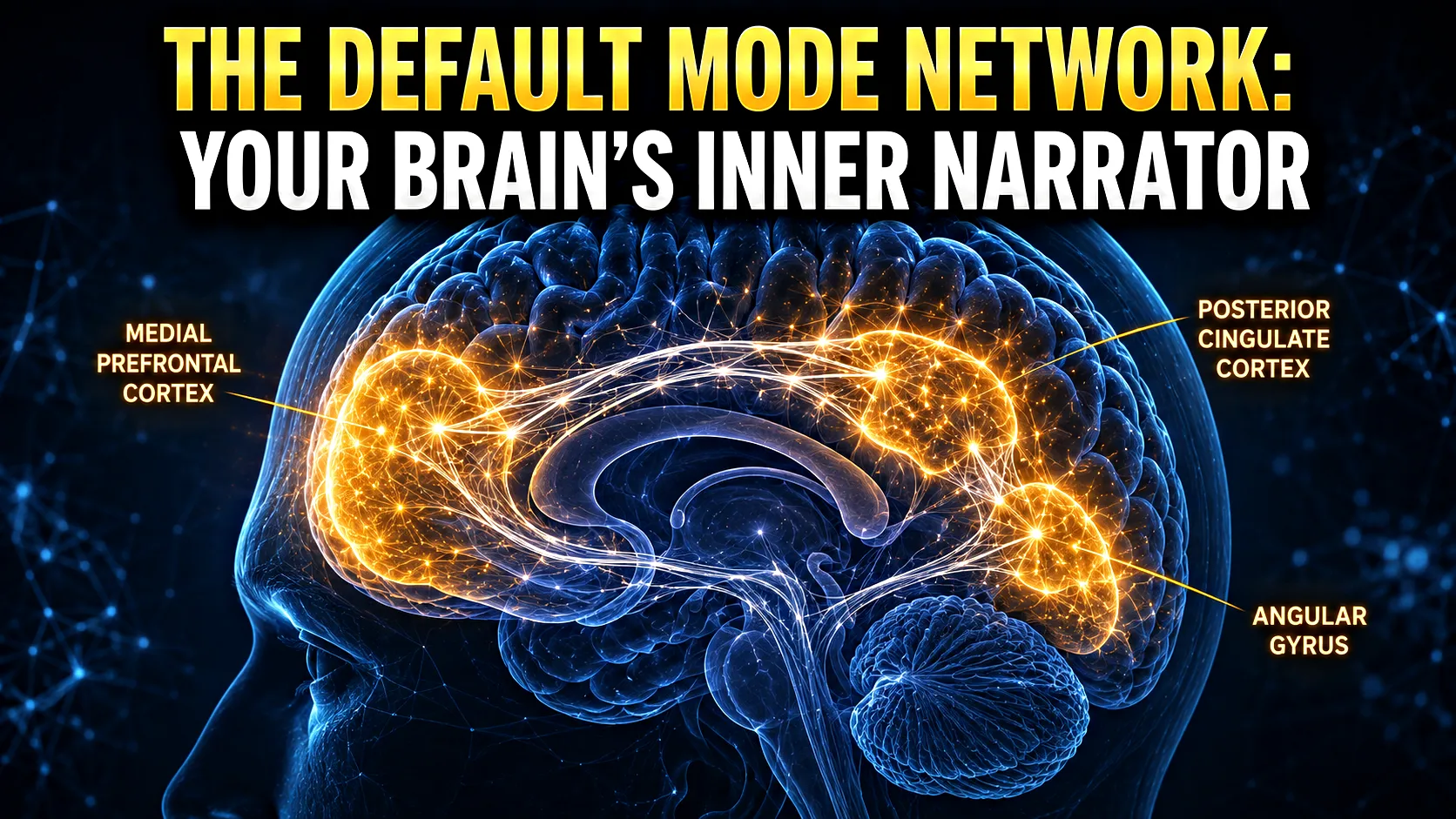
Most people have never heard of the Default Mode Network. Almost everyone has experienced it. It is the mental activity that fills the space between focused tasks: the inner conversation that runs when you are not actively engaged with the external world, the memories that surface unbidden in quiet moments, the rumination that replays a painful interaction from three years ago, the voice that offers a running commentary on everything you do and whether it is good enough. It is the brain’s internal narrator, and it is the system most directly responsible for the story you tell about who you are. Understanding it changes how you understand yourself, your patterns, and why changing them requires more than willpower or positive thinking.
The Default Mode Network was discovered through what was initially considered a nuisance in brain imaging research. In the early days of functional MRI studies in the 1990s, researchers noticed that certain brain regions consistently became more active during the rest periods between tasks rather than less. They expected the brain to quiet down when not performing a specific task. Instead, specific regions reliably increased their activity when participants were simply resting and left to their own thoughts. Marcus Raichle, neurologist at Washington University in St. Louis, formally described and named this as the brain’s default mode of function in a landmark 2001 paper in the Proceedings of the National Academy of Sciences. Two decades of subsequent research have established the Default Mode Network as arguably the most consequential brain system for understanding human identity, self-concept, limiting beliefs, and the specific way that changing deeply held patterns about the self requires approaches that reach this system directly.
In my Reiki teaching practice, the DMN is the neuroscience concept I share with students who want to understand at the deepest level why their inner experience is structured the way it is, and why the same patterns keep returning. This article gives you the complete picture: what the DMN is, what it does, how its dysfunction produces the specific experiences of rumination and self-limiting narrative, and what practices, including meditation and Reiki healing, have been documented to genuinely modulate its activity.
Table of Contents
What the Default Mode Network Actually Is
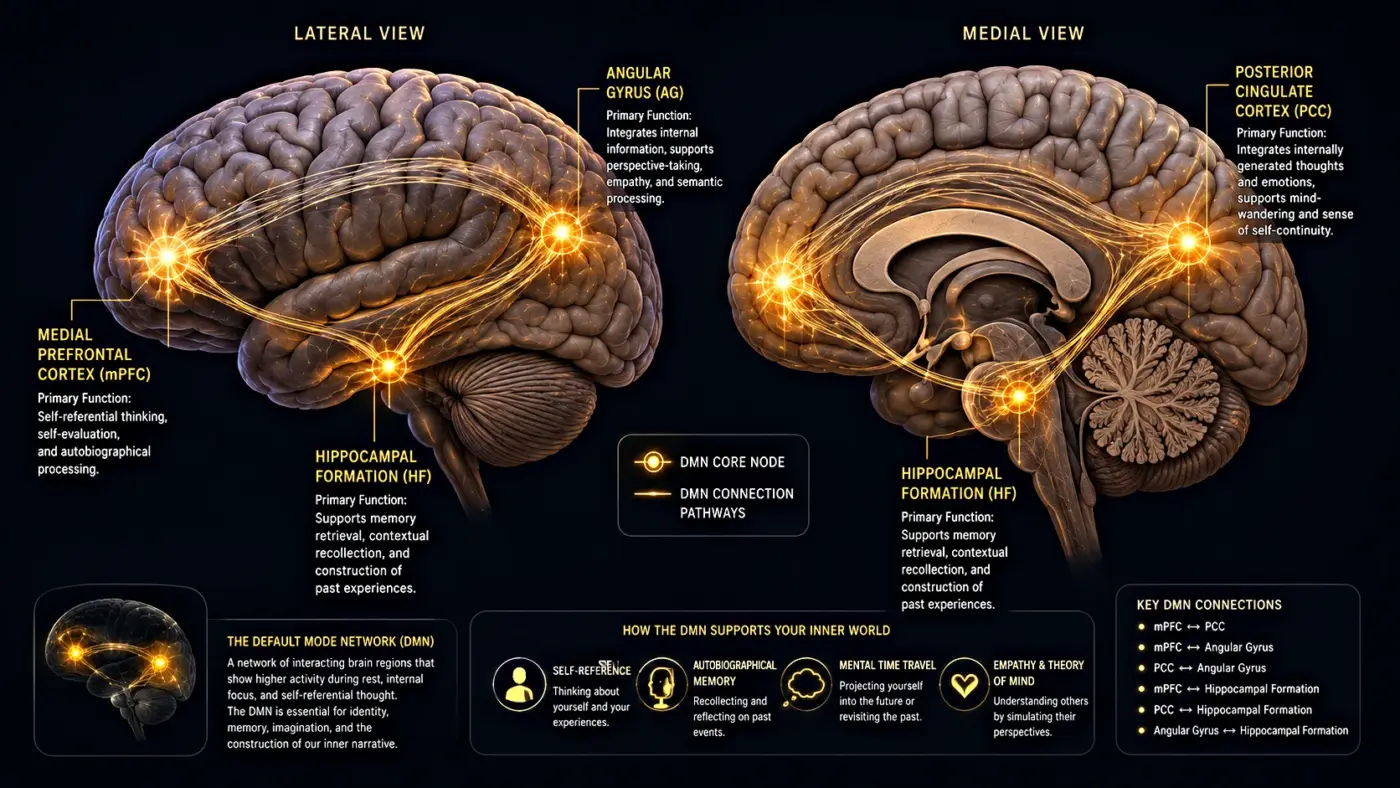
The Default Mode Network is not a single brain region. It is a collection of anatomically distinct but functionally synchronized brain regions that consistently activate together during rest and internally directed cognitive states, and that deactivate together during externally focused, attentionally demanding tasks. The network includes several primary nodes whose specific functions have been mapped through decades of neuroimaging research.
The medial prefrontal cortex (mPFC) occupies the center of the DMN and is most directly associated with self-referential processing: thinking about oneself, evaluating personal traits and experiences, and constructing the narrative sense of “I.” A July 2024 study published in the Journal of Neuroscience established that higher-level representations of the self are constructed in the mPFC through integration of information from various cortical areas, and that the DMN and limbic network are crucially involved in encoding and evaluating information relevant to the self.
The posterior cingulate cortex (PCC) acts as a major hub of the DMN, with research published in Neuron’s 2023 twenty-year DMN review by Vinod Menon at Stanford University describing it as playing a central role in self-related processes driven by PCC activity and moderated by mPFC. The PCC is particularly active during autobiographical memory retrieval and internally directed thought.
The angular gyrus and inferior parietal lobule integrate information about time, space, and self, allowing the DMN to place the self within autobiographical context. The hippocampal formation, which connects to the DMN through the medial temporal lobe subsystem, provides the episodic memory content that the DMN’s narrative function draws on.
An April 2025 comprehensive review published in MDPI Biology, covering DMN research from infancy to adulthood, described the network’s essential function succinctly: it is crucial for self-reflection, emotional processing, social interaction, and mental exploration. It becomes active when the brain is not engaged with external demands and turns inward toward its own contents.
What the DMN Does: The Four Primary Functions
Understanding what the DMN actually does, specifically and precisely, is the prerequisite for understanding why it matters so profoundly for personal development, manifestation work, and inner healing.
Function 1: Constructing the Self-Narrative
The DMN’s most consequential function is the construction and maintenance of what researchers call the autobiographical self: the ongoing narrative that integrates past experience, present self-concept, and anticipated future into a coherent sense of identity. Vinod Menon’s 2023 Neuron review described the DMN as a system that “integrates and broadcasts memory, language, and semantic representations to create a coherent internal narrative.” This internal narrative is not neutral documentation of experience. It is an interpretive framework that selects, organizes, and presents experience in ways consistent with the established self-concept.
The critical insight is this: the DMN’s narrative function is conservative by design. Its job is to maintain a coherent, stable sense of self across time. This means it preferentially retrieves memories, generates thoughts, and interprets incoming experience in ways that are consistent with the established self-concept. If the established self-concept includes beliefs such as “I am not creative,” “I am not good with money,” or “I am someone things happen to rather than someone who makes things happen,” the DMN’s narrative function will consistently surface memories, generate spontaneous thoughts, and frame new experiences in ways that confirm and reinforce those beliefs. Not because you are choosing to dwell in negativity, but because the DMN is performing its primary function of maintaining narrative coherence around the established self-concept.
Function 2: Autobiographical Memory Retrieval and Future Simulation
The DMN governs access to autobiographical memory, the personally experienced events that form the experiential basis of self-knowledge. Research documented in the 2021 Nature Reviews Neuroscience paper “The Default Mode Network: Where the Idiosyncratic Self Meets the Shared Social World” established that memory for both the past and the future activates the DMN and shapes its connectivity. Thinking about past experiences and imagining future events both engage the same DMN architecture, which is why autobiographical memory and future-oriented visualization use overlapping brain systems.
For manifestation practice, this overlap is directly relevant: the future you imagine during visualization is processed through the same DMN system that holds your autobiographical self-narrative. If the autobiographical self-narrative is organized around a limiting self-concept, the DMN’s future simulation will systematically distort or undermine future-oriented visualization toward outcomes consistent with the established narrative rather than the intended new one. The person practicing visualization is using the DMN to simulate a desired future, but the DMN is running that simulation through the filter of the established self-story. Only when the self-narrative changes does the future simulation become fully available to the desired content.
Function 3: Social Cognition and Theory of Mind
The DMN is extensively involved in thinking about other people, their beliefs, intentions, and perspectives, what researchers call theory of mind. The 2021 Nature Reviews Neuroscience paper documented that thinking about other people activates the DMN, not only during rest but also while engaged with other social agents in real-world interaction. The DMN is the brain system through which we model other minds, interpret social signals, and construct our understanding of our place in relational contexts.
This function of the DMN is relevant to the specific kind of limiting beliefs most common in people who seek inner healing: beliefs about how others perceive them, whether they belong, whether they are welcome and wanted in social and professional contexts. These are DMN-level beliefs about the self in relation to others, and they are among the most resistant to change precisely because the DMN processes and reinforces them automatically during every moment of social rest and reflection.
Function 4: Mind Wandering and the Rumination Loop
Mind wandering, the spontaneous generation of thought during periods of reduced external focus, is one of the cognitive functions most directly associated with the DMN. Research from multiple neuroimaging studies has confirmed that the DMN is the primary generator of the stream of consciousness that fills moments of reduced external engagement.
When mind wandering is dominated by negative self-referential content, it produces what clinical psychology calls rumination: the repetitive, unproductive cycling of thought around past difficulties, personal failures, and anticipated future problems. A 2023 study published in Social Cognitive and Affective Neuroscience by researchers at Harvard University and Massachusetts General Hospital found that individuals at risk for depression showed greater DMN activation, specifically in the medial prefrontal cortex and inferior parietal lobule, when processing negative self-referential information, with PCC and mPFC activation specifically associated with rumination tendency. Rumination is not a character flaw or a habit of lazy thinking. It is the DMN doing what it is designed to do when its self-narrative architecture is organized around negative self-concept: generating and recycling the thoughts most consistent with the established self-story.
DMN Hyperconnectivity: When the Autopilot Takes Over
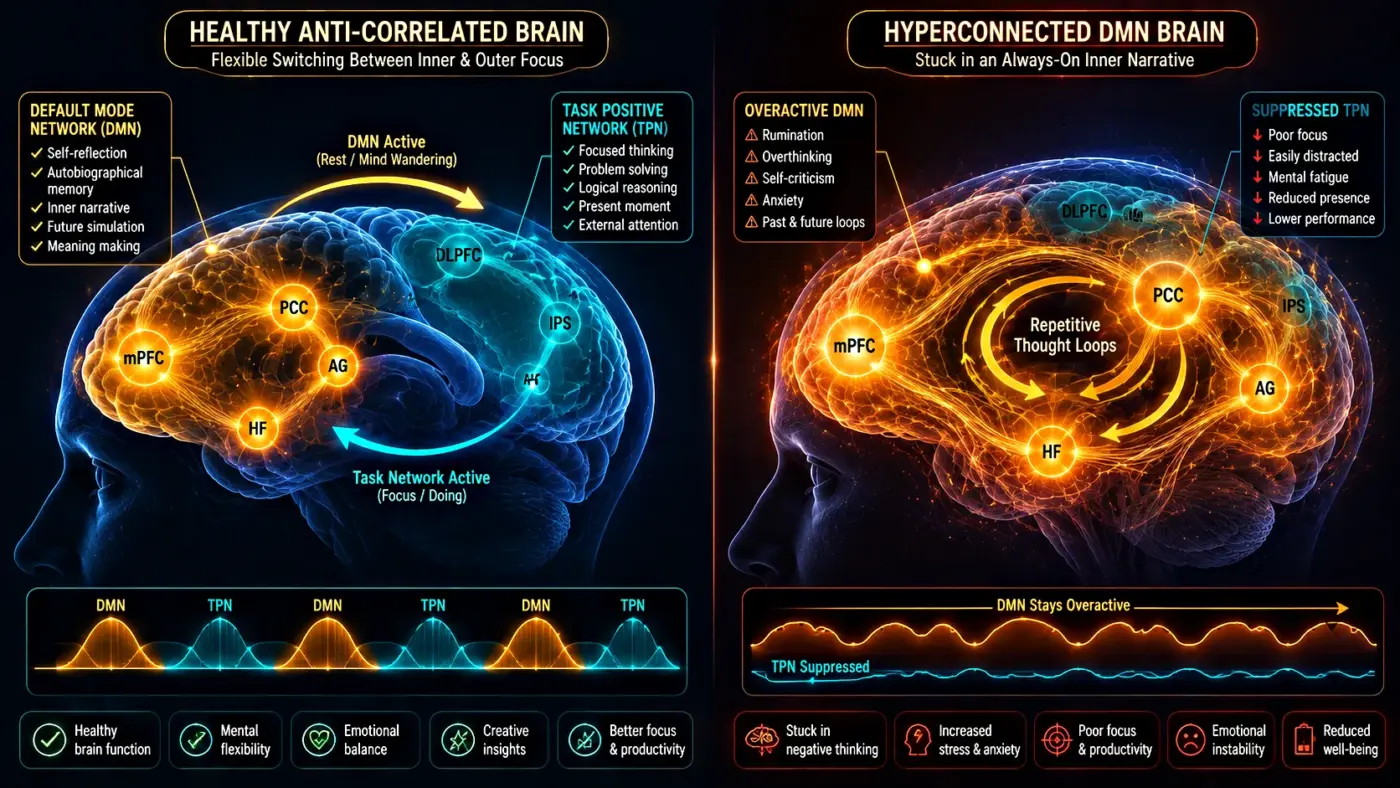
In neurologically typical people, the DMN and the Task Positive Network, the brain system responsible for focused external attention, operate in an anti-correlated relationship. When one is active, the other tends to be suppressed. When you focus deeply on an external task, the DMN quiets. When your external focus relaxes, the DMN reactivates. This dynamic switching is healthy and functional.
In individuals with depression, anxiety, and certain trauma patterns, this anti-correlation breaks down. Research documented in a January 2025 paper published in Biological Psychiatry: Cognitive Neuroscience and Neuroimaging found that the DMN is intricately linked with self-referential thinking, episodic memory recall, and goal-directed cognition, and that altered DMN functional connectivity is associated with cognitive impairment across multiple diagnostic categories. A February 2025 paper in Premier Science described DMN hyperconnectivity, particularly in the subgenual anterior cingulate cortex, as sustaining ruminative thought patterns and emotional distress in major depressive disorder and anxiety.
When the DMN is hyperconnected, it breaks through into conscious awareness even during tasks that should suppress it. The person trying to focus on work finds themselves repeatedly pulled into self-referential rumination. The person attempting visualization or meditation finds the DMN’s habitual self-narrative flooding the practice with counter-content. The inner critic does not quiet down when asked to. It is running on a system whose suppression mechanism has been compromised by chronic stress, depression, or trauma, and it will continue running until the underlying system is addressed.
What Changes the DMN: The Evidence-Based Approaches
The question that matters practically is not just what the DMN is but what genuinely modulates it. The research offers specific, evidence-based answers that connect directly to the practices discussed throughout this site.
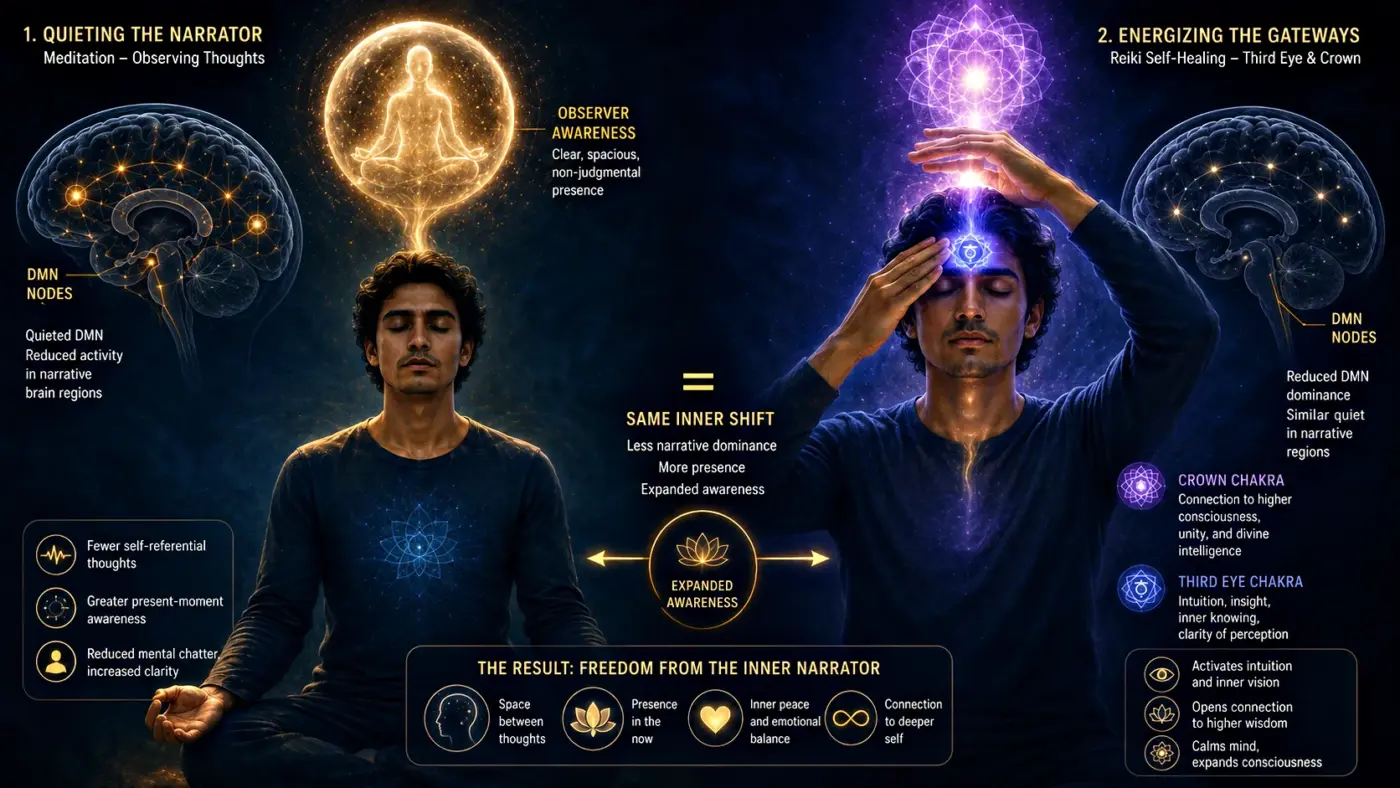
Mindfulness Meditation and DMN Deactivation
The most extensively documented approach to DMN modulation is mindfulness meditation. Neuroimaging research consistently finds that experienced meditators show reduced DMN activity during meditation compared to non-meditators, and that regular meditation practice produces lasting changes in DMN functional connectivity at rest. The 2025 Premier Science paper specifically documented that mindfulness-based neurofeedback produces measurable benefits in regulating DMN activity, reducing hyperconnectivity in the subgenual anterior cingulate cortex associated with rumination.
The mechanism is understood: mindfulness meditation trains the practitioner to notice when the DMN’s self-referential narrative is generating content and to disengage from it without suppressing it, which over consistent practice weakens the automatic capture that the DMN’s habitual narratives exert over attention. The person becomes increasingly able to observe the DMN’s self-story rather than inhabiting it as though it were unquestionable reality. This observer distance is itself a transformation of the self-narrative’s power, even before the narrative content changes.
Reiki Healing and DMN States
From the Reiki and energy healing framework, the DMN’s function connects directly to what practitioners describe as the quality of the internal field during a healing session. A Reiki self-healing session conducted with genuine unhurried presence and internal stillness produces states that experientially parallel what neuroscience describes as reduced DMN narrative dominance: a quality of awareness that is present and quietly observant rather than caught in the stream of self-referential thought.
The specific Reiki healing centers most relevant to DMN-level self-concept work are the Third Eye Chakra, which governs the clarity and quality of inner perception and the inner narrative, and the Crown Chakra, which governs the connection to a sense of identity larger than the personal self-story. When these centers carry energetic blocks, the inner narrative tends toward contraction, rigidity, and the self-limiting quality that the DMN produces when organized around limiting beliefs. Reiki healing directed to these centers, with the explicit intention of releasing the contracted self-story and opening to a more expanded sense of identity, addresses the energetic dimension of what mindfulness meditation addresses at the cognitive level.
In my teaching practice, I have observed that students who maintain a consistent Reiki self-healing practice report a gradual but tangible change in the quality of their inner narrator over months: a progressive loosening of the automatic self-critical and self-limiting quality of the DMN’s habitual content, accompanied by the emergence of a quality of inner spaciousness that creates room for new self-narrative to form. This is the energetic correlate of what neuroscience documents as reduced DMN hyperconnectivity through meditation practice.
Psychedelic Research and DMN Disruption
Among the most striking recent research on DMN modulation is the body of work on psilocybin and related psychedelic compounds, which produce their characteristic effects largely through a dramatic and temporary reduction of DMN functional connectivity. Research published in multiple peer-reviewed journals has documented that psilocybin disrupts the DMN’s self-referential narrative processing, producing what researchers describe as ego dissolution and what participants often experience as a profound loosening of the fixed self-story. The therapeutic effects of psilocybin on depression and trauma, documented in multiple clinical trials, are now understood to be substantially mediated through this temporary DMN disruption, which appears to create a window of increased neural plasticity during which new self-narrative patterns can form.
This research is mentioned not as a recommendation but as scientific evidence that the DMN’s self-referential narrative is the central target of some of the most clinically effective treatments for depression, trauma, and rigid limiting beliefs currently being studied. It confirms that the DMN is where the limiting self-story lives, and that shifting it requires approaches that genuinely alter its activity rather than simply arguing with its content.
The DMN and Manifestation: The Connection That Explains Everything
For anyone working with manifestation principles, the DMN is the system that most directly explains both why manifestation works when it works and why it fails when it fails. The desired future that manifestation practice is designed to produce must, to become genuinely available to the person, be compatible with the self-narrative that the DMN maintains. A desired future that contradicts the DMN’s established self-story will be consistently undermined by the same system that is being asked to help generate it.
The person who visualizes financial abundance while their DMN is generating a self-narrative of “someone who struggles with money” is not simply dealing with a negative thought they can choose to dismiss. They are dealing with the output of a coherent brain system that is running its established program as designed. The visualization practice runs on top of the DMN’s self-narrative rather than through it, which is why it often produces hope and inspiration in the moment but limited lasting change in the pattern.
What produces lasting change is the combination of practices that address the DMN’s self-narrative directly: sustained mindfulness or Reiki self-healing practice that reduces the DMN’s narrative dominance and creates the observer distance from which new narrative can be considered, theta-state practices including SATS that install new belief content during the brain’s most receptive window, and energy healing work that addresses the energetic dimension of the self-concept held in the chakra system. Each approach addresses a different dimension of the same system. Together, they produce the kind of genuine, durable shift in self-narrative that manifestation requires at its foundation.
Disclaimer: The information in this article is intended for educational purposes only and does not constitute medical advice. Reiki and energy healing are complementary practices and are not a substitute for professional medical treatment. Always consult a qualified healthcare professional for medical concerns.
Frequently Asked Questions
What is the Default Mode Network and what does it do?
The Default Mode Network is a collection of brain regions including the medial prefrontal cortex, posterior cingulate cortex, angular gyrus, and hippocampal formation that consistently activate together during rest and internally directed thought, and deactivate during externally focused tasks. It was formally described by Marcus Raichle at Washington University in a landmark 2001 PNAS paper and has been studied extensively since. Its primary functions include constructing and maintaining the autobiographical self-narrative, retrieving episodic memory and simulating future scenarios, social cognition and theory of mind, and generating the stream of spontaneous thought known as mind wandering. A July 2024 Journal of Neuroscience study confirmed that the DMN and limbic network play a crucial role in encoding and evaluating self-referential information, with higher-level representations of the self constructed in the medial prefrontal cortex.
How does the Default Mode Network relate to limiting beliefs?
The Default Mode Network is the primary brain system responsible for maintaining the self-narrative, the ongoing story about who you are and what is possible for someone like you. Research by Vinod Menon at Stanford University, published in Neuron’s 2023 twenty-year review, described the DMN as integrating memory, language, and semantic representations to create a coherent internal narrative. Because the DMN’s function is to maintain narrative coherence around the established self-concept, it preferentially retrieves memories, generates spontaneous thoughts, and frames new experiences in ways consistent with existing self-beliefs. Limiting beliefs are not simply thoughts the person is choosing to think. They are the DMN’s established narrative running its program automatically, which is why changing them requires approaches that reach the DMN’s self-narrative directly rather than simply arguing with its content at the conscious level.
What is DMN hyperconnectivity and how does it cause rumination?
In neurologically typical people, the Default Mode Network and the Task Positive Network operate in an anti-correlated relationship: when one is active, the other tends to be suppressed. DMN hyperconnectivity occurs when this anti-correlation breaks down, allowing the DMN’s self-referential narrative to break through into awareness even during tasks that should suppress it. A February 2025 paper in Premier Science documented that DMN hyperconnectivity, particularly in the subgenual anterior cingulate cortex, sustains ruminative thought patterns and emotional distress in depression and anxiety. A 2023 study at Harvard University and Massachusetts General Hospital found that individuals at risk for depression showed greater mPFC and inferior parietal lobule activation during negative self-referential processing, with this activation correlated with rumination tendency. Rumination is the DMN’s habitual negative self-narrative running without effective suppression.
How do meditation and Reiki healing affect the Default Mode Network?
Mindfulness meditation is the most extensively documented approach to DMN modulation. Neuroimaging research consistently finds reduced DMN activity during meditation in experienced practitioners, and the 2025 Premier Science paper documented that mindfulness-based neurofeedback produces measurable reductions in DMN hyperconnectivity associated with rumination. The mechanism involves training the practitioner to notice DMN narrative content and disengage from it without suppression, which over consistent practice reduces the automatic capture that habitual self-narrative exerts over attention. Reiki self-healing addresses the DMN’s corresponding dimension in the energy body: the Third Eye Chakra governs the quality and clarity of inner narrative and perception, and the Crown Chakra governs identity beyond the personal self-story. Consistent Reiki healing directed to these centers, combined with meditation practice, addresses both the energetic and neurological dimensions of the DMN’s self-narrative simultaneously.