

Of all seven chakras, the third eye is the one students approach with the most curiosity and, often, the most confusion. Many arrive expecting something dramatic, visions, psychic powers, or a sudden mystical awakening. In my years of practice, I have found the real value of this chakra to be quieter and far more useful in daily life, a clearer connection to your own intuition and the ability to see a situation accurately, without the distortion of fear, wishful thinking, or other people’s opinions clouding your judgment.
In this guide I will walk you through everything I teach about the third eye chakra, called Ajna in Sanskrit, including its location, the well documented connection to your pituitary gland, the signs of imbalance I see most often, and the specific practices that genuinely help sharpen intuition and inner clarity.
Table of Contents
What Is the Third Eye Chakra
Ajna translates from Sanskrit as command or perceive, and it is located at the center of the forehead, slightly above and between the eyebrows, the sixth of the seven primary chakras. Its color is indigo, its bija mantra is OM, and it is closely associated with the element of light, reflecting its role as the center through which inner perception and clarity become possible.
The third eye chakra governs intuition, insight, and your capacity to perceive truth clearly, both about the world around you and about yourself. In my practice, I describe this chakra as your internal command center, the part of you responsible for cutting through confusion and seeing a situation as it actually is, rather than as fear or wishful thinking would prefer it to be.
The Third Eye Chakra and the Pituitary Gland
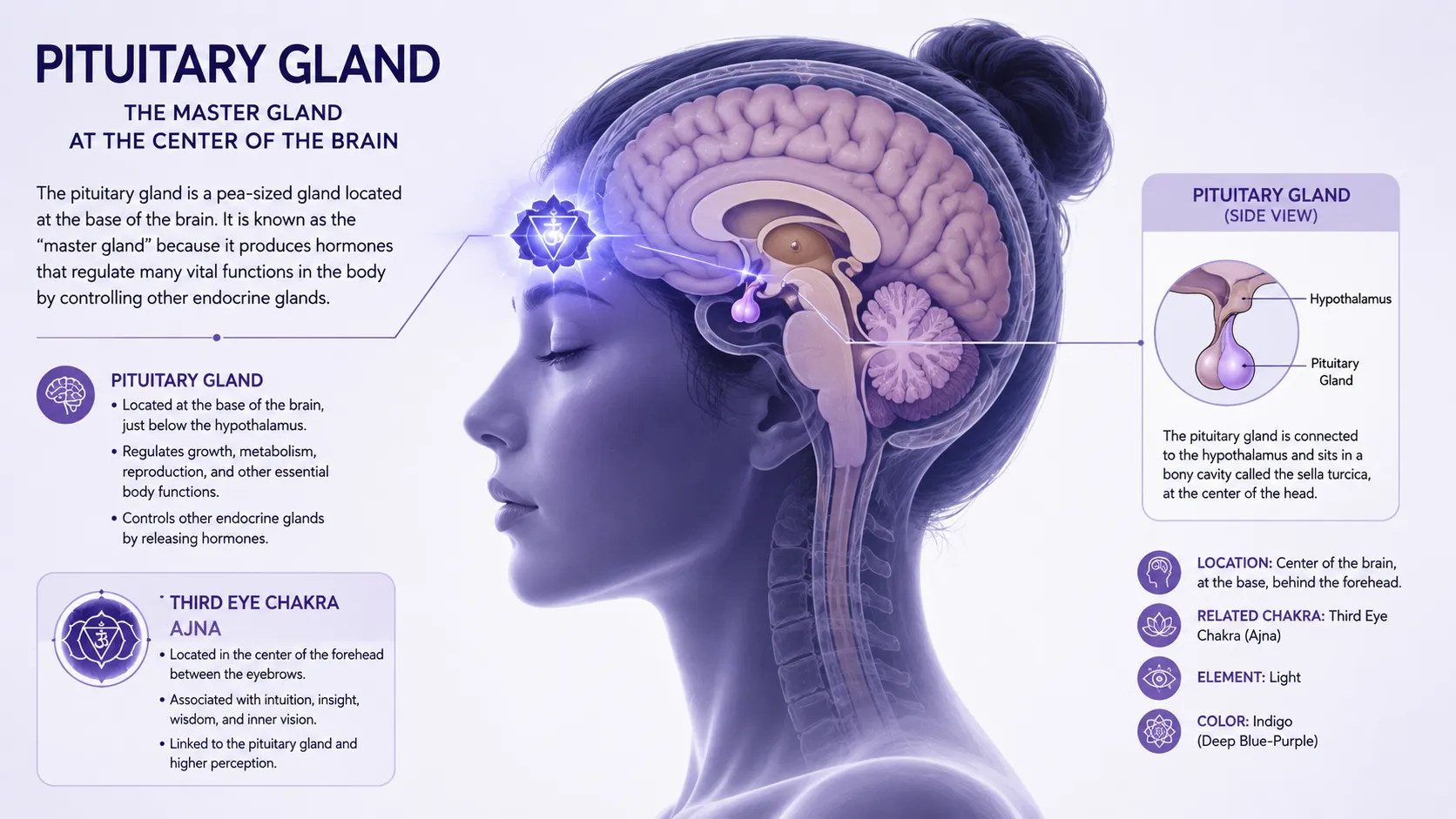
This is the anatomical correlation I find most compelling among all seven chakras, because the functional parallel is genuinely precise. The third eye chakra is traditionally associated with the pituitary gland, a pea sized structure located near the center of the brain, almost exactly in the location traditional teaching assigns to Ajna. The pituitary is often called the master gland, because it regulates nearly every other hormone producing gland in the body, including the thyroid, adrenals, and reproductive glands, by releasing hormones that direct their activity.
What I find remarkable is how closely this master regulatory function mirrors the traditional description of Ajna as a command center. Long before endocrinology identified the pituitary’s role in directing the entire hormonal system, yogic teaching had already placed a center of command and perception at this exact anatomical location. The pituitary also plays a role in your body’s photoreceptive system, responding indirectly to light cycles, which connects meaningfully to this chakra’s traditional association with the element of light and inner vision.
I want to be precise here, because there is some variation across traditions and modern writers about whether the third eye chakra is associated with the pituitary gland, the pineal gland, or both. In my own teaching, I follow the framework that places the pituitary at the third eye chakra, given its master regulatory function and its precise anatomical location, while the pineal gland, which produces melatonin and governs your sleep cycle, is more commonly associated with the crown chakra above it.
Some practitioners and researchers describe both glands as working together within this region, and I think that is a fair characterization. The exact correspondence is less important than understanding that this part of the brain governs both literal physiological regulation and the traditional seat of intuitive perception.
Signs of a Blocked or Imbalanced Third Eye Chakra
In my experience, third eye chakra imbalance tends to show up as a disruption in how clearly a person perceives themselves and their circumstances.
Signs of an Underactive Third Eye Chakra
- Persistent confusion or difficulty seeing a situation clearly
- Distrust of your own intuition, even when your gut instinct is sending clear signals
- Overreliance on pure logic, dismissing intuitive insight as unreliable
- Difficulty visualizing or imagining future possibilities
- Frequent headaches concentrated in the forehead area
Signs of an Overactive Third Eye Chakra
- Excessive overthinking or getting lost in abstract ideas disconnected from practical reality
- Difficulty concentrating on everyday tasks
- A tendency toward delusion or difficulty distinguishing intuition from anxiety driven imagination
- Disconnection from your physical body and immediate surroundings
Students often ask me how to tell the difference between genuine intuition and ordinary anxiety, since both can feel like a strong, urgent inner signal. In my experience, the distinction usually comes down to quality. Anxiety tends to feel frantic, repetitive, and tied to worst case scenarios. Genuine intuition tends to feel calm, clear, and often arrives as a single quiet knowing rather than a spiraling stream of fearful thoughts. Learning to recognize this difference is, in itself, a core part of third eye chakra development.
What Causes a Blocked Third Eye Chakra
A handful of patterns show up consistently when I trace third eye chakra imbalance back to its root with students.
Being repeatedly told your perceptions were wrong. Students who grew up in environments where their intuition or perception of events was consistently dismissed or contradicted by authority figures often develop a long lasting distrust of their own inner knowing, well into adulthood.
Over reliance on external validation for decisions. Years spent looking to other people, data, or outside authority for every decision, rather than developing trust in your own internal sense of clarity, gradually weakens this chakra’s natural function.
Information overload and constant distraction. Modern life’s relentless stream of notifications, opinions, and competing information makes it genuinely difficult to hear your own quiet intuitive signal, which tends to require stillness and sustained attention to register clearly.
Sleep disruption. Because this chakra’s region of the brain is closely tied to your broader sleep wake regulation system, chronic sleep deprivation tends to directly impair the mental clarity and perceptual sharpness associated with a healthy third eye chakra.
How to Heal and Balance Your Third Eye Chakra
The third eye chakra responds particularly well to practices involving stillness, visualization, and intentional reduction of external mental noise.
Third Eye Meditation
Sit comfortably with your eyes closed and bring your attention to the point between your eyebrows. Visualize a soft indigo light glowing steadily at this point. Resist the urge to force any particular experience or vision. The goal of this practice is simply sustained, quiet attention, not dramatic perceptual events.
Trataka, or Candle Gazing
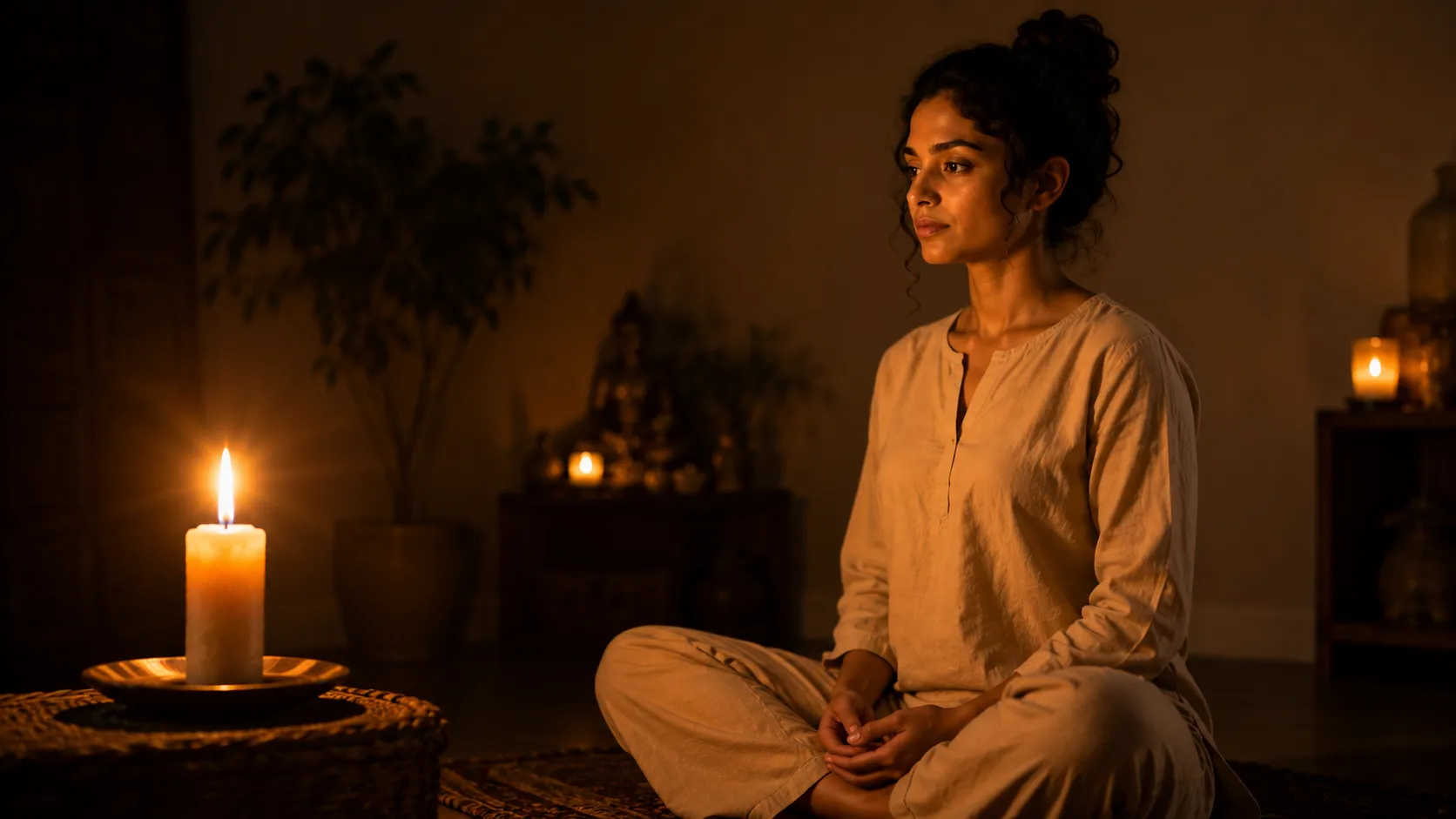
This traditional practice involves gently gazing at a candle flame for several minutes, then closing your eyes and holding the afterimage in your mind’s eye. Trataka is one of the most widely taught practices specifically associated with third eye chakra development, since it trains sustained, focused attention, the same quality genuine intuitive perception depends on.
Journaling Without Editing
I often recommend a simple practice of free writing for several minutes without pausing to edit or judge what comes out. This bypasses the analytical mind enough that intuitive insight, which tends to be quieter and easily overridden by logical second guessing, has a better chance of surfacing onto the page.
Digital Stillness
Given how directly information overload interferes with third eye chakra clarity, I recommend students build in regular periods of genuine digital disconnection, even briefly, since constant external input makes it nearly impossible to register the quieter internal signals this chakra depends on.
Bija Mantra Chanting
The seed sound associated with the third eye chakra is OM, sometimes given as KSHAM depending on tradition. Chanting this sound during meditation supports focused attention at the point between the eyebrows.
Reiki and Hands On Energy Work
In my own sessions, third eye work often involves placing the hands gently near the forehead while the student rests in stillness. I have found this particularly useful for students facing a significant decision, since direct energetic focus here tends to support a clearer, calmer perspective when clarity matters most.
Disclaimer: The information in this article is intended for educational purposes only and does not constitute medical advice. Reiki and energy healing are complementary practices and are not a substitute for professional medical treatment. Always consult a qualified healthcare professional for persistent headaches, sleep disorders, or hormonal concerns.
Intuition Versus Wishful Thinking
I want to spend extra time on this distinction, because it is one of the most common points of confusion I encounter in third eye chakra work, and getting it wrong can genuinely mislead a person’s decisions. Intuition, in the way I teach it, is not the same as simply wanting something to be true. Genuine intuitive insight tends to arrive independent of what you hope will happen, sometimes even pointing toward an outcome you would rather avoid.
Wishful thinking, by contrast, almost always aligns conveniently with what you already want. If your inner sense consistently tells you exactly what you were hoping to hear, that is worth examining honestly, since it may be desire wearing the costume of intuition rather than authentic perceptual clarity. In my own practice, I encourage students to notice this distinction specifically around major decisions, relationships, career moves, financial choices, since this is precisely where the temptation to confuse the two is strongest, and where the cost of confusing them tends to be highest.
Third Eye Chakra Work at Major Life Decisions
I want to spend extra time here, because this is where third eye chakra clarity matters most practically. In my experience, the moments when people most need a clear, undistorted connection to their own perception are precisely the moments when that connection becomes hardest to access, major career decisions, choosing whether to stay in or leave a relationship, significant financial choices, or any situation involving genuine uncertainty about the right path forward.
I have noticed that students under significant stress almost universally describe their thinking as foggy or scattered during exactly the decisions that most need clarity. This is not a coincidence. Stress hormones genuinely impair the kind of calm, sustained attention that intuitive clarity depends on, which means the third eye chakra is, in a very real sense, working against unfavorable physiological conditions during precisely the moments it is needed most.
This is part of why I almost always recommend that students facing a major decision build in deliberate stillness before attempting to access genuine clarity, even a single day of reduced input and quiet reflection, rather than trying to think their way to an answer in the middle of the same chaotic mental environment that created the confusion in the first place. Clarity rarely arrives by pushing harder. It tends to arrive once the noise quiets down enough for it to be heard.
The Third Eye Chakra and Dreams
One area I find genuinely fascinating, and one that comes up often in my practice, is the relationship between third eye chakra health and dream recall and clarity. Many students notice that as they deepen their meditation practice and third eye chakra work generally, their dreams become more vivid, more memorable, and occasionally more clearly symbolic or insightful.
I want to be careful here not to overstate this connection as scientifically proven, since dream research remains a genuinely complex and incompletely understood field. What I can say from years of direct observation with students is that this pattern shows up consistently enough that I consider dream journaling a useful, low effort complement to more active third eye chakra practices. Simply keeping a notebook by your bed and recording dreams immediately upon waking, before the details fade, tends to gradually sharpen both dream recall and a person’s general sense of intuitive clarity during waking hours as well.
Frequently Asked Questions
What gland is connected to the third eye chakra
The third eye chakra is traditionally associated with the pituitary gland, often called the master gland because it regulates nearly every other hormone producing gland in the body. Some traditions also reference the nearby pineal gland in connection with this chakra.
How do you tell the difference between intuition and anxiety
Intuition tends to feel calm and clear, often arriving as a single quiet knowing, while anxiety tends to feel frantic, repetitive, and focused on worst case scenarios. Learning to distinguish between the two is a core part of third eye chakra development.
What is the bija mantra for the third eye chakra
The bija, or seed mantra, for the third eye chakra is OM, though some traditions use KSHAM. Chanting this sound during meditation supports focused attention at the point between the eyebrows.
Can sleep deprivation affect the third eye chakra
Yes. Chronic sleep deprivation can impair the mental clarity and perceptual sharpness traditionally associated with a healthy third eye chakra, since this region of the brain is closely tied to the body’s broader sleep wake regulation system.
Related Guides
- Throat Chakra Vishuddha: Complete Guide to Voice and Truth
- Heart Chakra Anahata: Complete Guide to Love and Connection
- Solar Plexus Chakra Manipura: Guide to Confidence and Power
- Sacral Chakra Svadhisthana: Guide to Creativity and Emotion
- Root Chakra Muladhara: Complete Guide to Grounding and Safety
- The 7 Chakras Explained: Complete Guide to Energy Centers