
In more than a decade of teaching Reiki, I have noticed a pattern that almost never fails. When a student tells me they feel anxious for no clear reason, financially insecure even when their numbers are fine on paper, or simply unable to relax in their own body, the root chakra is almost always the place we need to start. It is the foundation every other chakra builds on, and when it is unstable, everything above it tends to wobble too.
In this guide I am going to walk you through everything I teach my own students about the root chakra, called Muladhara in Sanskrit. You will learn exactly where it sits, what it governs, the real signs of imbalance I see most often in practice, the documented connection to your adrenal glands and stress response, and the specific grounding techniques that actually work.
Table of Contents
What Is the Root Chakra
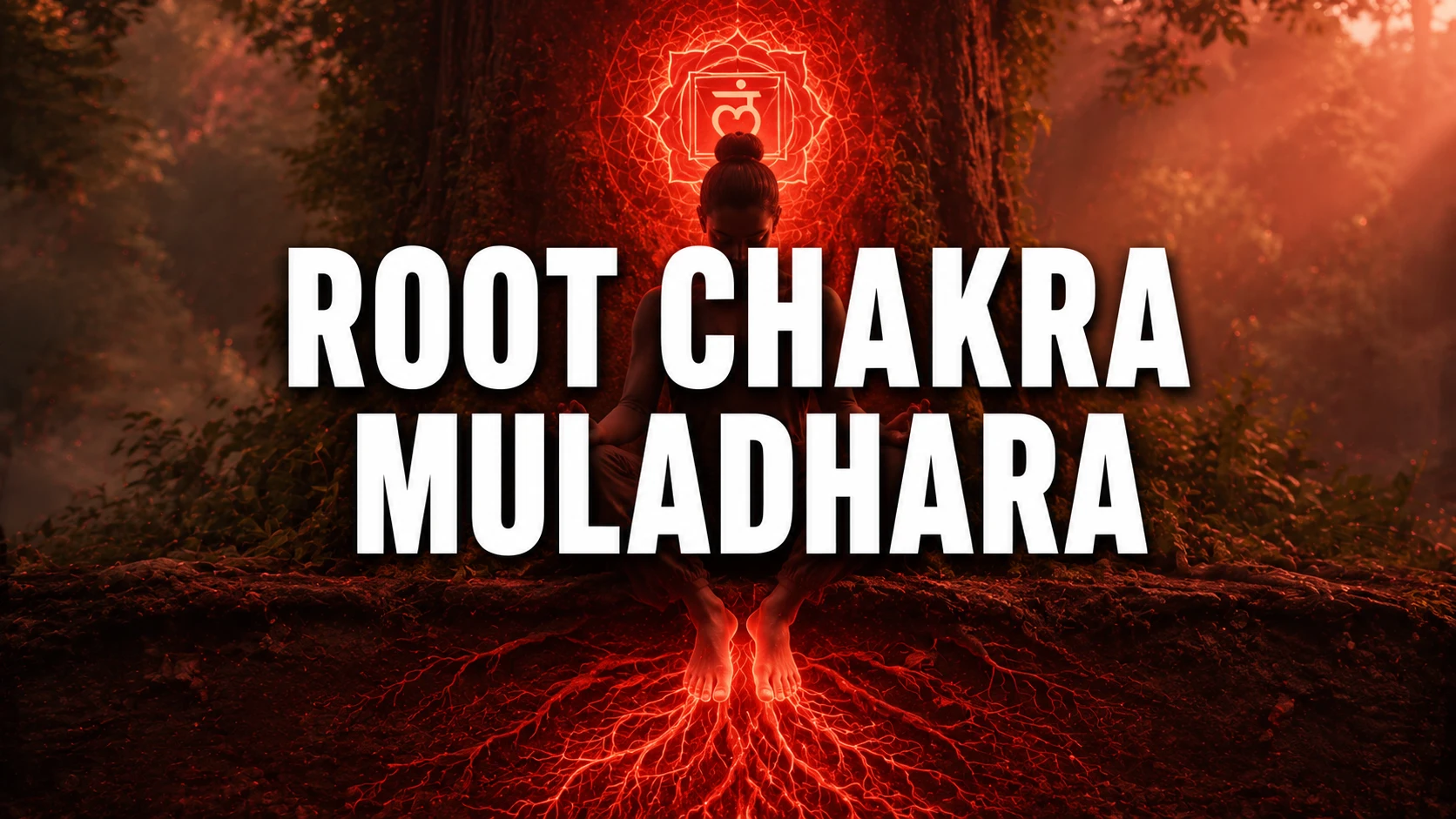
Muladhara translates from Sanskrit as root support, and that name describes its function precisely. Located at the base of the spine, at the perineum, the root chakra is the first of the seven primary energy centers and the foundation the other six are built upon. Its color is red, its bija mantra is LAM, and its element is earth.
The root chakra governs your basic sense of safety in the world. This includes physical safety, financial security, and a felt sense of belonging, whether to a family, a community, or simply to your own body. When this chakra is functioning well, you move through the world with a quiet confidence that your basic needs will be met. When it is disrupted, that confidence is replaced by a low grade hum of anxiety that can be hard to pin to any single cause.
The Root Chakra and Your Nervous System
This is the part of root chakra education I think deserves far more attention than it usually gets, because it transforms this from an abstract spiritual concept into something you can actually feel and verify in your own body.
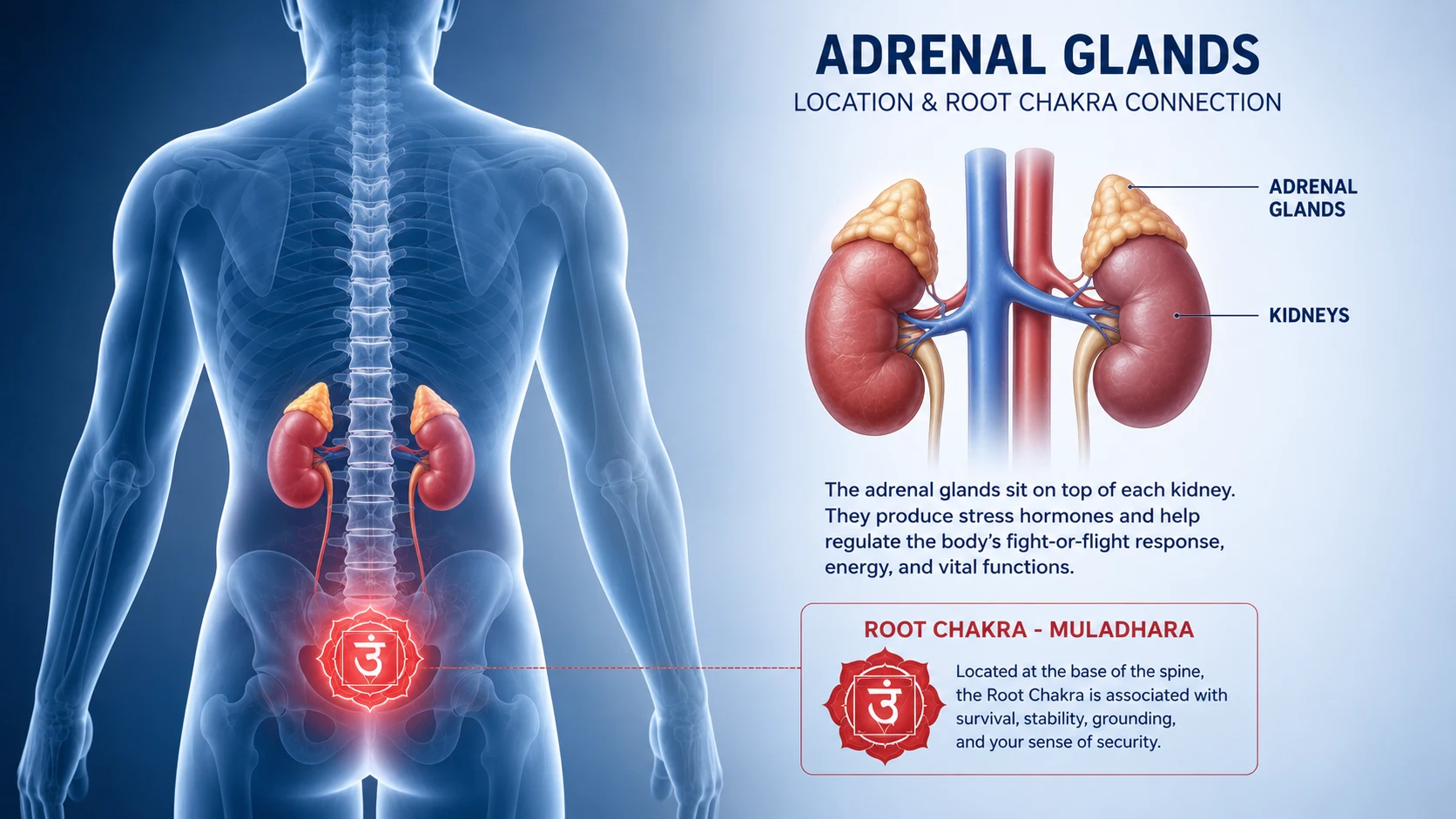
The root chakra is traditionally associated with the adrenal glands, two small glands that sit on top of each kidney. The adrenal medulla, the inner portion of these glands, is responsible for your immediate fight or flight response, releasing adrenaline the instant your nervous system perceives a threat. The adrenal cortex, the outer portion, releases cortisol, the hormone responsible for your body’s longer term response to ongoing stress, regulating blood sugar, blood pressure, and inflammation along the way.
When you are in genuine survival mode, whether that is a real physical threat or a prolonged period of financial stress, job insecurity, or relationship instability, your adrenal glands are working overtime. This is the physiological mechanism that traditional teachings were describing with the root chakra centuries before cortisol had a scientific name. In my own practice, I have found this connection to be one of the clearest examples of how ancient energetic mapping and modern physiology describe the same underlying experience using completely different language.
There is also a documented connection between root chakra grounding practices and what researchers in nervous system science call polyvagal theory, a framework describing how your vagus nerve regulates your shift between states of safety and states of threat. Grounding techniques, the same practices traditional teachings have used for centuries to stabilize Muladhara, are increasingly studied for their measurable effect on lowering cortisol and calming an overactive stress response.
I find it worth explaining the adrenal system in a bit more detail, because understanding the mechanism makes the root chakra concept far less abstract. The adrenal cortex produces three categories of hormones, cortisol for stress regulation, aldosterone for managing blood pressure and electrolyte balance, and small amounts of sex hormones including testosterone, estrogen, and progesterone. When someone lives in a prolonged state of perceived insecurity, whether the threat is real or rooted in old patterning, these systems stay engaged far longer than they were designed to.
Western medicine recognizes extreme dysfunction of these glands as distinct diseases, such as Cushing’s syndrome from excess cortisol or Addison’s disease from cortisol deficiency, but there is a wide middle ground of chronic low grade adrenal strain that does not rise to the level of diagnosable disease yet still significantly affects how a person feels day to day. In my experience, this middle ground is exactly where root chakra imbalance tends to live.
Signs of a Blocked or Imbalanced Root Chakra
In my experience working directly with students, root chakra imbalance tends to show up in fairly consistent patterns. I want to walk through both underactive and overactive presentations, because the root chakra can become disrupted in either direction.
Signs of an Underactive Root Chakra
- Chronic anxiety about money, even when your financial situation is objectively stable
- A persistent feeling of being ungrounded or disconnected from your physical body
- Difficulty trusting that your basic needs will be met
- Lower back pain, leg discomfort, or tension in the feet
- Restlessness or an inability to feel settled, even while resting
Signs of an Overactive Root Chakra
- Excessive hoarding of money or material possessions out of fear, rather than need
- Rigid resistance to change, even change that would clearly benefit you
- Overly materialistic focus, using possessions to compensate for a deeper sense of insecurity
- Physical tension that does not respond to typical relaxation techniques
Students often ask me how to tell the difference between an imbalanced root chakra and ordinary anxiety. In my experience, the distinction is rarely about the feeling itself, since anxiety is anxiety regardless of its root cause. The distinction is more about pattern and timing. Root chakra related anxiety tends to be persistent and only loosely tied to actual present day circumstances, often tracing back to early life experiences of instability, even when current circumstances are secure.
What Causes a Blocked Root Chakra
In my practice, a few patterns show up again and again when I trace a student’s root chakra imbalance back to its origin.
Early childhood instability. Growing up in a household with financial stress, frequent moves, family conflict, or inconsistent caregiving tends to imprint a deep, often unconscious sense that safety cannot be fully trusted. This is frequently the single most common root cause I encounter.
Major financial disruption. Job loss, business failure, or a significant financial setback as an adult can destabilize even a previously well grounded root chakra, particularly if the disruption happened suddenly or without warning.
Physical trauma or chronic illness. Because the root chakra governs your basic relationship to your physical body, any experience that disrupts your sense of bodily safety, including injury, illness, or surgery, can create a corresponding energetic disruption.
Prolonged disconnection from nature and physical movement. Modern life, with long hours spent indoors and disconnected from natural surroundings, tends to leave the root chakra chronically under stimulated in a way that traditional, more outdoor centered lifestyles did not.
How the Root Chakra Shows Up in Daily Life
Beyond the textbook signs of imbalance, I find it more useful to teach students how root chakra disruption actually shows up in ordinary daily moments, because that is where most people will first notice it.
In my practice, I have found that people with an underactive root chakra often struggle to make decisions, particularly financial ones, because each choice feels weighted with disproportionate risk. A simple decision like changing jobs or moving to a new apartment can trigger a level of anxiety that seems out of proportion to the actual stakes involved. This is not a character flaw or a sign of weakness. It is the nervous system responding to an old pattern of perceived danger, even when the present moment is genuinely safe.
Relationships are another common area where I see root chakra imbalance surface. Students with an unstable sense of safety often struggle with one of two patterns, either clinging tightly to relationships out of fear of abandonment, or keeping people at arm’s length to avoid the vulnerability that comes with depending on someone else. Neither pattern is about the relationship itself. Both trace back to the same underlying root chakra disruption.
Sleep is another area worth paying attention to. A root chakra that is chronically activated by stress tends to keep the nervous system in a low level state of alertness, even at night, which can show up as difficulty falling asleep, restless sleep, or waking suddenly without an obvious trigger. If you have ever woken at three in the morning with your heart racing for no clear reason, an unsettled root chakra is worth considering as one possible contributing factor.
The Root Chakra Across the Life Cycle
One pattern I have observed repeatedly over years of teaching is that root chakra concerns tend to resurface at predictable life transitions, even for students who had previously done significant healing work. Major life changes such as starting a new career, becoming a parent, experiencing illness, or navigating significant loss all place new demands on your fundamental sense of safety, and it is completely normal for root chakra work to become relevant again during these periods.
I want to be clear that this is not a sign of failure or of healing work undone. Think of it less like a problem you solve once and permanently close, and more like a foundation that occasionally needs reinforcement as the structure built on top of it grows larger and more complex. A person navigating a significant career change at forty needs the same fundamental grounding support as a person navigating financial instability at twenty five, even though the circumstances look entirely different on the surface.
How to Heal and Balance Your Root Chakra
The good news is that the root chakra responds well to consistent, relatively simple practices. I want to walk through the methods I recommend most often, starting with the most accessible.
Grounding Through Physical Contact With the Earth

Walking barefoot on grass, sand, or soil is one of the most direct ways to stimulate the root chakra. There is genuine physiological research behind this practice as well, with several studies on grounding, sometimes called earthing, showing measurable reductions in markers of stress and improvements in emotional stability among people who practice it regularly.
Root Chakra Meditation
Sit comfortably with your spine straight and bring your attention to the base of your spine. Visualize a glowing red light at this point, steady and warm. With each inhale, imagine roots growing downward from your spine into the earth beneath you. With each exhale, release tension from your legs, hips, and lower back. Five to ten minutes of this practice daily is enough to begin noticing a shift for most students.
Bija Mantra Chanting
Chanting the sound LAM, the seed mantra associated with the root chakra, creates a vibrational focus in the lower spine and pelvic region. You do not need to chant loudly. A quiet, steady repetition during meditation is sufficient.
Grounding Yoga Poses
Standing poses that emphasize a strong connection to the ground, such as mountain pose, and restorative poses like child’s pose, are traditionally associated with root chakra activation. The physical sensation of pressing firmly into the earth through your feet or your seated position reinforces the same grounding signal your nervous system receives from barefoot walking.
Reiki and Hands On Energy Work
In my own sessions, I often begin by placing my hands near the base of the spine or the feet when a student presents with root chakra related concerns. This direct energetic focus, paired with the student’s own breath and intention, tends to support a more immediate sense of grounding than self practice alone, particularly for students dealing with acute anxiety or recent instability.
Nutrition and Physical Foundation
While I am not a nutritionist and will not give specific dietary prescriptions here, I will say that in my experience, students who pay attention to basic physical foundations, consistent meals, adequate protein, and stable blood sugar, tend to find their root chakra work more effective. This makes sense when you consider that the root chakra is deeply tied to your physical body’s sense of safety, and an undernourished or erratically fed body has a harder time feeling fundamentally secure, regardless of how much meditation you layer on top.
Disclaimer: The information in this article is intended for educational purposes only and does not constitute medical advice. Reiki and energy healing are complementary practices and are not a substitute for professional medical treatment. Always consult a qualified healthcare professional for medical concerns.
Why Root Chakra Work Supports Every Other Chakra
I want to close with the point I make to every student who is new to chakra work, because I think it gets overlooked far too often. The seven chakras are not seven separate, isolated systems you address one at a time in any order you choose. They function more like a building, and the root chakra is the foundation everything else is constructed on top of.
A student who comes to me wanting to work on heart chakra issues, struggling to receive love or set healthy boundaries in relationships, will often find that progress stalls until we also address an unstable root chakra underneath it. This is not because the heart chakra work was wrong. It is because it is genuinely difficult to open fully to love and connection when your nervous system does not yet feel safe in the world. The same pattern holds for solar plexus work around confidence, or throat chakra work around speaking your truth. None of these upper chakras function at their best while the foundation beneath them is shaky.
This is why, in my own practice, I almost always recommend that students new to energy work begin here, with the root chakra, even if the issue that brought them to me seems unrelated on the surface. A stable foundation makes every other piece of inner work more effective, faster, and more lasting.
How Long Does Root Chakra Healing Take
This is one of the most common questions I receive, and I want to give you an honest answer rather than a marketing one. Some students notice an immediate, if temporary, sense of calm after a single grounding session or meditation. That is real, and it matters. But the deeper, more lasting shift, the kind where chronic anxiety genuinely loosens its grip, typically takes weeks of consistent practice, particularly when the root cause traces back to childhood patterns rather than recent circumstances.
I tell my students to think of root chakra work the way they would think of physical fitness. A single workout will not transform your body, but it will make you feel slightly better that day. Consistency over weeks and months is what produces lasting change. The same principle applies here.
Frequently Asked Questions
What organ is connected to the root chakra
The root chakra is traditionally associated with the adrenal glands, which sit atop the kidneys and regulate the body’s stress response through hormones like cortisol and adrenaline.
What does it feel like when your root chakra is blocked
A blocked root chakra often feels like persistent, hard to explain anxiety, a sense of being ungrounded or disconnected from your body, chronic worry about money or safety even when circumstances are stable, and physical tension in the lower back, hips, or legs.
Can grounding really lower stress hormones
Several studies on grounding practices, including walking barefoot on natural surfaces, have shown measurable reductions in stress markers and improvements in emotional stability among regular practitioners, supporting what traditional root chakra teachings have described for centuries.
What is the bija mantra for the root chakra
The bija, or seed mantra, for the root chakra is LAM. Chanting this sound is traditionally believed to create grounding vibrations in the lower spine and pelvic region, supporting a sense of safety and stability.