
Of all seven chakras, the sacral chakra is the one I see students misunderstand most often before we begin working together. Many arrive expecting this center to be purely about sexuality, and while that is part of its territory, in my years of practice I have found the sacral chakra to be just as much about creativity, emotional flow, and your basic permission to feel pleasure without guilt. When this chakra is healthy, life simply feels more vivid.
In this guide I will walk you through everything I teach about the sacral chakra, called Svadhisthana in Sanskrit, including its location, the documented hormonal connection to your reproductive glands, the signs of imbalance I see most often, and the specific practices that genuinely help restore a healthy flow to this part of your energy system.
Table of Contents
What Is the Sacral Chakra
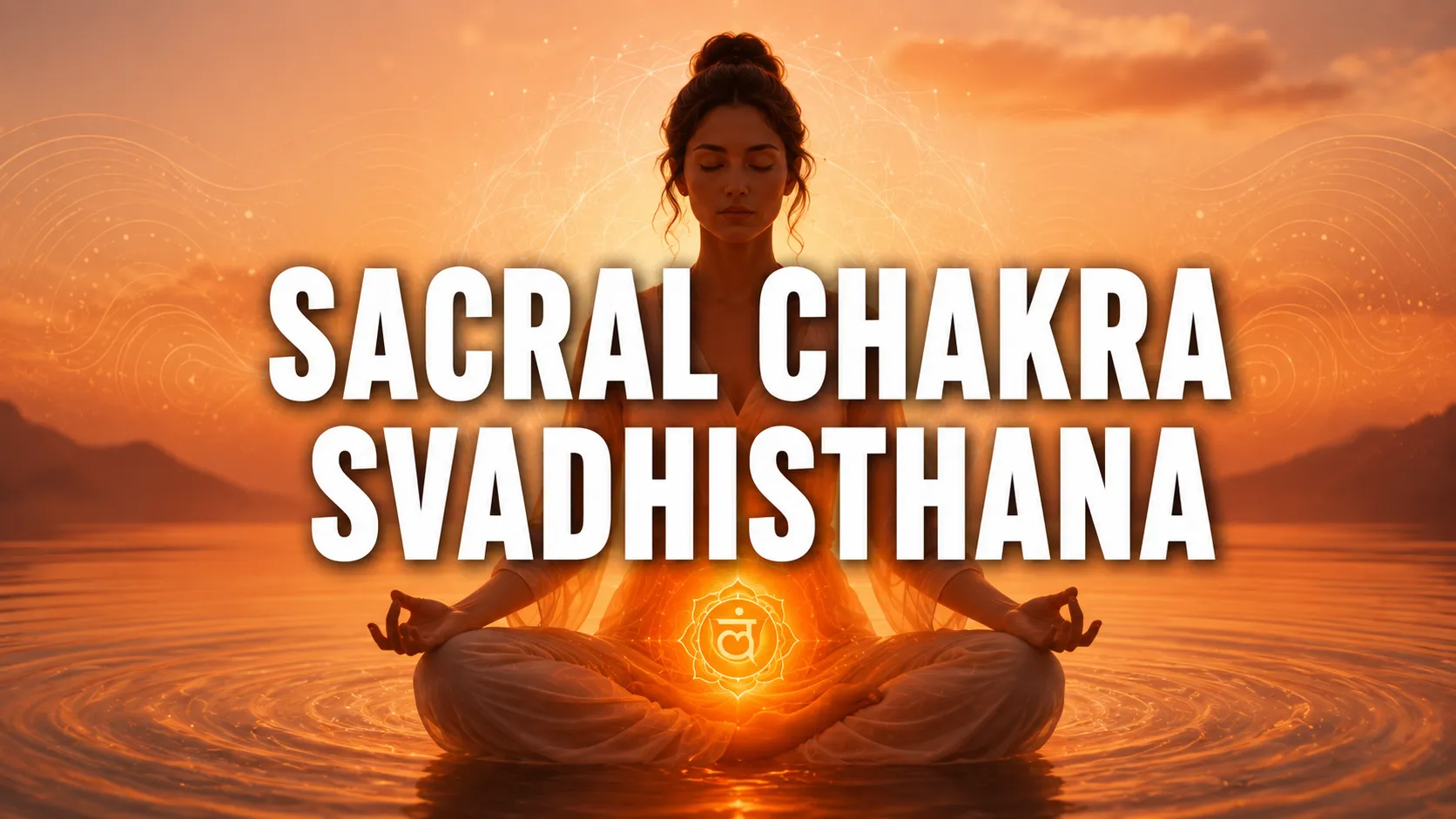
Svadhisthana translates roughly as one’s own place or sweetness, and it sits in the lower abdomen, located about two finger widths below the navel and roughly two finger widths above the root chakra. Its color is orange, its bija mantra is VAM, and its element is water, which is a fitting symbol given how closely this chakra is tied to emotional flow and flexibility rather than the more solid, grounded quality of the root chakra beneath it.
The sacral chakra governs creativity, sensuality, emotional expression, and your relationship with pleasure in all its forms, not only sexual pleasure but also the simple enjoyment of food, art, music, and rest. In traditional teaching, this chakra is also described as becoming developmentally active during early adolescence, roughly between six and fourteen years of age, which lines up with the period when emotional intelligence, creative identity, and awareness of one’s own body typically begin to mature.
The Sacral Chakra and Your Reproductive Hormones

This is the connection I think deserves the most careful explanation, because it is genuinely well documented in basic human physiology. The sacral chakra is traditionally associated with the gonads, the ovaries in women and the testes in men. These glands are responsible for producing the body’s primary sex hormones, estrogen and progesterone in women, and testosterone in men, along with smaller amounts of these hormones in the opposite sex as well.
These hormones do far more than regulate reproduction. They play a significant role in mood regulation, energy levels, libido, and yes, creative drive. Anyone who has experienced the emotional shifts that accompany a menstrual cycle, or the noticeable changes in mood and motivation tied to hormonal fluctuation more broadly, has a direct, lived experience of exactly what traditional sacral chakra teaching describes. When I explain this connection to students, I am not asking them to believe something abstract. I am pointing to a pattern most people have already felt in their own body without having language for it.
In my own practice, I have found that students experiencing menstrual irregularities, low libido, or noticeable mood swings tied to their cycle often respond well to sacral chakra focused energy work, used alongside, never as a replacement for, appropriate medical care when hormonal symptoms are significant or persistent.
It is worth noting that the gonads also serve a function beyond hormone production that traditional teaching speaks to in its own symbolic language. These reproductive organs carry the genetic material, the DNA, that gets passed to the next generation. Traditional teaching describes the sacral chakra as holding the karmic imprints, the deep, often unconscious patterns inherited or carried forward through life. While this is a more esoteric claim than the documented hormone production function, I find the symbolic parallel meaningful, that this is the energy center most closely tied to both biological inheritance and the emotional patterns we unconsciously carry forward from our own upbringing.
Signs of a Blocked or Imbalanced Sacral Chakra
Sacral chakra imbalance tends to show up in fairly recognizable patterns, both when this chakra is underactive and when it becomes overactive.
Signs of an Underactive Sacral Chakra
- Creative blocks or a persistent feeling of being uninspired
- Emotional numbness or difficulty identifying what you are actually feeling
- Guilt or shame around pleasure, rest, or enjoyment
- Low libido or general disconnection from your own sensuality
- Rigidity, difficulty adapting when plans or circumstances change
Signs of an Overactive Sacral Chakra
- Emotional overwhelm, feeling flooded by your own feelings or the feelings of others
- Tendencies toward addictive patterns around food, sex, or substances
- Using pleasure or intimacy as a way to avoid deeper emotional processing
- Mood swings that feel disproportionate to the actual circumstances
Students often ask me why they feel creatively blocked even when their life circumstances have not obviously changed. In my experience, this is one of the clearest sacral chakra signals there is. Creativity does not run on willpower alone. It requires a felt sense of emotional safety and flow, and when the sacral chakra is constricted, that flow simply is not available, no matter how hard you try to force it.
What Causes a Blocked Sacral Chakra
In my work with students, a handful of root causes show up consistently when we trace sacral chakra imbalance back to its origin.
Emotional or sexual trauma. Because this chakra governs both emotional expression and sexuality, experiences of trauma in either category tend to create some of the deepest and most persistent sacral chakra disruption I encounter in practice.
Cultural or religious shame around pleasure. Many students grew up in environments that implicitly or explicitly taught them that pleasure, sensuality, or strong emotional expression were something to suppress or be ashamed of. This conditioning often outlives the environment that created it by decades.
Suppressed creativity over time. Years spent prioritizing practical responsibility over creative expression, common in demanding careers or caretaking roles, gradually dampens this chakra’s natural flow, even without a single identifiable traumatic event.
Major relationship transitions. Breakups, the start of a new relationship, or navigating significant intimacy challenges all place direct demands on the sacral chakra, since this center governs your capacity for vulnerability and emotional openness with another person.
How to Heal and Balance Your Sacral Chakra
The sacral chakra responds particularly well to practices that involve movement, creativity, and gentle reconnection with your body, since this is fundamentally a chakra of flow rather than stillness.
Creative Expression Without Judgment

This is the single practice I recommend most often for sacral chakra healing. The specific creative outlet matters far less than the willingness to create without immediately judging the result. Painting, dancing, writing, cooking, or playing music all work, as long as the focus stays on the process of creating rather than producing something impressive.
Sacral Chakra Meditation
Sit or lie comfortably and place a hand on your lower abdomen, just below the navel. Visualize a warm orange light pulsing gently at this point. With each breath, imagine that light expanding slightly, like ripples moving outward on water. This practice is particularly effective when done slowly, without rushing, since the sacral chakra responds to a fluid, unhurried quality rather than forced intensity.
Movement and Hip Opening Practices
Because the sacral chakra is located in the pelvic region, gentle hip opening yoga poses and free, unstructured movement, such as dancing without choreography, are traditionally associated with releasing stored tension in this area. Many students report a noticeable emotional release during these practices, which is common and nothing to be concerned about.
Time Near Water
Given the sacral chakra’s association with the water element, time spent near a river, lake, or ocean is traditionally recommended as a simple, accessible way to restore a sense of emotional flow. Even something as ordinary as a warm bath, approached with intention, can serve this purpose.
Bija Mantra Chanting
The seed sound associated with the sacral chakra is VAM. Chanting this sound quietly during meditation creates a vibrational focus in the lower abdomen, supporting the same grounding and activation that physical practices target from a different angle.
Reiki and Hands On Energy Work
In my own sessions, sacral chakra work often involves placing the hands gently over the lower abdomen while the student focuses on breath and presence. I have found this particularly supportive for students working through grief, the aftermath of a difficult relationship, or a prolonged period of creative block, since the hands on presence itself often helps reestablish a sense of safety that self practice alone can take longer to build.
Disclaimer: The information in this article is intended for educational purposes only and does not constitute medical advice. Reiki and energy healing are complementary practices and are not a substitute for professional medical treatment. Always consult a qualified healthcare professional for medical concerns, including hormonal or reproductive health issues.
The Sacral Chakra in Relationships and Major Life Transitions
I want to spend extra time on this, because it is one of the most practically useful aspects of sacral chakra work and one of the least discussed. This chakra becomes especially relevant during periods of significant change, breakups, new relationships, career shifts, relocation, or any transition that requires you to adapt and remain emotionally flexible rather than rigid.
In my experience, students moving through major life transitions who also do sacral chakra focused work tend to report less resistance to the change itself. This makes sense once you understand the chakra’s core function. A healthy sacral chakra allows you to move with the natural ebb and flow of life rather than gripping tightly against it. Reducing that resistance does not make difficult transitions painless, but it does tend to reduce the layer of additional suffering that comes from fighting against what is already happening.
I also want to address something I hear from students fairly often, the fear that focusing on pleasure or creativity is somehow self indulgent or unproductive. In my years of teaching, I have found the opposite to be true. Students who give themselves permission to engage with healthy pleasure and creative expression consistently report more energy, not less, available for the rest of their responsibilities. A blocked sacral chakra does not make you more disciplined. It tends to make you more depleted.
The Relationship Between the Sacral and Root Chakra
Because the sacral chakra sits directly above the root chakra, the two are closely intertwined, and in my experience it is rare to find significant sacral chakra imbalance without some corresponding root chakra involvement as well. This makes intuitive sense once you consider their functions. The root chakra establishes a basic sense of physical safety, and the sacral chakra builds emotional flow and creative expression on top of that foundation. It is genuinely difficult to feel safe enough to be creatively vulnerable or emotionally open when your more fundamental sense of security is still unstable.
This is part of why I generally recommend students address root chakra concerns first, or at minimum alongside sacral chakra work, particularly if they are dealing with both financial or safety related anxiety and creative or emotional blocks simultaneously. Working on the sacral chakra in isolation, while ignoring an unstable foundation beneath it, tends to produce slower, less durable results than addressing both together.
The Sacral Chakra Across Different Life Stages
One pattern I have observed repeatedly in my practice is that sacral chakra concerns tend to look different depending on the stage of life a student is in, even though the underlying chakra is the same. I think it is worth walking through this, because it helps explain why generic sacral chakra advice often misses the mark for a given person’s actual situation.
In early adulthood, sacral chakra imbalance most often shows up around identity and self expression, students figuring out who they are creatively and romantically, sometimes for the first time without the structure of family expectations shaping every choice. The work here tends to focus on permission, learning that pleasure, creativity, and emotional expression do not need to be earned or justified.
In the years surrounding parenthood, I see a very different pattern. Many students, particularly those who have spent years in a caretaking role, describe a kind of quiet sacral chakra depletion, a sense that their own creative and sensual identity has been gradually absorbed into caring for someone else’s needs. This is not a flaw in their parenting. It is simply what happens when a chakra responsible for personal pleasure and creative flow is consistently deprioritized for years at a time.
Later in life, particularly around major hormonal transitions like menopause or andropause, sacral chakra work often shifts toward acceptance and adaptation, helping the body and energy field adjust to genuine physiological change rather than resisting it. In my experience, students who approach this transition with sacral chakra awareness tend to navigate the accompanying mood and identity shifts with noticeably more ease than those who treat the change as something to fight against.
How Long Does Sacral Chakra Healing Take
As with any chakra work, timelines vary significantly depending on the depth and origin of the imbalance. Students working through a recent creative block or a temporary period of emotional numbness often notice a shift within a few weeks of consistent practice. Deeper patterns, particularly those rooted in trauma or long suppressed shame around pleasure and sexuality, generally require more sustained work, sometimes over many months, and in cases involving significant trauma, I always recommend pairing energy work with support from a qualified mental health professional.
I tell my students that sacral chakra healing is rarely linear. Unlike root chakra work, which tends to build steadily once grounding practices take hold, sacral chakra healing often comes in waves, periods of noticeable creative flow followed by quieter periods where the work feels stalled. This is completely normal and reflects the fluid, water like nature of this chakra rather than any failure in the practice itself.
Frequently Asked Questions
What organs are connected to the sacral chakra
The sacral chakra is traditionally associated with the gonads, the ovaries in women and the testes in men, which produce the body’s primary reproductive hormones including estrogen, progesterone, and testosterone.
Can a blocked sacral chakra affect creativity
Yes. Creative blocks are one of the most common signs of an underactive sacral chakra, since this energy center governs emotional flow and the sense of safety required for creative expression. Many students experience renewed creative inspiration after focused sacral chakra work.
What is the bija mantra for the sacral chakra
The bija, or seed mantra, for the sacral chakra is VAM. Chanting this sound is traditionally believed to support emotional flow and creative energy in the lower abdomen.
Is the sacral chakra only about sexuality
No. While sexuality is part of the sacral chakra’s domain, it equally governs creativity, emotional expression, and your general relationship with pleasure, including enjoyment of food, art, rest, and connection with others.
Related Guides
- Root Chakra Muladhara: Complete Guide to Grounding and Safety
- The 7 Chakras Explained: Complete Guide to Energy Centers
Discover more from Isrg Healing
Subscribe to get the latest posts sent to your email.