

Most people learn about the seven chakras from a yoga class flyer or a five minute video that lists colors and crystals and moves on. After more than a decade of teaching Reiki and working hands on with students who came to me confused, anxious, or stuck in patterns they could not explain, I can tell you the real value of chakra knowledge is not in memorizing names. It is in recognizing how these seven energy centers show up as actual patterns in your body, your habits, and your relationships.
In this guide I am going to walk you through each of the seven chakras the way I actually teach them in my practice, with their Sanskrit names, physical locations, what happens when they are balanced versus blocked, and the documented correlation between this ancient energy map and the modern endocrine system. This is not a list you skim. It is a framework you can use to understand your own body better starting today.
Contents of 7 Chakras Explained
What Are Chakras, Exactly
The word chakra comes from Sanskrit and translates to wheel or disc. In the yogic and Ayurvedic traditions, chakras are described as spinning centers of energy positioned along the spine, from the base of the spinal column to the crown of the head. The concept first appears in Vedic texts dating back roughly 3,000 years, long before anatomy and endocrinology existed as sciences.
While some tantric traditions reference well over a hundred energy points across the body, the system most practitioners in the West work with focuses on seven primary chakras. Each one governs a specific zone of physical function, emotional experience, and consciousness. When a chakra is open and balanced, energy flows through it without restriction. When it is blocked, suppressed, or overactive, that imbalance tends to surface as a physical symptom, an emotional pattern, or both.
What I find most interesting, and what I want to spend real time on in this article, is that this is not just spiritual theory. There is a documented anatomical correlation between the location of each chakra and a corresponding gland or nerve plexus in the endocrine system. I will break that down chakra by chakra below, because understanding this connection is what makes chakra work practical rather than abstract.
I have taught this material to hundreds of students over the years, and the question I hear most often in the first session is some version of “how do I know if this is even real.” It is a fair question. My honest answer is that I do not ask students to believe anything on faith. I ask them to pay attention to their own body and notice whether the patterns described in this guide match what they already feel but have never had language for. Almost everyone who does this exercise finds at least one chakra description that lands with uncomfortable accuracy.
The Seven Chakras In Order, From Root To Crown
Each of the seven chakras sits at a specific point along the spine and carries its own Sanskrit name, color, bija mantra (seed sound), and area of influence. Here is the complete breakdown.

1. Root Chakra (Muladhara)
Location: Base of the spine, at the perineum
Sanskrit name: Muladhara, meaning root support
Color: Red
Bija mantra: LAM
Governs: Safety, survival, financial stability, physical grounding
The root chakra is your foundation. It governs your basic sense of safety in the world, your relationship with money and security, and your connection to your physical body. In Reiki practice, this is almost always the first center I check when a student describes feeling anxious without an obvious cause, because an unsettled root chakra often produces that exact symptom.
The root chakra is associated with the adrenal glands, which sit atop the kidneys and release cortisol, the body’s primary stress hormone. When you are in genuine survival mode, whether that is a financial crisis or a physical threat, your adrenal glands activate. This is the physiological mechanism that traditional teachings were pointing to long before cortisol had a name.
Signs of a blocked root chakra include chronic anxiety about money, difficulty feeling settled in your own body, lower back pain, and a persistent sense that the ground beneath you is not stable. A balanced root chakra feels like quiet confidence. You trust that your basic needs will be met.
2. Sacral Chakra (Svadhisthana)
Location: Lower abdomen, roughly two inches below the navel
Sanskrit name: Svadhisthana, meaning one’s own place
Color: Orange
Bija mantra: VAM
Governs: Creativity, sexuality, pleasure, emotional fluidity
The sacral chakra is your center for creativity, intimacy, and emotional expression. It corresponds closely to the reproductive organs and is often linked to the ovaries and testes, which regulate sex hormones that influence mood, desire, and creative drive.
In my experience, sacral chakra imbalances show up most often in people who have shut down their emotional expression, sometimes after a painful relationship, sometimes simply from years of prioritizing logic over feeling. Students often ask me why they feel creatively blocked even when nothing obvious has changed in their life. More often than not, the sacral chakra is the place to look first.
Signs of imbalance include creative blocks, difficulty enjoying pleasure without guilt, and either emotional numbness or emotional overwhelm. When balanced, you feel a healthy connection to your own desires and a natural flow of creative energy.
3. Solar Plexus Chakra (Manipura)
Location: Upper abdomen, between the navel and the base of the sternum
Sanskrit name: Manipura, meaning city of jewels
Color: Yellow
Bija mantra: RAM
Governs: Personal power, confidence, self-esteem, willpower
This is your center of personal power. The solar plexus chakra corresponds to the pancreas, which regulates blood sugar and digestion, and is closely tied to the body’s overall metabolic and digestive function. This is also the chakra most directly linked to the vagus nerve, the long nerve that runs from your brainstem through your gut and plays a central role in your nervous system’s stress response.
When this chakra is balanced, you carry a quiet, steady confidence. You make decisions without excessive second guessing, and your sense of self-worth does not depend entirely on outside validation. When it is blocked, you may notice chronic self-doubt, a need for constant approval, digestive issues like bloating or irritable stomach, or the opposite extreme, an aggressive need for control over people and situations.
4. Heart Chakra (Anahata)
Location: Center of the chest
Sanskrit name: Anahata, meaning unstruck or unhurt
Color: Green, sometimes depicted as pink
Bija mantra: YAM
Governs: Love, compassion, forgiveness, connection
The heart chakra sits at the literal and symbolic midpoint of the chakra system, bridging the three lower chakras associated with the physical self and the three upper chakras associated with spiritual consciousness. It is associated with the thymus gland, which plays a direct role in immune function, an interesting parallel given how often emotional stress and heartbreak coincide with weakened immunity.
In my practice, I have found the heart chakra to be one of the most commonly blocked centers in adults, particularly those who grew up learning to prioritize other people’s needs over their own. A blocked heart chakra often shows up as difficulty receiving love even when it is freely offered, chronic people pleasing, or feeling emotionally guarded despite wanting connection.
A balanced heart chakra allows you to give and receive love without keeping score, to forgive without losing your boundaries, and to feel compassion for others without absorbing their pain as your own.
5. Throat Chakra (Vishuddha)
Location: Center of the throat
Sanskrit name: Vishuddha, meaning especially pure
Color: Blue
Bija mantra: HAM
Governs: Communication, self-expression, truth, authenticity
This is your center of voice and authentic expression. The throat chakra corresponds anatomically to the thyroid gland, which sits directly over this location and regulates metabolism, energy levels, and mood through hormone production. It is genuinely remarkable how closely thyroid dysfunction symptoms, including fatigue, mood swings, and a feeling of being unheard or unable to speak up, mirror traditional descriptions of a blocked throat chakra.
People with a blocked throat chakra often describe a physical sensation of tightness in the throat when they need to say something difficult, or they find themselves either staying silent when they should speak, or dominating conversations as an overcompensation. A balanced throat chakra allows you to speak your truth clearly, kindly, and without excessive fear of how it will be received.
6. Third Eye Chakra (Ajna)
Location: Center of the forehead, slightly above and between the eyebrows
Sanskrit name: Ajna, meaning command or perception
Color: Indigo
Bija mantra: OM or KSHAM, depending on tradition
Governs: Intuition, insight, clarity, inner wisdom
The third eye chakra is associated with the pituitary gland, often called the master gland because it regulates nearly every other hormone producing gland in the body, and sits in almost the exact anatomical location ancient yogic texts assigned to this energy center. The pituitary also responds to light and helps regulate your circadian rhythm, which is part of why so many practitioners associate this chakra with perception and inner sight.
When the third eye chakra is balanced, you trust your intuition and can see situations clearly without being clouded by fear or overthinking. When it is blocked, you may experience confusion, an overreliance on pure logic at the expense of instinct, or difficulty trusting your own judgment even when your gut is sending clear signals.
7. Crown Chakra (Sahasrara)
Location: Top of the head
Sanskrit name: Sahasrara, meaning thousand petaled
Color: Violet or white
Bija mantra: Silent OM
Governs: Spiritual connection, higher consciousness, purpose
The crown chakra represents your connection to something larger than the individual self, whatever language you use for that. It is associated with the pineal gland, which produces melatonin and governs your sleep wake cycle. Unlike the other six chakras, the crown is not tied to a single hormone function as directly. Instead, traditional teaching holds that it influences the harmony of the entire endocrine system when it is open and aligned.
A blocked crown chakra often shows up as a sense of disconnection or meaninglessness, even when life circumstances look fine on paper. A balanced crown chakra brings a quiet sense of purpose and connection that does not depend on any single external outcome.
How The Chakras Correlate To The Endocrine System
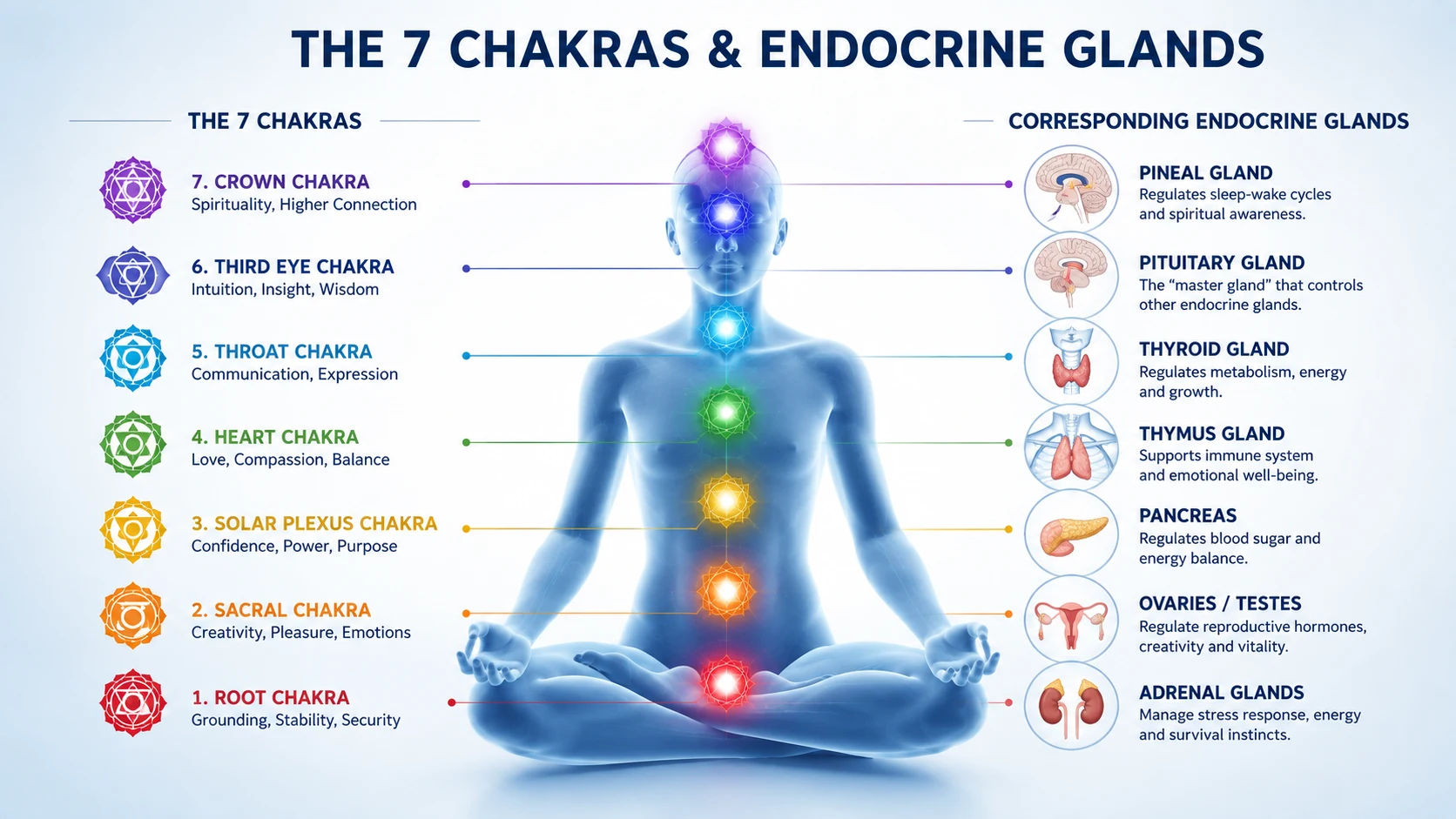
This is the part of chakra education that gets skipped most often, and it is the part I think matters most. Modern anatomy did not exist when the chakra system was first described in Vedic texts roughly 3,000 years ago. Yet when you map the seven chakra locations against the body’s major endocrine glands and nerve plexuses, the correspondence is strikingly precise.
| Chakra | Endocrine Correlation | Function |
|---|---|---|
| Root | Adrenal glands | Cortisol release, stress response |
| Sacral | Ovaries / Testes | Sex hormone regulation |
| Solar Plexus | Pancreas | Blood sugar, digestion |
| Heart | Thymus | Immune function |
| Throat | Thyroid | Metabolism, energy, mood |
| Third Eye | Pituitary | Master regulation of other glands |
| Crown | Pineal | Melatonin, circadian rhythm |
I am not a medical doctor, and I want to be clear that this correlation is anatomical and observational, not a claim that chakra healing replaces endocrine medicine. What it does offer is a useful bridge. When a student comes to me with a thyroid issue, I am not surprised to also hear they have struggled for years with speaking up for themselves. When someone describes chronic digestive trouble, I am not surprised that they also describe a lifelong struggle with self-confidence. The energetic pattern and the physical pattern tend to move together.
There is also a connection worth mentioning between the chakra system and the nervous system, specifically the three main energy channels described in yogic anatomy, known as nadis. The central channel, called sushumna, runs along the spine and roughly parallels the location of the spinal cord and central nervous system. The two channels that spiral around it, ida and pingala, are traditionally associated with the parasympathetic and sympathetic branches of the nervous system, the same two systems that govern your rest and digest state versus your fight or flight state. Practitioners who study both yogic anatomy and modern physiology have pointed out how closely this three channel model maps onto what we now understand about autonomic nervous system regulation.
None of this means ancient yogis had access to modern dissection or imaging technology. What it suggests is that careful, sustained observation of the body, sustained over centuries and across thousands of practitioners, arrived at a functional map that modern anatomy later confirmed from a completely different angle. That convergence is part of why I take this system seriously in my own practice, and why I think it deserves more than a passing mention in most chakra content available online today.
Signs Your Chakras May Be Out Of Balance
You do not need special training to notice when something is off energetically. In my experience, the most common signs students report, organized by which chakra is typically involved, include the following.
- Root: Chronic worry about money or safety, feeling ungrounded, lower back tension
- Sacral: Creative blocks, emotional numbness, guilt around pleasure or rest
- Solar Plexus: Low self-esteem, digestive issues, need for control
- Heart: Difficulty receiving love, chronic people pleasing, emotional guardedness
- Throat: Trouble speaking up, throat tightness under stress, fear of judgment
- Third Eye: Confusion, distrust of your own intuition, mental fog
- Crown: A sense of disconnection or lack of purpose despite outward success
It is worth saying clearly that none of these signs on their own confirm a chakra imbalance, and many overlap with ordinary stress, sleep deprivation, or underlying medical and mental health conditions that deserve proper attention. I always tell my students that energy work is a complement to a full, balanced approach to wellbeing, not a replacement for it.
How Chakra Balancing Actually Works
There is no single correct method for chakra balancing, and I encourage students to find what genuinely resonates rather than forcing a practice that feels mechanical. That said, a few approaches show up consistently across traditions and in my own practice.
Meditation and breathwork. Focused attention on a specific chakra, paired with slow breathing, is one of the most accessible ways to begin noticing where your energy feels stuck.
Bija mantra chanting. Each chakra has a corresponding seed sound, listed earlier in this guide. Chanting these syllables, even quietly, creates a vibrational focus that many students find grounding.
Yoga asana practice. Specific postures are traditionally associated with opening specific chakras. Grounding poses support the root chakra, while heart opening poses like backbends support the heart chakra.
Reiki and energy healing. In my own sessions, I work directly with a student’s energy field to identify where flow is restricted and support the body’s own capacity to rebalance. This is not a quick fix. It is a practice, much like any form of physical or mental conditioning.
Crystals and gemstones. Many traditions pair specific stones with specific chakras, such as red jasper for the root chakra or rose quartz for the heart chakra. I want to be honest with my students about this practice. There is no peer reviewed evidence that crystals emit measurable energy that affects the body. What I have observed is that the ritual of choosing, holding, and focusing on an object during meditation can genuinely support the mental discipline that chakra work requires. The value is in the intention and the consistency of practice, not in the mineral itself.
Journaling and self-inquiry. This is the method I recommend most often to students who are new to energy work and feel skeptical about more esoteric tools. Simply reading through the signs of imbalance for each chakra and honestly journaling about which ones resonate is often enough to identify where to focus your attention first.
Whatever method you choose, consistency matters more than intensity. A few minutes of focused attention on a specific chakra each day, sustained over weeks, tends to produce more noticeable shifts than a single long session done once and never repeated. This mirrors what we know about building any new habit or skill. The nervous system responds to repetition, not to a single dramatic effort.
Disclaimer: The information in this article is intended for educational purposes only and does not constitute medical advice. Reiki and energy healing are complementary practices and are not a substitute for professional medical treatment. Always consult a qualified healthcare professional for medical concerns.
Common Misconceptions About Chakras
After years of teaching, I have noticed the same handful of misunderstandings come up again and again. Clearing these up tends to make chakra work far more useful and far less confusing.
Misconception one: a balanced chakra means feeling happy all the time. Balance does not mean the absence of difficult emotions. A balanced heart chakra still grieves. A balanced solar plexus chakra still feels self-doubt occasionally. What balance actually means is that you move through these states without getting permanently stuck in them.
Misconception two: you only need to work on your weakest chakra. The seven chakras function as an interconnected system, not seven separate switches. A blocked root chakra often creates downstream effects in the sacral and solar plexus chakras, because a lack of basic safety tends to disrupt your sense of self-worth and creative expression as well. Effective chakra work usually involves looking at the whole system, not isolating a single point.
Misconception three: chakra healing works instantly. Some students do report immediate shifts after a single session, and I never want to dismiss that experience. But the imbalances that took years to form, often shaped by childhood experiences, long term stress, or repeated relationship patterns, generally take sustained practice to meaningfully shift. Anyone promising permanent transformation in one session is overselling what energy work realistically does.
Frequently Asked Questions
How many chakras are there in the human body
Most Western practitioners work with seven primary chakras running from the base of the spine to the crown of the head. Some tantric traditions describe well over a hundred minor energy points throughout the body, but the seven chakra system is the most widely taught and studied framework.
Can a chakra be too open instead of blocked
Yes. An overactive chakra can cause symptoms just as disruptive as a blocked one. For example, an overactive solar plexus chakra can show up as controlling behavior or aggression, while an underactive one shows up as low self-esteem. Balance, not just openness, is the goal.
How long does it take to balance a blocked chakra
This varies significantly depending on how long the imbalance has been present and what is causing it. Some students notice a shift after a single focused session, while deeper, long-standing patterns can take consistent practice over weeks or months to meaningfully shift.
Is there scientific proof that chakras exist
Chakras are not a recognized anatomical structure in conventional Western medicine. However, the locations traditionally assigned to each chakra correspond closely to major endocrine glands and nerve plexuses, which is part of why many integrative practitioners view the system as a useful framework for understanding the mind-body connection.
Related Guides
- Reiki Before Surgery What Hospitals Measured When Patients Got It
- Reiki for Autism Therapists Why Burnout Drops With Energy Healing
- Reiki Level 1 2 and 3 What No One Tells You About Each Attunement
Discover more from Isrg Healing
Subscribe to get the latest posts sent to your email.