
Almost every student who walks into my practice for the first time asks me some version of the same question. They want to know if the aura is something real, or if it is just a metaphor people use to sound spiritual. After years of working hands on with hundreds of students and clients, I can tell you my honest answer is more interesting than a simple yes or no. The aura is a real energetic field that surrounds the body, and parts of it overlap with something modern science has been measuring since 1992 under a different name, the biofield.
In this guide I am going to explain exactly what the aura is, the seven layers that make it up, how it connects to the chakra system, what the scientific research actually says, and how you can begin learning to sense your own energy field starting today. This is the foundation article I send every new student before we go any deeper into chakra work.
I want to be upfront about something most articles on this topic avoid. There is a real difference between what energy healing traditions teach about the aura and what laboratory science has been able to measure so far. I am not going to blur that line for you. Instead, I will walk you through both, the traditional model that practitioners like me work with daily, and the documented scientific research that overlaps with it, so you can form your own informed view rather than taking either side on faith.
Table of Contents: What Is Aura
What Is the Aura, Exactly
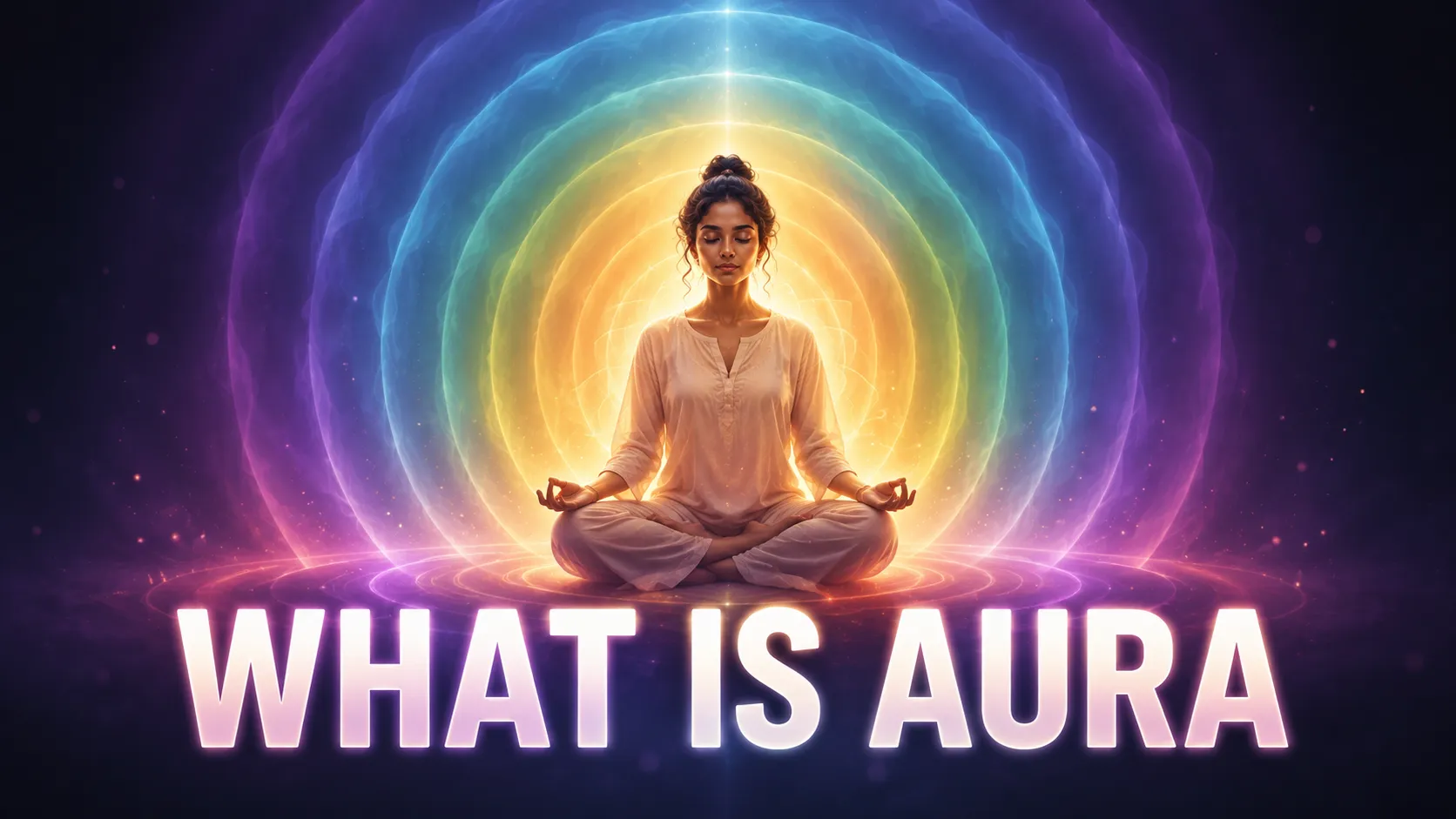
The aura is the field of subtle energy that surrounds and extends beyond your physical body. It is not visible to most people in ordinary waking consciousness, but practitioners across nearly every culture and era have described some version of this field. Christian art depicted saints with halos of light. Kabbalistic traditions referenced an astral light surrounding the body. Vedic scriptures, Tibetan and Indian Buddhist teachings, and many Native American traditions all describe a human energy field in remarkably similar terms, despite having no documented contact with one another.
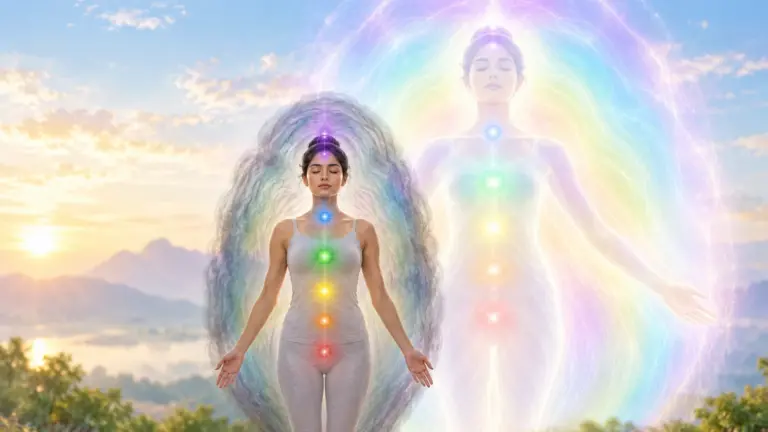
In my own practice, I think of the aura as the energetic signature of everything happening inside you, physically, emotionally, mentally, and spiritually, radiating outward in layers. It is shaped by your chakras, which act like the engines generating and regulating the energy that forms each layer of the field.
The Seven Layers of the Aura
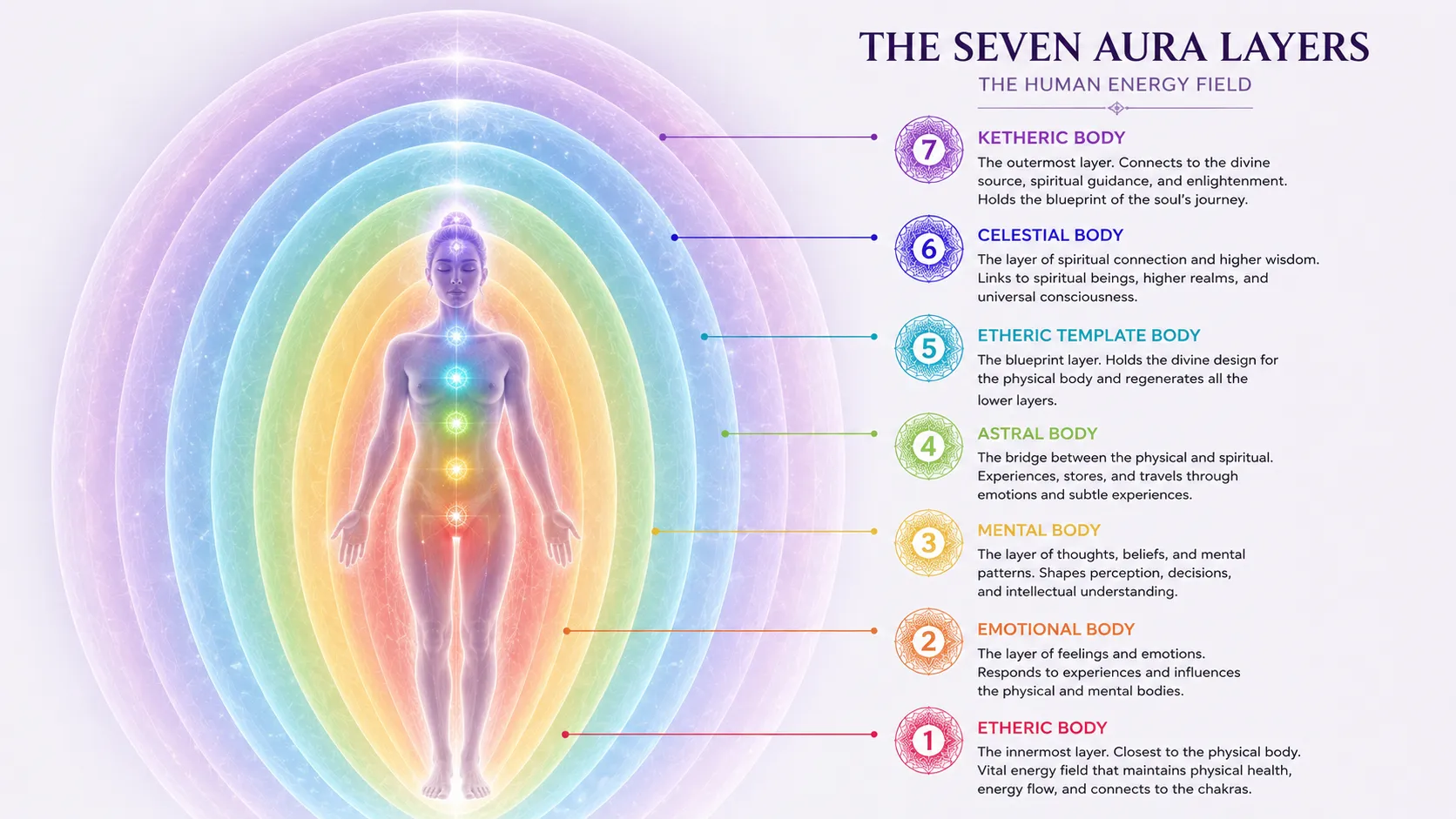
The most widely referenced model of the aura’s structure comes from the work of Barbara Brennan, a former NASA physicist turned energy healer, who identified seven distinct layers of the human energy field, each vibrating at a progressively higher frequency the further it sits from the physical body. I use this same seven layer framework with my own students because it maps cleanly onto the seven chakra system.
One detail that took me years of practice to fully appreciate is that the odd numbered layers, the first, third, fifth, and seventh, tend to have a more structured, organized quality, while the even numbered layers, the second, fourth, and sixth, feel more fluid and less defined. This alternating pattern of structure and fluidity is consistent across most experienced practitioners’ descriptions, even when they trained in entirely different lineages, which I find to be one of the more compelling pieces of anecdotal consistency in this field.
1. Etheric Body
The closest layer to the skin, extending roughly two to five centimeters outward. This is the densest layer and is associated with the root chakra. It serves as a blueprint for the physical body itself, and it is generally the easiest layer for beginners to start sensing, since it closely mirrors the physical form.
2. Emotional Body
Extending a bit further out, this layer holds your emotional patterns and is associated with the sacral chakra. When I work with students who describe feeling emotionally heavy or weighed down without an obvious cause, this is often the layer where that residue is sitting.
3. Mental Body
This layer carries the structure of your thoughts, beliefs, and mental patterns, and is associated with the solar plexus chakra. Practitioners who describe sensing this layer often report a faster, more vibrant quality compared to the etheric layer.
4. Astral Body
Extending about a foot from the body, this layer is where most energetic exchange between people takes place. It is associated with the heart chakra and is often the layer responsible for the immediate sense of connection or discomfort you feel when meeting someone new, before a single word is exchanged.
5. Etheric Template
This layer holds the blueprint for the etheric body, functioning almost like a holding pattern for your physical form at a higher vibrational level. It is associated with the throat chakra and relates to your capacity for authentic self-expression.
6. Celestial Body
Associated with the third eye chakra, this layer is connected to spiritual experience, intuition, and unconditional love expressed on a broader scale than personal relationships.
7. Ketheric Template
The outermost and highest vibrating layer, associated with the crown chakra. This layer is described as the layer of divine connection, oneness, and your link to higher consciousness or purpose.
What I want students to understand is that these seven layers are not separate bubbles stacked on top of each other like Russian dolls. They interpenetrate one another and the physical body simultaneously, much like how your nervous system, circulatory system, and skeletal system all occupy the same physical space without being the same structure.
The Aura and the Chakras: How They Work Together
If the chakras are the engines, the aura is the field those engines generate and maintain. Each of the seven chakras feeds energy primarily into its corresponding auric layer, which is why a blocked or imbalanced chakra so often shows up as a disturbance in the matching layer of the aura. A blocked heart chakra, for example, often correlates with a contracted or guarded astral body, the layer responsible for emotional connection with others.
This is part of why I always teach the aura and the chakras together rather than as separate topics. In my practice, when I sense a disturbance in someone’s energy field, the next step is almost always to trace that disturbance back to the specific chakra that is generating it. You cannot fully work with one system without understanding the other.
What Does Modern Science Actually Say About the Aura
This is the section I think deserves more honest attention than most spiritual content online gives it. In 1992, an expert committee convened by the Office of Alternative Medicine at the United States National Institutes of Health gave the human energy field its first formal scientific definition, calling it the biofield. The NIH defined it as a massless field, not necessarily electromagnetic, that surrounds and permeates living bodies and affects the body.
This was not a concept invented by wellness culture. It was a term researchers identified as necessary to describe something real, and in some respects measurable, about living organisms. Since that 1992 definition, biofield science has grown into its own area of academic study, with a dedicated peer reviewed research framework. A landmark 2015 paper published in Global Advances in Health and Medicine by researchers Rubik, Muehsam, Hammerschlag, and Jain laid out a comprehensive scientific framework for biofield physiology, covering its history, terminology, and physical basis.
What does the body actually generate that researchers can measure? Every cell in the human body produces measurable electrical activity, which is precisely what technologies like EEG and ECG already monitor in mainstream medicine. The body also emits extremely weak photon emissions, sometimes called biophotons or ultraweak photon emission, a phenomenon documented in multiple peer reviewed studies. Researchers have proposed that this biophotonic activity may play a role in cellular communication.
A 2020 review published in Global Advances in Health and Medicine identified more than 200 studies examining biofield therapies, including Reiki, Healing Touch, and Therapeutic Touch, reporting positive outcomes in areas like pain reduction, anxiety relief, and wound healing support. The National Cancer Institute has also formally classified biofield therapy as a recognized category of complementary and alternative medicine, distinct from standard electromagnetic therapies specifically because the underlying mechanism is not yet fully explained by conventional instruments.
I share these details not to claim that science has proven the aura exists exactly as energy healers describe it, but because I think students deserve to know that the broader premise, the idea that the body generates and is affected by a subtle field of energy, sits within a real and growing area of scientific inquiry rather than pure fantasy. That distinction matters to me, and I think it should matter to you too.
I want to be straightforward with you here, because I think honesty matters more than hype. The scientific concept of the biofield is not identical to the seven layer auric model described in energy healing traditions. The biofield research focuses on measurable electromagnetic and biophotonic activity, while the traditional aura model includes layers, like the celestial and ketheric templates, that have not been measured by any scientific instrument. What the biofield research does confirm is that the underlying premise, that the body generates and is surrounded by a field of energy beyond simple biochemistry, is not pseudoscience. It is an active, if still developing, area of legitimate scientific inquiry.
Can You Actually See or Sense an Aura
Most people who attempt to see an aura for the first time get discouraged within a few minutes because they expect a vivid burst of color, like in a movie. In my experience teaching this skill, that is rarely how it begins. Here is the method I teach new students.
Soften your gaze. Instead of focusing sharply on a person’s outline, relax your eyes the way you would when looking at one of those hidden image puzzles. Let your peripheral vision do more of the work than your direct focus.
Use a plain background. Have your subject stand against a plain white or light colored wall. Busy backgrounds make it much harder for a beginner to notice the subtle shift in light right at the edge of the body.
Start with the etheric layer. This is the easiest layer to perceive because it sits closest to the body and is the densest. Many beginners describe seeing a faint white, gray, or shimmering outline a few centimeters from the skin before they ever perceive actual color.
Practice consistently. Like any sensory skill, this improves with repetition. I have had students who saw nothing for their first several attempts and then suddenly began perceiving color clearly after a week of short daily practice.
Not everyone who practices energy work develops strong visual perception of the aura, and that is completely normal. Many practitioners, myself included, rely more heavily on feeling or sensing the energy field with the hands rather than seeing it visually. Both are equally valid ways of working with this system.
What Aura Colors Are Said to Mean
Within energy healing traditions, different colors observed in the aura are associated with different emotional and energetic states. I want to be clear that this is a traditional, experience based framework rather than a scientifically validated one, but it remains a useful starting point for students learning to interpret what they sense.
- Red: Strong physical vitality, passion, or in some cases unprocessed anger
- Orange: Creativity, emotional expression, and sociability
- Yellow: Mental clarity, confidence, and personal power
- Green: Compassion, balance, and a strong connection to the heart
- Blue: Calm communication and a settled, peaceful state
- Indigo or violet: Strong intuition and spiritual focus
- White or gold: A high state of spiritual connection or transformation
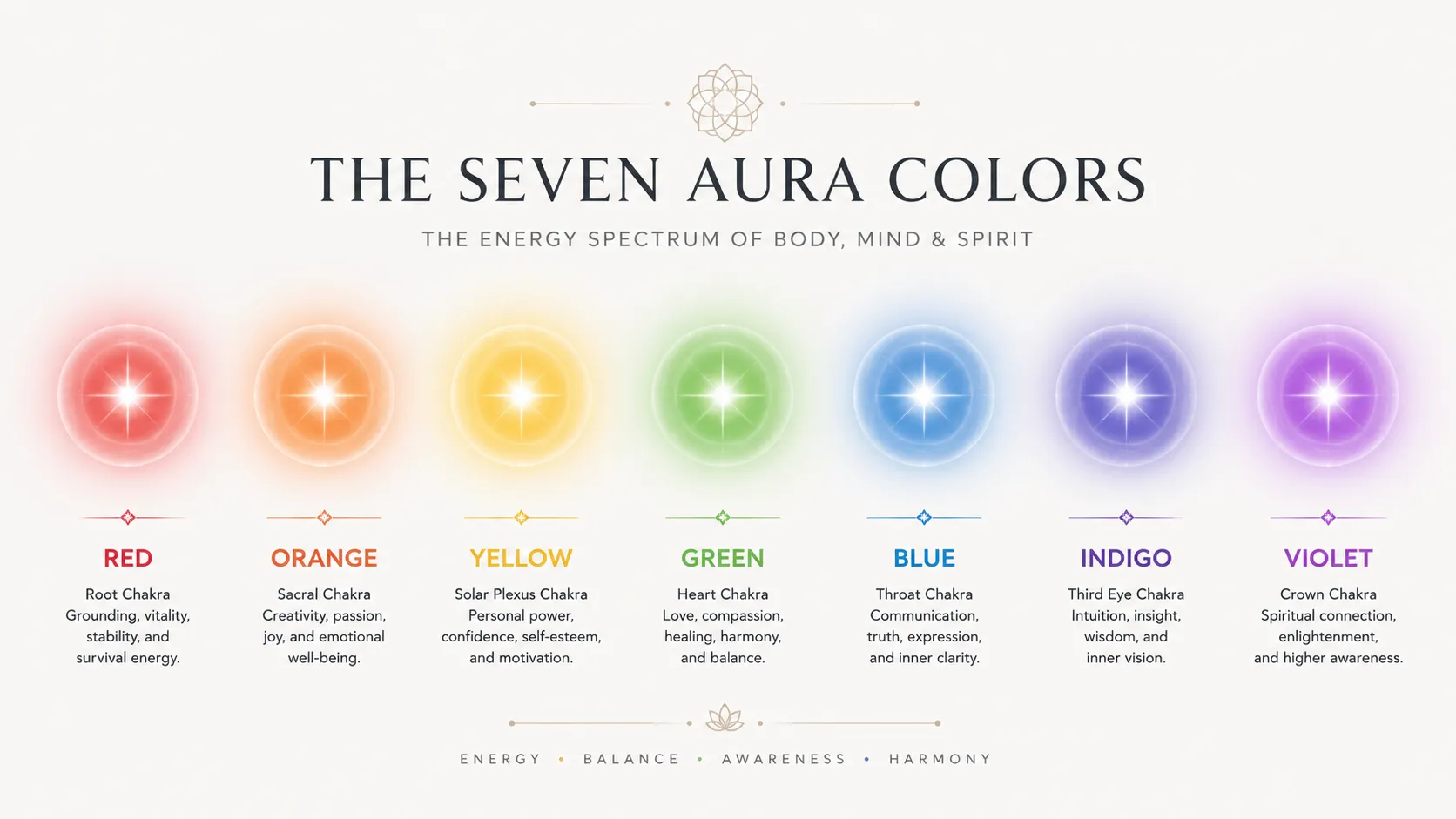
In my own sessions, I rarely see a single solid color across someone’s entire field. Most people present with a dominant color paired with smaller patches or flickers of other colors, which simply reflects the layered, dynamic nature of human emotional and energetic experience at any given moment.
How to Strengthen and Protect Your Aura
A strong, clear aura is not about achieving some permanent perfect state. It is about maintaining resilience, the ability for your energy field to recover quickly after stress, conflict, or fatigue. A few practices I recommend consistently to students include the following.
Grounding practices. Time in nature, walking barefoot on grass or earth, and root chakra focused breathwork all support the etheric layer of your field, which forms the foundation for the layers above it.
Energetic boundaries. Visualizing a protective layer of light around your field before entering crowded or emotionally intense environments is a technique I teach almost every student who describes feeling drained after being around certain people.
Regular energy clearing. Reiki sessions, meditation, and intentional breathwork all support the natural clearing and rebalancing of your auric field, much the way physical exercise supports your circulatory system.
Mindful environments. Pay attention to who and what you spend extended time around. Chronic exposure to high conflict environments or relationships tends to show up as contraction or depletion in the astral and emotional layers of the field over time.
I often tell students that aura maintenance is less like a one time fix and more like dental hygiene. You do not brush your teeth once and consider it done forever. The same daily, low effort consistency applies here. A few minutes of grounding in the morning and a brief boundary visualization before a difficult meeting or social event will, over weeks and months, build a level of energetic resilience that no single intensive session can replicate.
It is also worth noting that physical health and auric health are not separate concerns. Adequate sleep, hydration, and time away from screens all support a clearer, more stable energy field, simply because your physical body and your energetic field are not two unrelated systems. They are different expressions of the same living organism.
Disclaimer: The information in this article is intended for educational purposes only and does not constitute medical advice. Reiki and energy healing are complementary practices and are not a substitute for professional medical treatment. Always consult a qualified healthcare professional for medical concerns.
Common Misconceptions About the Aura
A few misunderstandings come up consistently in my teaching, and clearing them tends to make this entire subject far more approachable.
Misconception one: only gifted people can sense an aura. Visual or tactile sensitivity to energy is a skill, not an inherited gift reserved for a select few. Like any skill, some people develop it faster than others, but consistent practice produces results for the vast majority of students I have worked with.
Misconception two: a healthy aura is always large and bright. Size and brightness are not the only measures of a healthy field. A well regulated, appropriately bounded aura is often more valuable than an enormous, unfocused one, particularly for people who tend to absorb other people’s emotional states too easily.
Misconception three: aura photography proves what color your aura is. Aura photography, often produced using devices based on Kirlian photography or biofeedback sensors, can be a fun and sometimes genuinely interesting introduction to this topic. However, these devices measure specific electrical or thermal properties of the hand, not a confirmed direct image of the seven layer auric field described in energy healing traditions. I encourage students to treat aura photos as a starting conversation, not a definitive diagnostic tool.
Misconception four: a damaged aura is permanent. I hear this concern often from students who have been through a difficult breakup, illness, or period of high stress and worry their energy field has been permanently altered. In my experience, the aura is remarkably responsive to consistent care. Even fields that feel heavily contracted or depleted after a hard period tend to recover meaningfully within weeks of regular grounding, breathwork, and rest. The field is dynamic, not fixed.
Frequently Asked Questions
Is the aura scientifically proven to exist
The seven layer auric model from energy healing traditions has not been scientifically measured in full. However, the related concept of the human biofield, defined by the National Institutes of Health in 1992 as a field surrounding and permeating living bodies, is an active area of legitimate peer reviewed research. The body’s measurable electrical activity and biophoton emissions are documented, though they do not fully confirm every traditional claim about the aura’s seven layers.
How far does the aura extend from the body
Traditional teaching describes the innermost etheric layer extending roughly two to five centimeters from the skin, with each successive layer extending further outward. The outer layers, such as the astral body, are often described as extending a foot or more, though this varies by individual and by tradition.
Can anyone learn to see auras
Most people can develop at least some capacity to perceive the aura with consistent practice. Softening your gaze, using a plain background, and starting with the etheric layer closest to the body are the most effective starting techniques for beginners.
What is the difference between the aura and the chakras
The chakras are the seven energy centers along the spine that generate and regulate energy. The aura is the layered field of energy that surrounds the body, largely produced and maintained by those same seven chakras. Each chakra corresponds to one of the seven layers of the aura.