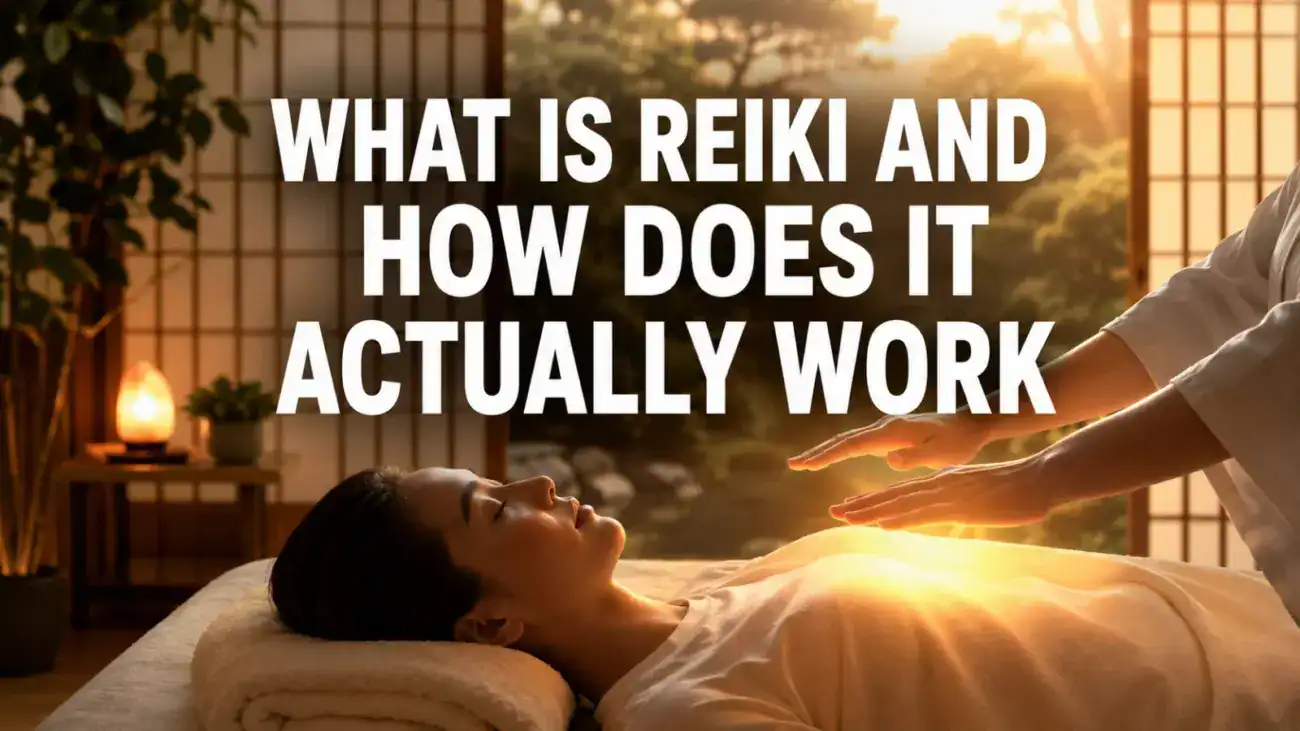
Most people stumble upon Reiki during one of the hardest seasons of their lives. A surgery that left them exhausted, an anxiety that no medication fully quieted, or a grief that conventional care simply could not reach. That is usually when someone mentions Reiki, and the first honest question that follows is: what exactly is it? Not the romanticised version, not the dismissive one either, but the real answer backed by history, biology, and verified research. This article gives you that answer, clearly and completely
What is Reiki Table of Contents
What Reiki Actually Means: The Word Itself Tells the Story
Reiki is a Japanese compound word. Rei (pronounced “ray”) translates as universal, higher wisdom, or the spiritual dimension of existence. Ki (pronounced “kee”) is the Japanese term for life force energy, identical in concept to qi or chi in Chinese medicine and prana in the Sanskrit tradition. Together, Reiki translates most accurately as spiritually guided life force energy.
This is not a poetic interpretation. It is a functional description. In practice, Reiki refers to both the invisible energy itself and the healing system built around channelling that energy to support the body’s own capacity to heal. Understanding the word removes much of the confusion that surrounds the practice.
The Verified History of Reiki: What Actually Happened on Mount Kurama
Reiki as a formal healing system was founded by Mikao Usui, born on August 15, 1865, in the village of Taniai in Gifu Prefecture, Japan. His family lineage traced back to the samurai clan of Tsunetane Chiba. He was raised as a Tendai Buddhist, educated at the Zendo-Ji temple school from childhood, and went on to study medicine, psychology, and theology across Japan, China, and reportedly the United States.
In my practice as a Reiki Master, I often tell students that the most important thing to understand about Usui Sensei is that he spent decades seeking before he found. He was not a gifted child who woke up healing people. He was a dedicated scholar who searched for answers across every tradition available to him.
In early 1922, Usui Sensei undertook a 21-day spiritual discipline called isyu guo on Mount Kurama, a sacred mountain north of Kyoto. The practice involved fasting, meditation, prayer, and chanting. On the final day of his retreat, accounts inscribed on his 1927 memorial stone, written by his student Juzaburo Ushida, record that he experienced a sudden powerful energy above his head. That experience is documented as the origin of Reiki Ryoho, the Usui System of Natural Healing.
He descended from the mountain and reportedly experienced four spontaneous healings in succession. Shortly after, in April 1922, he opened his first Reiki clinic and teaching school in Harajuku, Tokyo. Over the following four years until his death on March 9, 1926, he taught Reiki to over 2,000 students and initiated approximately 16 Reiki Masters.
How Reiki Spread from Japan to the World
Usui Sensei’s student and eventual successor, Dr. Chujiro Hayashi (1880 to 1940), a former naval commander, systematised Reiki further. He developed the hand position sequences that many Reiki practitioners still use today and established a clinic in Tokyo where detailed records of client treatments were kept.
The bridge between Japan and the Western world was built by Hawayo Takata, a Hawaiian-born woman of Japanese descent. In 1935, Takata arrived at Hayashi’s clinic seriously ill with gallstones, a tumour, appendicitis, and severe nervous exhaustion. After four months of daily Reiki sessions, she was completely well. She spent the next two years training under Hayashi and was initiated as a Reiki Master in 1938.
Takata brought Reiki to Hawaii and then to the mainland United States. Before her death in 1980, she initiated 22 Reiki Masters, whose lineages now account for the majority of Reiki practitioners worldwide. Today, Reiki is practised in more than 80 countries.
The Five Reiki Principles: The Heart of the System That Most People Miss
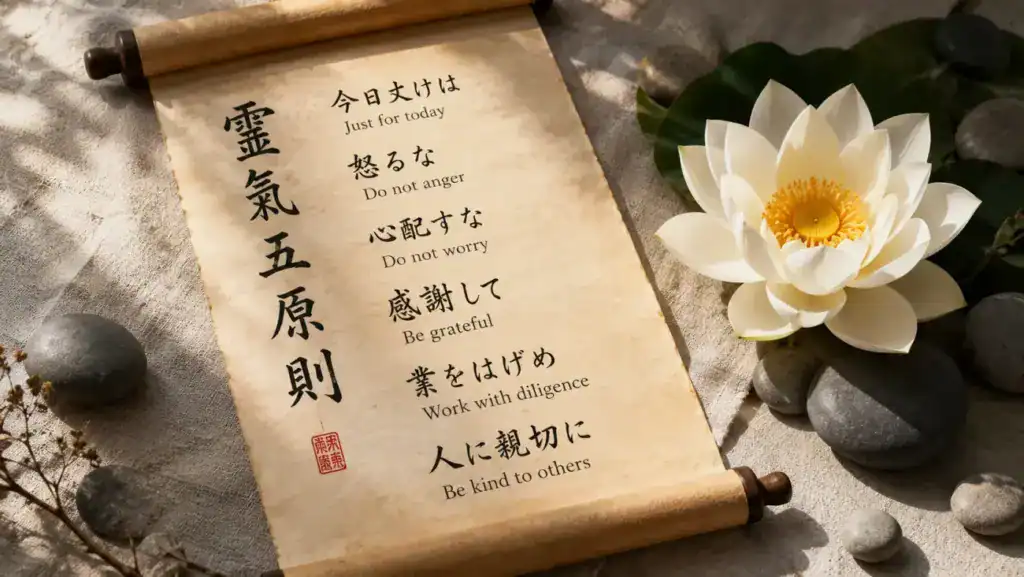
Students often ask me what separates Reiki from other energy healing modalities. My answer is always the same: the Gokai. Mikao Usui considered his five precepts to be at least as important as the hands-on healing itself. He stated explicitly that Reiki is 50% precepts and 50% energy.
The Gokai in their original Japanese form:
- Kyo dake wa – Just for today
- Ikaru na – Do not be angry
- Shinpai suna – Do not worry
- Kansha shite – Be grateful
- Gyo o hage me – Work diligently and honestly
- Hito ni shinsetsu ni – Be kind to others
Usui Sensei called these principles shoufuku no hihoo (the secret art of inviting happiness) and manbyo no ley-yaku (the spiritual medicine for all illness). He instructed his students to recite them every morning and evening, seated in the gassho position (hands in prayer), both aloud and in the heart.
The phrase “just for today” was deliberate. It does not demand perfection across a lifetime. It asks only for the present moment. In my own experience working with hundreds of students, this single phrase dissolves more resistance to healing than any technique I have ever taught.
What Happens During a Reiki Session: The Honest Explanation
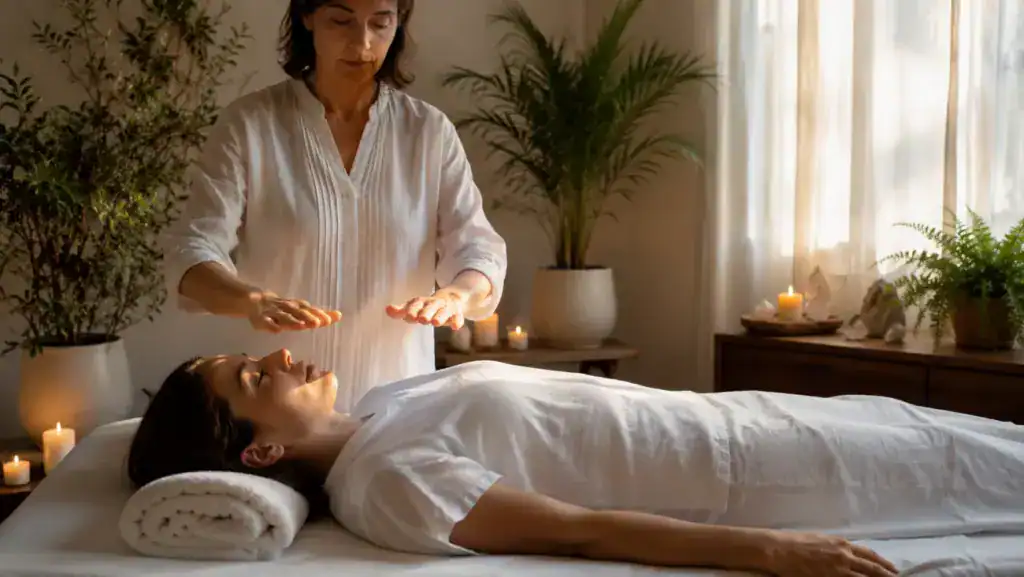
A Reiki practitioner channels universal life force energy through their hands, either through light touch or by holding their hands just above the body. The recipient remains fully clothed and typically lies on a treatment table. Sessions generally last between 45 and 90 minutes.
The practitioner works through a sequence of hand positions covering the head, torso, back, and limbs. Each position is held for two to five minutes. The energy does not originate from the practitioner’s personal reserve. This is a critical and often misunderstood point. Reiki practitioners do not deplete their own energy. They act as a conduit, much like a wire conducts electricity without becoming the electricity.
Recipients commonly report warmth, tingling, deep relaxation, spontaneous emotional release, or simply a profound sense of calm. Some fall asleep. Some notice colours or images. Some feel nothing unusual in the moment but report improved sleep and reduced pain in the days following.
What is equally important to state clearly: Reiki is a complementary practice. It works alongside conventional medical treatment, not instead of it. A Reiki session before surgery reduces pre-operative anxiety. A session during cancer treatment supports the management of fatigue and nausea. A session after a difficult week can reset the nervous system in ways that an hour of ordinary rest does not.
Disclaimer: The information in this article is intended for educational purposes only and does not constitute medical advice. Reiki and energy healing are complementary practices and are not a substitute for professional medical treatment. Always consult a qualified healthcare professional for medical concerns.
The Science of Reiki: What Verified Research Actually Shows
The scientific investigation of Reiki has grown substantially in the past decade. The following research findings are drawn from peer-reviewed publications.
Quality of Life: The 2025 Meta-Analysis
A systematic review published in March 2025 in Systematic Reviews (Liu et al., 2025, DOI: 10.1186/s13643-025-02811-5) analysed randomised controlled trials involving 661 participants aged 14 and above. The study found a statistically significant improvement in quality of life following Reiki therapy, with a standardised mean difference of 0.28 (95% CI 0.01 to 0.56, p = 0.043). The analysis further identified that sessions of 8 or more at 60 minutes each produced the strongest results.
Mental Health: Depression, Anxiety, and Stress
A review published in the journal Complementary Therapies in Clinical Practice concluded that Reiki demonstrates a consistently greater therapeutic effect than placebo for clinically relevant levels of depression and stress, with high-grade evidence. Evidence for anxiety reduction was rated moderate to high. The reviewers concluded that incorporating Reiki as a complementary treatment alongside mainstream psychotherapy for depression and stress is appropriate.
Cancer Care: Fatigue and Pain
A 2026 study published in the Holistic Nursing Practice Journal (DOI: 10.1097/hnp) found that cancer patients who received Reiki sessions experienced statistically significant reductions in fatigue, along with effective pain and stress alleviation and improved overall quality of life.
Postmenopausal Symptoms and Depression: 2025 Randomised Trial
A randomised controlled trial published on August 8, 2025 in a Brazilian medical journal (DOI: 10.1590/1806-9282.20250076) by researchers Esra Sabanci Baransel and Tuba Ucar of Inonu University in Turkey examined 82 postmenopausal women. Four weekly Reiki sessions produced measurable reductions in menopausal symptoms and depression levels compared to the control group who received only routine care.
Reiki in Hospitals: A Mainstream Reality
According to a 2025 study published in SAGE Open Medicine (PMC11873885), more than 800 hospitals, representing approximately 15% of all hospitals in the United States, now offer Reiki as part of their patient services. These include major academic medical centres such as Brigham and Women’s Hospital, M.D. Anderson Cancer Center, and California Pacific Medical Center.
Brigham and Women’s Hospital alone has over 60 volunteer Reiki practitioners on staff and has provided more than 40,000 Reiki sessions to patients, family members, and hospital staff over an eight-year period.
The Three Levels of Reiki Training: What Each One Actually Involves
Reiki is transmitted through a process called attunement, in which a Reiki Master uses a specific ritual to open the student’s energy channels and align them to the Reiki frequency. Without attunement, a person cannot practice Reiki regardless of how much they read or study.
Reiki Level 1 (Shoden)
The first degree focuses on self-healing and in-person healing of others. Students receive four attunements, learn the hand positions, and begin working with Reiki energy directly on the physical body. This level is appropriate for anyone seeking personal healing and is not restricted to those intending to become practitioners.
Reiki Level 2 (Okuden)
The second degree introduces three sacred symbols: the power symbol (Cho Ku Rei), the mental/emotional symbol (Sei Hei Ki), and the distance symbol (Hon Sha Ze Sho Nen). This third symbol is what enables distance Reiki healing, the ability to send healing energy across any physical distance, whether across a room or across an ocean. The scientific principle underlying distance Reiki is currently studied under the framework of non-local consciousness and quantum biofield theory.
Reiki Level 3 (Shinpiden) and Master Teacher
The third degree is the Master level. It involves receiving the Master symbol (Dai Ko Myo) and, at the Teacher level, learning to attune others. A Reiki Master Teacher carries the lineage of the system and the responsibility of transmitting it accurately to future generations.
I have found, after years of training students at every level, that each degree shifts something fundamental in the person receiving it. Level 1 opens perception. Level 2 deepens understanding. The Master degree is less an arrival than a deepening of ongoing commitment.
Distance Reiki and Chi Ball Attunements: How Remote Healing Works
One of the most common questions students and newcomers ask is whether Reiki can genuinely work at a distance. The answer, verified by thousands of practitioners worldwide and supported by an emerging body of biofield research, is yes.
The Hon Sha Ze Sho Nen symbol, introduced at Level 2, is understood to transcend linear time and physical space. When a practitioner activates this symbol and sets a clear intention, the Reiki energy connects with the recipient regardless of location. Recipients in organised distance healing studies have reported the same experiences, warmth, tingling, emotional release, and deep calm, as they do during in-person sessions.
A Chi Ball attunement is a specific method used to deliver Reiki attunements remotely. The Reiki Master creates a sphere of energy programmed with the attunement and sets an intention for the student to receive it at a designated time. This method is used by practitioners worldwide, including in our own ISRG Healing courses, to provide genuine attunements to students who cannot attend in person.
What Reiki Is Not: Clearing the Most Common Misconceptions
Reiki is not a religion
Usui Sensei was explicit on this point. He designed Reiki to be accessible to every person regardless of religious belief or cultural background. Practitioners of Christianity, Islam, Hinduism, Buddhism, Judaism, and no religion at all practice Reiki without contradiction. The Gokai principles are ethical, not theological.
Reiki is not massage
There is no manipulation of muscles or soft tissue. The practitioner’s hands either rest gently on the body or hover above it. Reiki works with the biofield, the energy body that surrounds and permeates the physical form, not with the physical structure itself.
Reiki does not require belief to work
This is perhaps the most liberating fact about Reiki. Sceptics, agnostics, and people with no interest in spiritual practice have experienced measurable results from Reiki sessions. The energy functions independently of the recipient’s belief system. What belief does affect is a person’s willingness to relax deeply enough to receive the healing, which is why an open mind, though not mandatory, is genuinely helpful.
Reiki is not a cure
No honest Reiki practitioner will claim that Reiki cures disease. What Reiki does is support the body’s innate intelligence and natural healing capacity. It reduces the energetic and emotional interference that slows recovery. It creates the internal conditions under which healing becomes more possible.
Who Can Benefit from Reiki
The short answer is: almost anyone. Reiki is safe for all ages, from newborns to the elderly. It is used with premature infants in neonatal units, with adults in surgical recovery, with cancer patients in oncology wards, with individuals managing chronic pain, anxiety, grief, burnout, and with people in perfectly good health who simply want to maintain their energetic wellbeing.
Students often ask me whether they need to be experiencing a health problem to benefit from Reiki. My answer is always no. Reiki is not only a response to illness. It is a practice of maintenance, balance, and conscious living. Some of the most powerful sessions I have witnessed have occurred in people who were, by conventional measures, completely fine but who were carrying invisible weight that Reiki helped them put down.
How to Begin Your Reiki Journey
There are two primary entry points into Reiki. The first is receiving a Reiki session from a trained practitioner, either in person or at a distance. This gives you a direct experience of the energy before committing to any further study. The second is enrolling in a Reiki Level 1 course and receiving your own attunement, which gives you the ability to practice Reiki on yourself daily.
Self-healing through Reiki is one of the most underutilised tools available to anyone willing to learn it. Twenty minutes of daily self-Reiki, practiced consistently, has been observed to produce significant shifts in stress levels, sleep quality, and emotional regulation within two to four weeks.
If you are considering formal training, look for a teacher who can clearly trace their Reiki lineage back to Mikao Usui, who teaches the Gokai as a central component of the system, and who offers genuine attunements rather than symbolic ones.
Discover more from Isrg Healing
Subscribe to get the latest posts sent to your email.
