

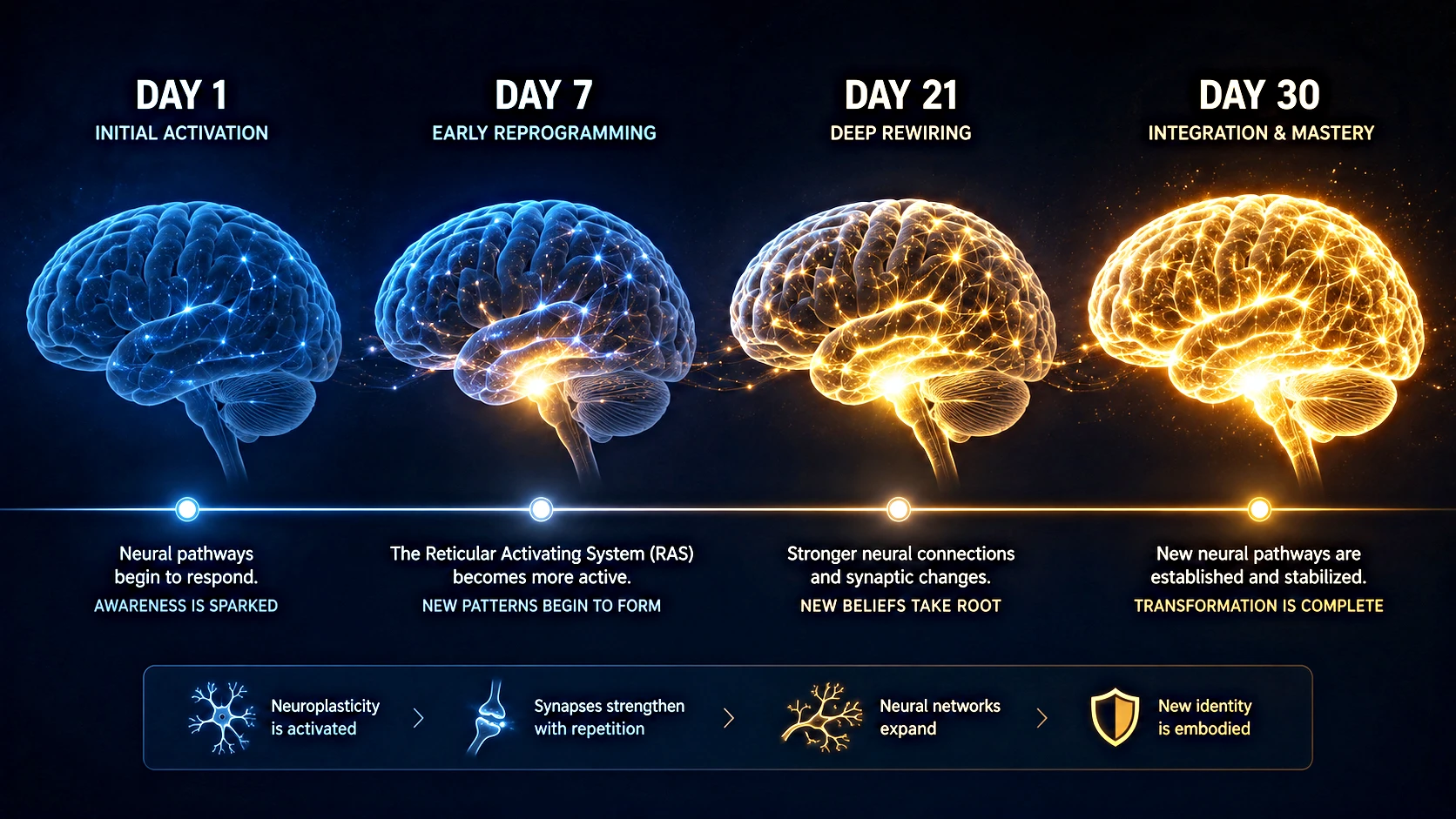
The most common complaint about manifestation is that it works for some people and seems to do nothing for others. What most guides leave out is the part that actually explains both outcomes: the biology. Manifestation is not an event that either happens or does not. It is a process that unfolds in the brain across a specific timeline, with measurable changes occurring in distinct phases. When you understand what your brain is actually doing during each week of a consistent practice, the process stops feeling mysterious and starts feeling like what it is: a structured form of neural training.
This article maps what the neuroscience research shows happens in the brain across a genuine 30-day daily manifestation practice. Not the motivational version. The accurate version, including what the research actually supports, what the honest timelines are, and why most people stop before the changes become visible. The sequence described here applies whether you are practicing visualization, scripting, affirmation, or Neville Goddard’s SATS technique the underlying brain mechanisms are the same.
Contents of Your Brain When You Manifest Every Day for 30 Days
Before Day 1: What Your Brain Looks Like Before You Start
Before mapping what changes, it helps to understand the baseline. The brain you bring to a manifestation practice on Day 1 has been shaped by years of established patterns: specific neural pathways that have been reinforced through repetition until they fire automatically, an RAS calibrated to filter daily experience through the lens of the established self-concept, and a Default Mode Network running a self-narrative built from accumulated experience.
The prefrontal cortex, which is responsible for goal-directed thinking and future-oriented planning, is competing for processing resources with the amygdala’s habitual threat responses and the dorsal striatum’s established automatic behavioral patterns. In most people, the amygdala and striatum win most of the time not because of weakness, but because established patterns are neurologically faster and more energy-efficient than deliberate new ones. Understanding this baseline is important because it explains why Day 1 and Day 7 feel very different from Day 21 and Day 30. The early days are working against an established neurological tide.
Days 1 to 7: The RAS Begins Calibrating
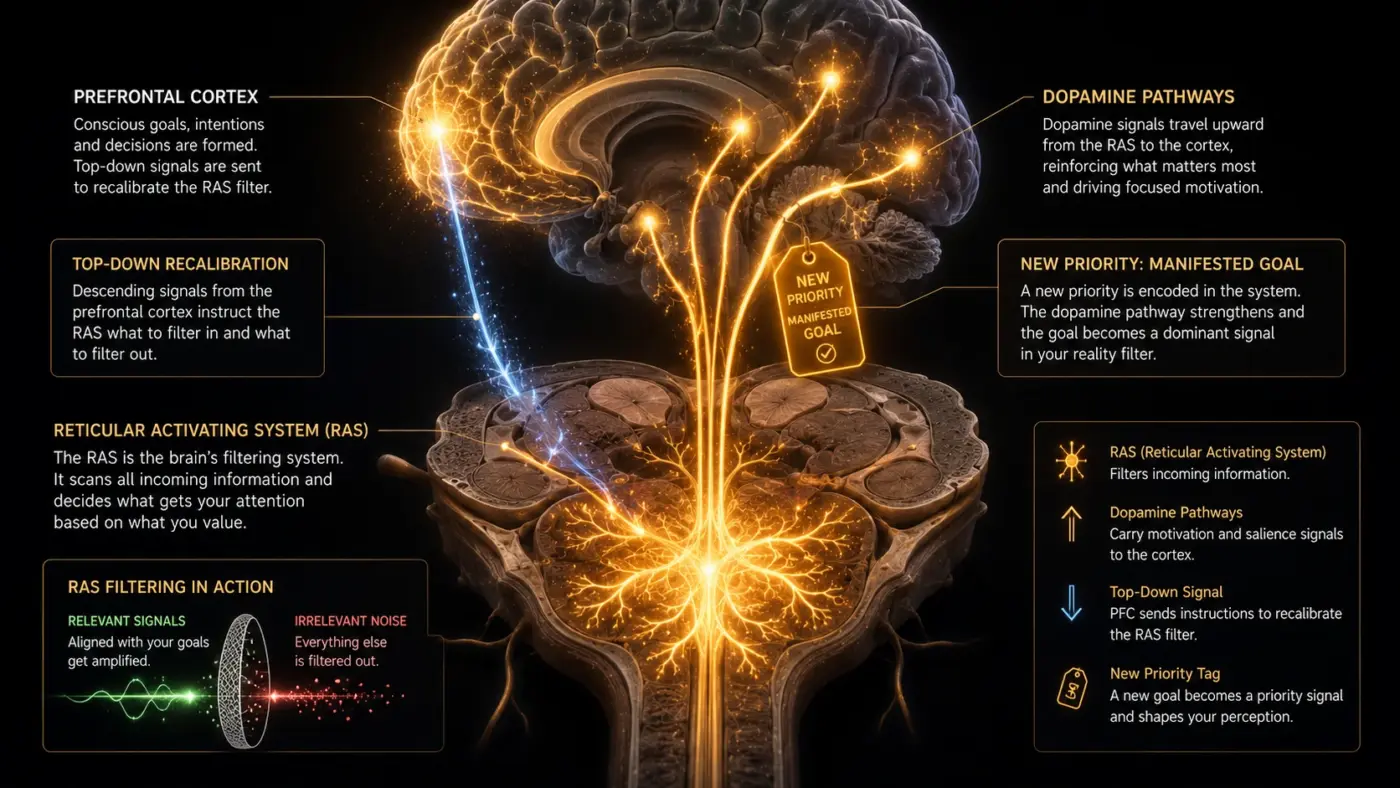
The first week of daily manifestation practice initiates changes in the brain’s attention and filtering systems before any structural change has occurred. The Reticular Activating System, the network of neurons in the brainstem that determines what information from the environment reaches conscious awareness, begins receiving new priority signals from the prefrontal cortex when a specific, emotionally meaningful intention is consistently held.
The RAS uses dopamine as one of its primary signaling molecules. As research documented in ScienceDirect’s overview of the RAS and its neurotransmitter systems confirms, the dopaminergic pathways running through the RAS are central to attention direction and goal-motivated behavior. When you consistently and emotionally engage with a specific intention, the dopamine system begins tagging that intention as a priority target, which shifts what the RAS flags as relevant in the environment.
In practical terms: by the end of the first week, people practicing daily manifestation with genuine emotional engagement typically begin noticing things they had not noticed before. Information relevant to the stated intention surfaces into awareness. Connections that were always present but previously filtered out start appearing. This is not synchronicity in the mystical sense it is the RAS beginning to shift its filtering criteria in response to the new dopamine-tagged priority. It is the earliest and most reliable signal that the practice is working.
What is not happening yet in Week 1 is structural neural change. The pathways are being stimulated more frequently, but Hebb’s Law neurons that fire together, wire together requires consistent repetition over time before new connections are physically strengthened. Week 1 is priming, not rewiring.
What Blocks Week 1 Progress
The most common Week 1 failure is emotional flatness during the practice. A visualization session conducted in a detached, analytical way produces minimal RAS response because the RAS responds to emotional salience, not cognitive content alone. If the practice feels like a to-do list item rather than a genuinely felt experience, the dopamine signaling that drives RAS recalibration is weak, and the Week 1 attention shifts either do not occur or are subtle enough to be dismissed. Emotional presence during the session is not optional it is the mechanism.
Days 8 to 14: The Default Mode Network Begins Loosening
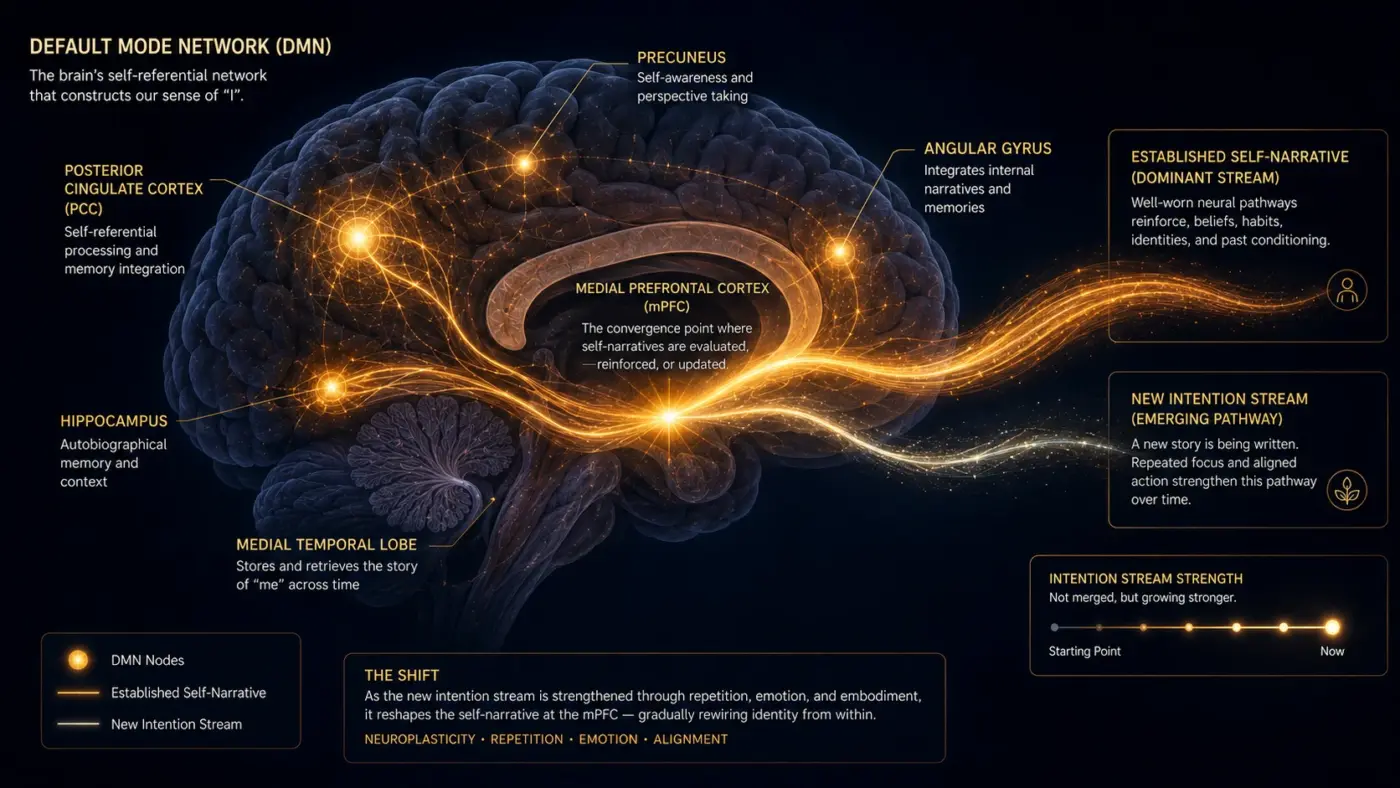
The second week marks the beginning of changes in the Default Mode Network, the brain’s internal narrator. As described in the article on this site about the Default Mode Network, this network constructs and maintains the autobiographical self-narrative the ongoing story about who you are and what is possible for someone like you. It preferentially surfaces memories, generates spontaneous thoughts, and frames new experience consistent with the established self-concept.
During Week 2 of consistent daily practice, the repeated introduction of a new intentional content a desired self-concept or outcome experienced as felt reality begins competing with the established DMN narrative. The DMN does not change quickly. But research on mindfulness-based interventions, including a well-cited study from Massachusetts General Hospital showing measurable DMN changes after eight weeks, suggests that consistent daily practice of internally directed attention work does begin shifting DMN activity patterns within two to three weeks. The mechanism is the same whether the practice is meditation or manifestation: repeated, sustained, internally directed attention directed away from the habitual self-narrative gradually reduces its automatic dominance.
In Week 2, this shows up as spontaneous moments of a different quality of thinking thoughts arising unprompted that are aligned with the desired outcome rather than with the established pattern. These moments are brief and easily dismissed. Recognizing them as evidence that the DMN is beginning to update is important for maintaining consistency through this phase, which is typically when motivation begins to drop because the external circumstances have not yet changed.
The Week 2 Motivation Dip
Week 2 is where most manifestation practices are abandoned. The initial enthusiasm from starting something new has faded. There are no external results yet. The internal shifts are subtle and easy to rationalize as imagination. This is the critical neurological threshold: the practice has begun producing real internal changes, but those changes are not yet stable enough to be self-sustaining. Stopping at Week 2 means the neurological investment made in Week 1 dissipates without producing lasting change. The brain returns to its established baseline. This is the specific mechanism behind the common experience of “I tried it for a while and nothing happened.”
Days 15 to 21: Neuroplastic Change Begins Accumulating
Week 3 is where the research on neuroplasticity and habit formation becomes most directly relevant. The popular claim that habits form in 21 days comes from a misreading of Maxwell Maltz’s 1960 observations in Psycho-Cybernetics, where he noted that amputees took a minimum of 21 days to stop feeling phantom limb pain. This minimum was subsequently misrepresented as an average and then as a universal rule. The actual research most definitively documented in Phillippa Lally and colleagues’ 2010 study at University College London, published in the European Journal of Social Psychology found that habit formation ranged from 18 to 254 days depending on the behavior and individual, with an average around 66 days.
What does happen around Day 21 is more specific: the neural pathways being stimulated by consistent daily practice have received enough repeated activation to begin showing measurable strengthening. This is not yet stable automaticity it is the threshold at which the new pattern starts to feel somewhat more natural than it did in Week 1, because the relevant neurons have been firing together consistently enough to strengthen their synaptic connections. Research on cognitive training and neuroplasticity consistently identifies a three-week threshold as when early practice effects begin accumulating into something detectable, even if full consolidation takes considerably longer.
Emotionally, Week 3 often brings a qualitative shift in how the practice feels. The visualization or intention-setting session starts to feel less effortful and more natural. The felt emotional state during the session becomes more accessible and more genuine. For people who reach Week 3 without abandoning the practice, this shift is usually what reinforces continuation the practice itself begins to feel rewarding rather than just dutiful.
Sleep and Overnight Consolidation During Weeks 2 and 3
One aspect of the 30-day neurological process that most manifestation guides ignore is what happens during sleep. As established in the article on this site about reprogramming the subconscious during sleep, the sleeping brain consolidates what was most emotionally salient at sleep onset. During Weeks 2 and 3, the daily practice is generating neural activity patterns that the brain’s overnight consolidation processes specifically slow-wave sleep hippocampal replay and REM theta integration are working on each night. The day’s practice and the night’s consolidation are a cycle, not separate events. Consistent daily practice means consistent nightly consolidation. This is why gaps in the practice during this phase are more disruptive than they might appear: each missed day breaks a consolidation cycle.
Days 22 to 30: Behavioral Alignment and External Shifts
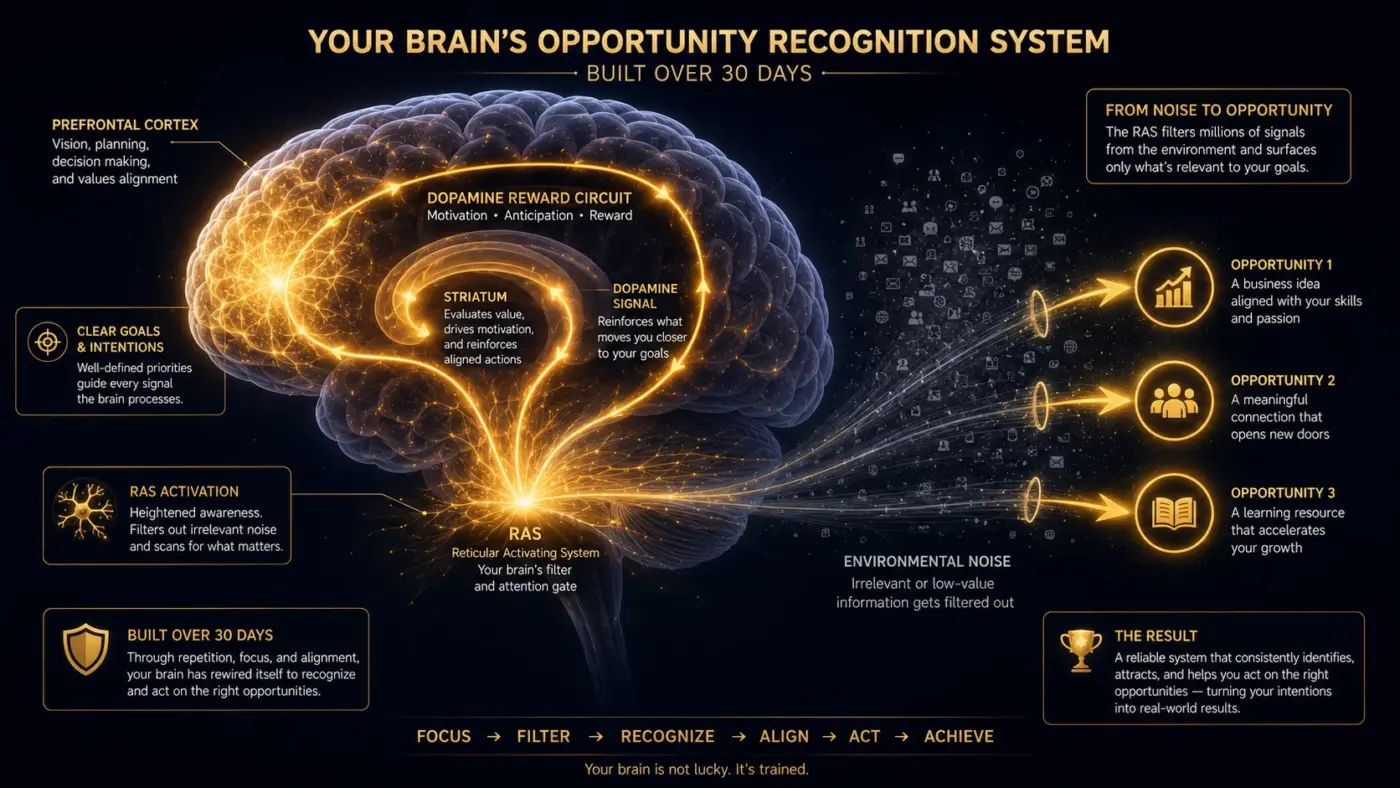
The final phase of the 30-day cycle is where the internal neurological changes begin translating into behavioral changes visible enough to affect external circumstances. This occurs through two mechanisms that now operate more reliably than they did in Week 1.
The first is the RAS, which by Week 4 has been recalibrated significantly enough to be surfacing relevant opportunities, information, and connections into conscious awareness on a consistent rather than occasional basis. The person genuinely begins noticing more relevant possibilities not because they appeared from nowhere, but because they were always in the environment and are now being filtered through instead of filtered out.
The second is behavioral congruence. As the new self-concept established through consistent manifestation practice strengthens neurologically, behavior begins to naturally align with it in ways that require less conscious effort than they would have in Week 1. Decisions that support the desired outcome feel more natural. Choices that contradict it produce more noticeable internal friction. This is the dopamine reward system and the prefrontal cortex working together: the goal is now more neurologically established, and the motivational and decision-making systems increasingly orient toward it automatically.
Research on goal pursuit documented by NYU psychology professor Peter Gollwitzer and colleagues established that goals that have been translated into specific implementation intentions concrete “when X situation occurs, I will do Y” plans produce significantly higher follow-through rates than goals held in abstract form. By Week 4, a well-established manifestation practice naturally generates these implementation intentions through increased clarity, more frequent noticing of relevant opportunities, and reduced internal friction around aligned behavior.
What External Change Looks Like at Day 30
An honest account of what typically manifests externally by Day 30 varies considerably depending on the nature of the goal, the depth of the contradicting subconscious programs being overwritten, and the degree of aligned action taken alongside the mental practice. For goals that require primarily a change in how the person shows up in communication, confidence, decision-making, or creative output 30 days of consistent practice often produces visible and acknowledged change. For goals that require significant external circumstances to shift financial situations, long-term relationships, professional trajectories 30 days typically produces clear internal change and initial external signals without complete external transformation.
This is not a failure of the method. It is the honest timeline of neuroplastic change. The brain changes before the world does, and internal shifts precede external ones with a lag that depends on how much of the external change is within the person’s direct behavioral influence versus how much depends on other people or complex systems outside their control. Managing this timeline honestly expecting internal change first and tracking it carefully is what prevents the Day 30 disappointment that abandons practices that were actually working.
Beyond 30 Days: What the Research Shows About Deeper Change
Thirty days is a significant threshold, but it is not the completion of the process for most people working with deeply established limiting patterns. The UCL habit research found an average of 66 days for simple behavioral habits and up to 254 days for complex ones. Deep identity-level change the kind that alters the subconscious narrative about who you are and what is possible for you operates on the longer end of this range.
The neuroplasticity research reviewed in a 2026 article from Naturalistico, synthesizing current scientific understanding, states this directly: “Automaticity takes time, and people vary in how quickly a new action starts to feel natural. Repetition, rhythm, shared structure, and meaningful routine have always been core tools for making change stick.” The 30-day practice described here is the foundation. Sustained practice beyond 30 days is where the changes from the first month consolidate from fragile new pathways into something genuinely automatic and stable.
For people whose manifestation practice incorporates Reiki self-healing alongside the visualization and intention-setting work, the energetic dimension of the subconscious programming is being addressed simultaneously with the neural dimension. The Reiki healing reduces the energetic charge of the contradicting limiting belief the resistance the new neural pathway has to overcome which is why students combining Reiki with consistent manifestation practice tend to find the neural reprogramming work producing results more quickly than those doing the cognitive practice alone.
The Honest Variables: Why Results Differ Between People
The 30-day timeline described above assumes consistent daily practice with genuine emotional engagement, adequate sleep for overnight consolidation, and aligned action taken alongside the mental work. Change any one of these variables and the timeline shifts. Change several and the practice produces minimal neurological effect regardless of the method used.
Emotional engagement during sessions is the variable with the greatest impact on timeline. The brain’s neuroplastic response to experience is proportional to the emotional intensity of that experience. A genuinely emotionally present 10-minute session will produce stronger and faster neural pathway changes than a 30-minute session conducted with detached mechanical repetition. This is documented consistently in research on experiential learning and memory formation: emotional salience is the primary amplifier of neuroplastic change.
Sleep quality is the second most impactful variable. Insufficient or disrupted sleep compromises both the consolidation of the day’s practice during the night and the prefrontal cortex’s capacity to maintain emotional presence during the next day’s practice. A manifestation practice conducted alongside chronic sleep deprivation is working against the brain’s own consolidation mechanisms at every step.
The presence of deeply established contradicting subconscious programs particularly those installed before age seven during the brain’s theta-dominant childhood window is the third variable. These programs are more thoroughly embedded and better supported by established neural infrastructure than patterns installed in adulthood. They typically require longer practice timelines and benefit significantly from approaches that address the energetic dimension of the subconscious alongside the cognitive practice.
Disclaimer: The information in this article is for educational purposes only and does not constitute medical advice. Always consult a qualified healthcare professional for medical concerns.
FAQs:
What actually changes in the brain during a 30-day manifestation practice?
During a consistent 30-day manifestation practice, the brain undergoes changes across several systems at different stages. In the first week, the Reticular Activating System begins recalibrating its filtering criteria in response to consistently held emotionally meaningful intentions, causing relevant opportunities and information to surface into awareness more frequently. In Weeks 2 to 3, the Default Mode Network’s habitual self-narrative begins loosening as the new intentional content competes with established patterns, and neural pathways associated with the new goal begin strengthening through repeated activation via the mechanisms of synaptic plasticity. By Week 4, behavioral congruence with the new goal-state increases as the prefrontal cortex’s goal-direction systems and the dopamine reward circuit orient more consistently toward the established intention. Overnight consolidation through slow-wave sleep replay and REM theta integration reinforces each day’s practice throughout the cycle.
How long does it take for manifestation to actually work?
Based on neuroplasticity research, including Phillippa Lally and colleagues’ 2010 UCL study published in the European Journal of Social Psychology, habit formation ranges from 18 to 254 days, with an average around 66 days. Thirty days of consistent daily practice typically produces clear internal changes — in emotional baseline, quality of attention, noticing of relevant opportunities, and alignment of spontaneous thought — but full external transformation of complex circumstances typically requires continued practice beyond 30 days. The specific timeline for any individual depends on the emotional depth of the practice, sleep quality, the degree of contradicting subconscious programming involved, and the amount of aligned action being taken alongside the mental practice.
Why do most people quit manifestation practice in Week 2?
Week 2 is the phase when initial enthusiasm has faded, internal changes are subtle enough to be dismissed or rationalized, and external circumstances have not yet shifted. This combination creates the perception that the practice is not working, when neurologically the brain has in fact begun making real changes — RAS recalibration has started, the Default Mode Network is beginning to loosen, and overnight consolidation is reinforcing each session’s work. Stopping at Week 2 means the neurological investment made in Week 1 dissipates without producing lasting change as the brain returns to its established baseline. Knowing the specific changes that are occurring invisibly during Week 2 — and that external results lag internal ones by weeks to months — is the primary factor that determines whether someone continues through the critical second week.
Does Reiki healing speed up the 30-day manifestation brain change process?
Reiki self-healing addresses the energetic dimension of subconscious programming that the neural reprogramming process works alongside. Specifically, the energetic charge maintained by limiting beliefs in the chakra system generates the emotional frequency that contradicts the manifestation intention during practice sessions, reducing their neuroplastic effectiveness. When Reiki healing clears this energetic charge in the relevant chakra center — for example, the Solar Plexus Chakra for self-worth limiting beliefs, or the Root Chakra for safety and scarcity patterns — the manifestation practice sessions encounter less internal resistance and produce stronger emotional engagement, which directly amplifies the neuroplastic response. Students who combine daily Reiki self-healing with consistent manifestation practice typically find the internal changes of the 30-day cycle becoming accessible earlier and more stably than those doing the cognitive practice alone.
Related Guides
- Manifestation Without Action: The Lie That Is Keeping You Stuck
- Tesla 369 Method: The Truth Behind the Most Viral Manifestation Technique
- Reticular Activating System and Visualization: The Brain Science
- Why Your Manifestation Is Not Working and How to Fix It
- What Is Manifestation and How Does It Really Work