
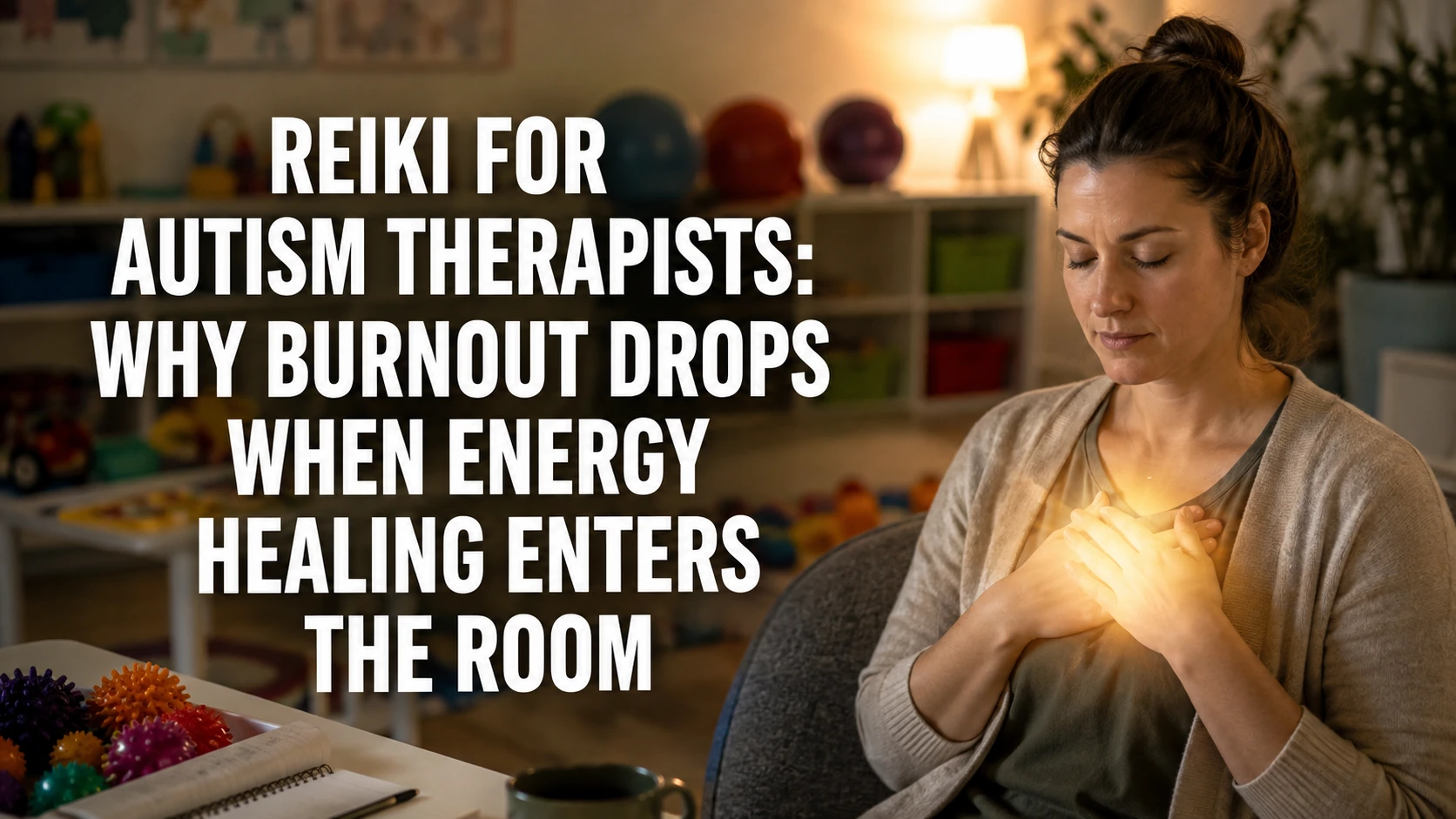
Walk into almost any autism center and you will find the same pattern repeating itself quietly behind the scenes. Behavior therapists, speech therapists, and special educationists giving everything they have to children who need intensive, sustained, emotionally demanding support, day after day, often with minimal recognition and even less support for their own wellbeing. The clinical term for what eventually happens to many of them is burnout. A large 2022 study from Punjab, Pakistan, involving 450 professionals across 51 autism centers, measured what happened when Reiki was introduced into that exact environment, and the results are worth far more attention than they have received.
Contents of Reiki For Autism
The Burnout Crisis Hiding Inside Autism Therapy
Burnout among professionals who work with autistic children is not a minor occupational hazard. It is a measurable, well-documented crisis. A study examining healthcare workers serving children with autism spectrum disorder found that emotional exhaustion scores averaged 62 percent, depersonalization scores averaged 23.7 percent, and only 76.5 percent retained a sense of personal accomplishment in their work. These numbers describe a workforce that is, on average, running on empty.
The reasons are not difficult to understand once you sit with them. Behavior therapists and speech therapists working with autistic children frequently manage intense sensory environments, unpredictable behavioral episodes, slow and incremental progress that requires enormous patience to sustain motivation around, and emotionally complex relationships with families who are often navigating their own grief, fear, and exhaustion. Special educationists carry the added weight of working within systems that are frequently underfunded and understaffed relative to the level of need.
This is precisely the population that researchers at Ijaz Psychiatric Institute in Lahore, Pakistan, set out to study when they asked a direct question: can Reiki measurably reduce burnout in the professionals who keep autism centers running?
Disclaimer: The information in this article is intended for educational purposes only and does not constitute medical advice. Reiki and energy healing are complementary practices and are not a substitute for professional medical treatment. Always consult a qualified healthcare professional for medical concerns.
Inside the Study: Scale, Structure, and Method
The research, approved by the Ethics Review Committee of Ijaz Psychiatric Institute, was conducted using a correlational research design with recruitment beginning in November 2019 and concluding in March 2020. This timing is itself notable, as the study concluded just as the global pandemic began reshaping mental health and workplace stress conversations worldwide.
The scale of the study sets it apart from most Reiki research, which typically involves sample sizes in the dozens. This study enrolled 450 participants, of whom 346 completed the full Reiki training. The professional composition was specific and clinically relevant: 146 behavior therapists, 104 speech therapists, and 96 special educationists, drawn from 51 separate autism centers across Punjab province. Burnout was measured using the Teacher Burnout Scale, a validated instrument designed to assess occupational exhaustion in education and therapy-based professions.
An interesting methodological detail emerged in how Reiki was delivered. Eighteen percent of participants received training in Sufi Reiki, a lineage variation that integrates Sufi spiritual practice with the Usui energy healing framework, while the remaining participants trained in the traditional Usui Reiki healing system. Attunements were delivered through two formats: 37 percent received attunement through LISCA, a distance attunement protocol, while the remaining 62 percent received their attunement over Skype. This detail matters for a specific reason: it demonstrates that the measured benefits occurred even when attunements were delivered entirely remotely, with no in-person contact between Reiki Master and participant required for the effect to register.
What the Data Actually Showed
The results were unambiguous. A paired t-test comparing burnout scores before and after the Reiki intervention showed a statistically significant difference (t = 1.89, df = 24, p less than .000). The researchers’ published conclusion stated directly that there was a significant difference in the mean burnout scores of professionals working in autism centers after implementing Reiki, with burnout levels decreasing following the intervention.
Beyond the primary burnout measure, the study captured a striking pattern in participant-reported benefits. Seventy-six percent of participants reported that Reiki had benefited their overall comfort level. Within that group, pain relief was reported by 41 percent of respondents, while a substantial 88 percent reported that Reiki provided them with relaxation. The researchers specifically highlighted a finding that deserves attention from every center director managing a therapy staff: burnout was found to be more likely among autism therapists specifically when they were working within an unsatisfied or unsupportive working environment. In other words, the data suggests that organizational culture and individual energetic depletion are not separate problems. They compound each other.
| Measured Outcome | Result |
|---|---|
| Total participants enrolled | 450 (346 completed training) |
| Autism centers involved | 51, across Punjab province |
| Professional composition | Behavior therapists (146), speech therapists (104), special educationists (96) |
| Burnout reduction significance | t = 1.89, df = 24, p < .000 |
| Reported improved comfort level | 76% of participants |
| Reported relaxation benefit | 88% of participants |
| Reported pain relief benefit | 41% of participants |
This Is Not an Isolated Finding: The US Clinician Study

The Pakistan autism therapist study does not stand alone in the research literature. A separate, methodologically rigorous study published in the Journal of Alternative and Complementary Medicine in 2015 examined whether Reiki could reduce burnout specifically in community mental health clinicians, a profession that shares significant overlap with autism therapy in terms of emotional labor and chronic occupational stress exposure.
This study used a crossover design, considered one of the stronger methodologies in clinical research, comparing genuine Reiki against sham Reiki, a placebo treatment designed to mimic the physical experience of Reiki without the energetic intention. Outcomes were measured using the Maslach Burnout Inventory, the same gold-standard instrument referenced in burnout research worldwide, alongside the Measure Your Medical Outcome Profile. The published conclusion stated clearly that the effects of genuine Reiki were statistically differentiated from sham Reiki, and that Reiki could be helpful in community mental health settings specifically for supporting the mental health of the practitioners themselves, not only their clients.
Taken together, these two studies, conducted on different continents, with different populations, nearly a decade apart, both arrive at the same conclusion through different methodologies: Reiki produces a measurable, placebo-differentiated reduction in occupational burnout among helping professionals working in emotionally demanding clinical environments.
Why Autism Therapists Specifically Carry This Risk
Understanding why autism therapy produces such a distinct burnout pattern requires looking beyond generic workplace stress. The work itself involves a specific combination of factors rarely found together in other professions. Progress is frequently slow and non-linear, requiring therapists to sustain motivation and emotional investment over months or years without the regular positive feedback loops that sustain morale in most jobs. Sensory environments are often genuinely challenging, involving loud or unpredictable behavioral episodes that activate a therapist’s own nervous system repeatedly throughout a single session. The emotional proximity to family grief and fear is constant, as therapists routinely witness and absorb the anxiety, exhaustion, and sometimes desperation of parents navigating a diagnosis that reshapes their entire family life.
What makes this combination particularly corrosive over time is that the very skills that make someone an excellent autism therapist, deep empathy, sustained patience, and emotional attunement to nonverbal cues, are the same qualities that leave them most vulnerable to absorbing the emotional and energetic load of the room without an adequate system for releasing it.
Why Reiki Specifically Appears to Help This Population
Students often ask me why Reiki, rather than other stress-reduction approaches, appears repeatedly in research involving high-emotional-labor professions. My answer, after years of working with practitioners and caregivers in demanding helping roles, is that Reiki addresses something that generic relaxation techniques do not directly target: the practitioner’s own energetic boundary.
A behavior therapist working closely with a dysregulated child for an extended session is not only managing the child’s behavior. They are also, often unconsciously, absorbing a portion of the emotional and energetic intensity present in that interaction. Without a practice that actively releases and clears that accumulated load, it compounds session after session, day after day, until the body and mind register it as chronic exhaustion. Reiki, whether self-administered or received from a practitioner, functions as a clearing mechanism for exactly this kind of accumulated energetic residue.
This is consistent with what the Pakistan study’s qualitative data suggests. The overwhelming majority of participants, 88 percent, reported relaxation as the primary benefit, which aligns precisely with the mechanism of energetic clearing rather than simply distraction or rest.
What a Practical Reiki Practice Looks Like for a Working Therapist

For a therapist with a full caseload and limited time, the question is rarely whether Reiki helps, but whether it is realistic to incorporate into an already demanding schedule. Based on both the structure of the Pakistan study and what I have observed training professionals in similarly demanding caregiving roles, a sustainable approach does not require hour-long sessions.
A brief self-Reiki practice of 10 to 15 minutes, performed at the end of a workday before transitioning home, is often more practically valuable than a longer but infrequent session. This is consistent with separate research from Chicago, where 1,724 brief ten-minute Reiki sessions delivered to members of high-stress communities produced a 72.62 percent average reduction in self-reported stress and a 63.34 percent reduction in reported pain, both statistically significant at p less than 0.01. The pattern across the research is consistent: brief, consistent Reiki practice produces meaningful results even without lengthy session times, which makes it a genuinely realistic option for time-constrained helping professionals.
For therapy centers and clinic directors, the Pakistan study’s finding regarding unsatisfied working environments suggests that introducing Reiki training as an organizational wellness offering may be most effective when paired with broader attention to workplace culture, rather than positioned as a standalone fix for a systemic problem.
What This Research Does Not Claim
It is important to state plainly what this research does not establish. Reiki is not a substitute for adequate staffing, fair compensation, manageable caseloads, or organizational support systems, all of which remain the primary structural drivers of occupational burnout. Neither study suggests that Reiki alone can resolve burnout in a workplace environment that is fundamentally unsupportive or under-resourced. What the research consistently shows is narrower and still significant: Reiki, used as a complementary self-care and stress-reduction practice, produces a measurable, statistically significant, placebo-differentiated reduction in burnout symptoms among professionals in high-emotional-labor caregiving roles.
For autism therapists, speech therapists, special educationists, and the families who depend on their sustained presence and patience, that is not a small finding. It is a research-backed answer to a question that the helping professions have struggled with for decades: how do those who give so much continually replenish what the work asks of them?